
Finally, new base rate for parcel delivery
AFTER years of cut-throat pricing in the last-mile delivery business, the Malaysian Communications and Multimedia Commission (MCMC) has finally come up with a measure to stop the rot.
A guideline that places a minimum price of RM5 per parcel of 2kg and below has been imposed on all licensed players by the regulator, effective since Dec 1, 2024.For those not in the know, the unbridled entry of foreign-owned players, has significantly impacted Malaysia’s last-mile parcel delivery sector, killing off most of the local players.
Listed local players such as Pos Malaysia Bhd, have racked up accumulated losses totalling some RM1.48bil since 2018 when foreign players were allowed into the Malaysian market without any limitations.
Similarly, GDEX Bhd has been loss-making in the last few years.
Nationwide Express Courier Services Bhd closed shop in 2022 after 37 years, while a number of smaller unlisted local delivery companies went bust too.
Association of Malaysian Express Carriers (Amec) president Ronald Tan has welcomed the new ruling.
“We applaud the minimum price guideline which addresses critical concerns such as ‘price-dumping’ and unhealthy competition, particularly from foreign players,” Tan, who is also chief executive officer of City-Link Express says.
City-Link, founded in 1979 by his father Datuk David Tan, is the country’s oldest locally-owned courier company.
Well-funded companies from countries like China flooded the market with their near-zero fee services, which led to the bloodbath for local players, notwithstanding the boom in eCommerce.
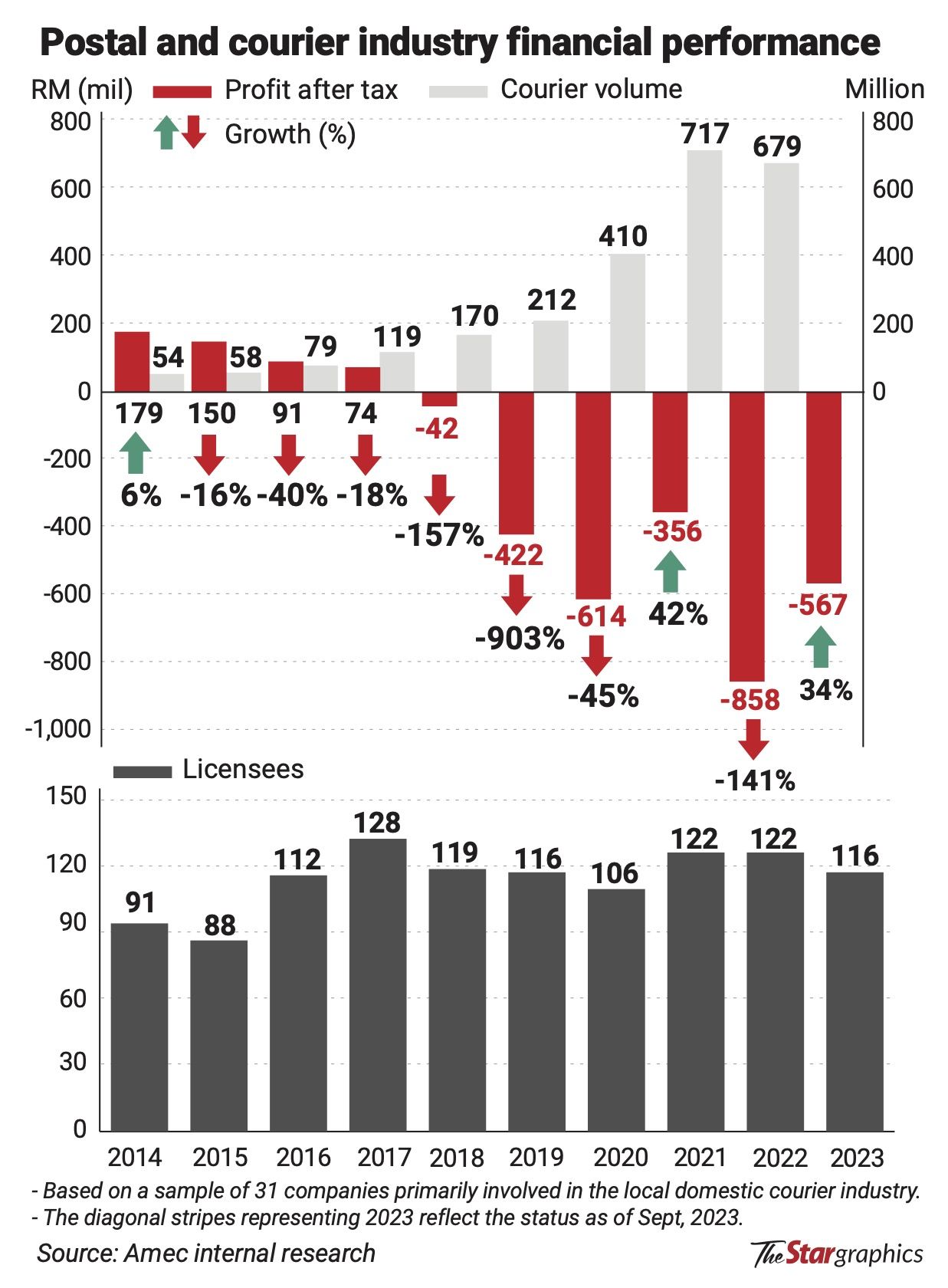
Amec notes that the local industry was profitable and sustainable prior to the 2018 sector liberalisation.
A moratorium on new courier licences was imposed for a two-year period from September 2020, but that didn’t help much.
By then, local players had lost a fair bit of market share.
Amec’s research shows that as of 2022, foreign players controlled the majority of the last-mile parcel delivery market in Malaysia. By that year, they held close to 60% of the market share, a figure projected to grow to 70% or more from 2023.
Tan also says that the cut-throat competition has led to a decline in service quality and could affect the livelihood of the 160,000 workers in the business.
“In 2019 and 2020, the average delivery period increased from 2.1 to 4.6 days and complaints about customer service and delivery delays surged, as noted by the MCMC,” Tan points out.
Notably, the association has been in talks with the regulators for the past five years to create a more level playing field and to ensure the sustainability of the sector.
“The last-mile delivery business is of national importance. For example, during the difficult times of the Covid-19 pandemic, two local companies were tasked by the government to handle the transportation of dangerous blood samples from state to state. Imagine if one day, the segment is totally controlled by foreign companies. Wouldn’t there be national security concerns?” he says.Under the new minimum RM5 price guideline, licensees cannot engage in unreasonable and harmful discounts or rebates that threaten the competitive opportunities of other licensees.
Non-compliance will require licensees to provide justification and further information to MCMC.
“Based on the evaluation of the information provided, MCMC can initiate further investigations based on Section 71 (Provision of Information) and Section 38 (Prohibition of anti-competitive conduct) of the Postal Services Act 2012.
Additionally, an external auditor will be engaged by the ministry to ensure compliance.
Providing false, incorrect or misleading information violates Section 71 and may result in fines of up to RM20,000, jail term of up to six months, or both.”
Tan says as of Dec 18, 2024, there are 101 licensed operators of which 27 are active players, counting last-mile delivery as their main business.
Malaysia’s courier fees are among the lowest in South-East Asia, Amec’s research shows.
Despite the new ruling, local players may still find the going tough, with operation costs going up after the minimum wage rate is increased to RM1,700 from RM1,500 per month.
Pos Malaysia Bhd group chief executive officer Charles Brewer says current predatory pricing behaviours are likely to continue.
“Unfortunately the new rate established by the MCMC is merely a guidance, and as with the previous base price parcel carriers have no legal obligation to adhere to it, no legal implications if they don’t,” Brewer tells Starbiz 7.
Touching on challenges, he adds that the base price is unsustainable and will lead to higher losses for all and more parcel carriers exiting the market.
Masking – where merchants can’t choose their courier providers – is another issue.
More than 70% of parcels created in Malaysia originate from “platforms” such as Shopee, Lazada, Tik Tok. And more than 70% of those parcels are injected into these platforms’ own delivery network.
“In June 2021, implemented ‘masking’ in our opinion is anti-competitive and monopolistic, and is presently under review with the Malaysia Competition Commission since June 11, 2024,” says Brewer.
He adds that current challenges have less to do with foreign players and a liberalised market, but more to do with the lack of regulation.Likewise, GDEX group managing director Teong Teck Lean says the reference price will only make operations slightly more viable.
While the parcel market in Malaysia is expected to reach US$1.58bil in 2025, Teong says it will be tough for local players to regain lost market share.
To boost its business offerings and ensure sustainability, GDEX has recently diversified into technology solutions.
Amec’s Tan reckons more needs to be done to “protect” the local sector. This is because foreign players are likely to be the biggest beneficiaries of the base price.
One area the association is looking at is the application of the local content policy with the last-mile sector increasingly deemed as vital. This was evident during the pandemic when it was counted on to deliver vaccines, medicines, food supplies and other critical goods to the public.
Local content policies aim to balance foreign investment with the protection of local interests.
According to Tan, large global companies collaborated with local last-mile players prior to the eCommerce boom. After 2018, however, the entry of foreign courier players, such as Flash, J&T Express and Singapore’s NinjaVan, saw direct competition.
For example, in markets like Indonesia and Vietnam, foreign players manage international deliveries while local players are tapped for domestic deliveries.
“This is where Malaysia’s Postal Service Act 2012 needs to be interpreted correctly, and the association is working closely with the government on this. “This is particularly important as the last-mile sector evolves, incorporating artificial intelligence and safeguarding national security data.”
In the financial sector, regulations require a significant portion of shareholding in banks and insurance companies to be held by Malaysians.
Locally-incorporated foreign banks have limits to the number of branches they can open. In the manufacturing sector too, local sourcing is encouraged in vehicle production.