
Revenues Not Telling The Story For Smith & Wesson Brands, Inc. (NASDAQ:SWBI) After Shares Rise 27%
Smith & Wesson Brands, Inc. (NASDAQ:SWBI) shareholders have had their patience rewarded with a 27% share price jump in the last month. Longer-term shareholders would be thankful for the recovery in the share price since it's now virtually flat for the year after the recent bounce.
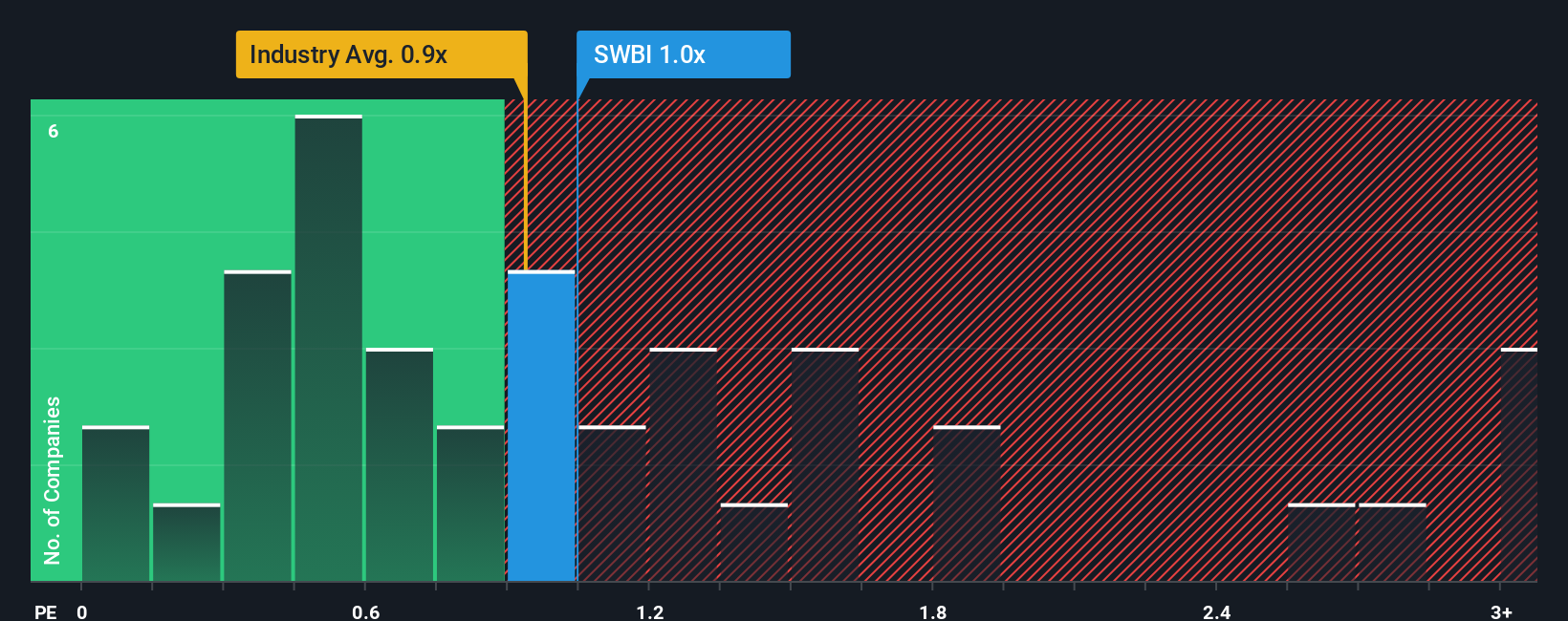
In spite of the firm bounce in price, it's still not a stretch to say that Smith & Wesson Brands' price-to-sales (or "P/S") ratio of 1x right now seems quite "middle-of-the-road" compared to the Leisure industry in the United States, where the median P/S ratio is around 0.9x. However, investors might be overlooking a clear opportunity or potential setback if there is no rational basis for the P/S.
See our latest analysis for Smith & Wesson Brands
How Has Smith & Wesson Brands Performed Recently?
With revenue that's retreating more than the industry's average of late, Smith & Wesson Brands has been very sluggish. Perhaps the market is expecting future revenue performance to begin matching the rest of the industry, which has kept the P/S from declining. So while you could say the stock is cheap, investors will be looking for improvement before they see it as good value. If not, then existing shareholders may be a little nervous about the viability of the share price.
Keen to find out how analysts think Smith & Wesson Brands' future stacks up against the industry? In that case, our free report is a great place to start.Is There Some Revenue Growth Forecasted For Smith & Wesson Brands?
There's an inherent assumption that a company should be matching the industry for P/S ratios like Smith & Wesson Brands' to be considered reasonable.
In reviewing the last year of financials, we were disheartened to see the company's revenues fell to the tune of 9.4%. This means it has also seen a slide in revenue over the longer-term as revenue is down 17% in total over the last three years. Accordingly, shareholders would have felt downbeat about the medium-term rates of revenue growth.
Shifting to the future, estimates from the dual analysts covering the company suggest revenue should grow by 1.5% over the next year. With the industry predicted to deliver 4.9% growth, the company is positioned for a weaker revenue result.
With this information, we find it interesting that Smith & Wesson Brands is trading at a fairly similar P/S compared to the industry. It seems most investors are ignoring the fairly limited growth expectations and are willing to pay up for exposure to the stock. These shareholders may be setting themselves up for future disappointment if the P/S falls to levels more in line with the growth outlook.
The Bottom Line On Smith & Wesson Brands' P/S
Smith & Wesson Brands' stock has a lot of momentum behind it lately, which has brought its P/S level with the rest of the industry. We'd say the price-to-sales ratio's power isn't primarily as a valuation instrument but rather to gauge current investor sentiment and future expectations.
When you consider that Smith & Wesson Brands' revenue growth estimates are fairly muted compared to the broader industry, it's easy to see why we consider it unexpected to be trading at its current P/S ratio. At present, we aren't confident in the P/S as the predicted future revenues aren't likely to support a more positive sentiment for long. A positive change is needed in order to justify the current price-to-sales ratio.
Plus, you should also learn about these 2 warning signs we've spotted with Smith & Wesson Brands (including 1 which is a bit unpleasant).
If companies with solid past earnings growth is up your alley, you may wish to see this free collection of other companies with strong earnings growth and low P/E ratios.
Have feedback on this article? Concerned about the content? Get in touch with us directly. Alternatively, email editorial-team (at) simplywallst.com.
This article by Simply Wall St is general in nature. We provide commentary based on historical data and analyst forecasts only using an unbiased methodology and our articles are not intended to be financial advice. It does not constitute a recommendation to buy or sell any stock, and does not take account of your objectives, or your financial situation. We aim to bring you long-term focused analysis driven by fundamental data. Note that our analysis may not factor in the latest price-sensitive company announcements or qualitative material. Simply Wall St has no position in any stocks mentioned.