
Supply Chain Stocks Are Plunging on Amazon's Logistics Launch. 1 Reason To Buy the Dip
Key Points
Amazon announced its new business, Amazon Supply Chain Services, this morning.
The company is opening up its logistics infrastructure to outside businesses.
Amazon's disruptive threat has been exaggerated in the past.
To the long list of industries that Amazon (NASDAQ: AMZN) has disrupted, or at least attempted to, you can now add logistics.
On Monday morning, the tech giant announced the new Amazon Supply Chain Services business, essentially opening up its logistics network, which historically just powered its e-commerce business, to outside business customers.
Will AI create the world's first trillionaire? Our team just released a report on the one little-known company, called an "Indispensable Monopoly" providing the critical technology Nvidia and Intel both need. Continue »
The move brings Amazon in direct competition with a vast array of logistics companies, and supply chain stocks tumbled on the news as the chart below shows.
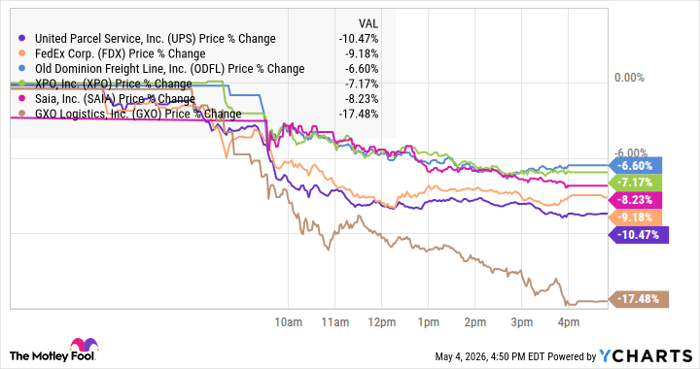
Package delivery companies like UPS (NYSE: UPS) and FedEx (NYSE: FDX) fell more than 8% on the news, showing investors expect Amazon to be stiff competition.
What is Amazon Supply Chain Services?
Amazon has invested heavily in its logistics service to support its massive e-commerce marketplace, and now the company is ready to open it up to outside businesses. This is essentially the same playbook Amazon used for its fulfillment services, opening its warehouse to marketplace sellers, and also how its cloud infrastructure business, Amazon Web Services, was born, as it began by allowing customers to rent its excess computing capacity.
Initial customers for Amazon Supply Chain Services (ASCS) include Procter & Gamble, 3M, Lands' End, and American Eagle, which are using Amazon Logistics across their supply chain.
ASCS includes a vast network made up of 80,000+ trailers, 24,000+, and 100+ aircraft, and the company has proven its ability to achieve fast delivery with its own products.
Companies like those above are using Amazon for everything from raw materials transportation to unifying inventory to fulfill orders across multiple sales channels, much like Amazon does with its own products.
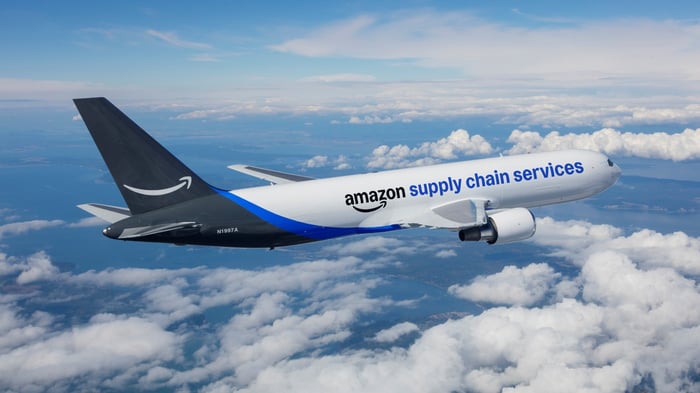
Image source: Amazon.
Will it disrupt the industry?
The size of Amazon's fleet will make it a major player in the supply chain space, but this business isn't entirely new. The company launched Amazon Freight in 2019, which provides freight brokerage and shipping for full truckload (FTL), and more recently, less-than-truckload (LTL) logistics services.
The global market for third-party logistics services is now valued at $1.3 trillion, meaning Amazon doesn't have to gain significant market share in order to move the needle, even for a company of its size.
For Amazon, the move clearly makes sense as it's leveraging technology and infrastructure that it's already built. However, that doesn't mean it will disrupt established companies.
Why buying the dip in logistics stocks could pay off
This isn't the first time that stocks have plunged when Amazon enters an industry. It happened with supermarkets after it bought Whole Foods, and pharmacy stocks fell after Amazon announced its own online pharmacy.
However, in both of those cases, Amazon's threat to the industry turned out to be exaggerated. The company has barely made a dent in supermarkets, and Amazon Pharmacy is still much smaller than major players like CVS.
Amazon already has the infrastructure in place to succeed in logistics, but investors may want to heed the experiences of grocery and pharmacy stocks before. While Amazon does have a deserved reputation as a disruptor, it's not easy to ramp up a new business from zero, especially against entrenched competitors like UPS and FedEx.
Don't be surprised if those stocks are higher a year from now.
Jeremy Bowman has positions in Amazon and XPO. The Motley Fool has positions in and recommends 3M, Amazon, Old Dominion Freight Line, and United Parcel Service. The Motley Fool recommends American Eagle Outfitters, FedEx, and XPO. The Motley Fool has a disclosure policy.