
Investors Shouldn't Be Too Comfortable With Quantum software's (WSE:QNT) Earnings
Quantum software S.A. (WSE:QNT) just reported some strong earnings, and the market reacted accordingly with a healthy uplift in the share price. However, we think that shareholders may be missing some concerning details in the numbers.
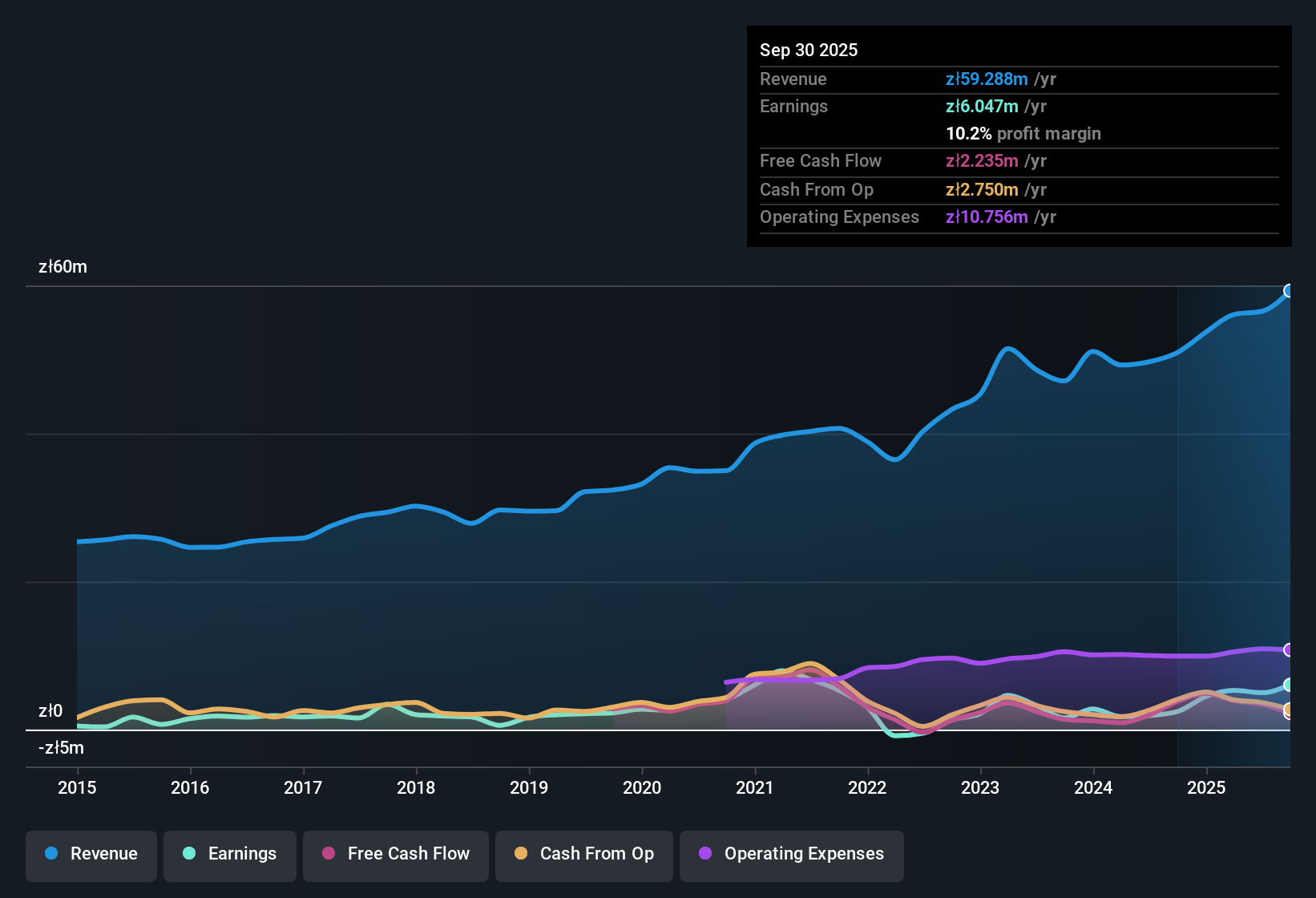
Examining Cashflow Against Quantum software's Earnings
One key financial ratio used to measure how well a company converts its profit to free cash flow (FCF) is the accrual ratio. In plain english, this ratio subtracts FCF from net profit, and divides that number by the company's average operating assets over that period. This ratio tells us how much of a company's profit is not backed by free cashflow.
That means a negative accrual ratio is a good thing, because it shows that the company is bringing in more free cash flow than its profit would suggest. That is not intended to imply we should worry about a positive accrual ratio, but it's worth noting where the accrual ratio is rather high. To quote a 2014 paper by Lewellen and Resutek, "firms with higher accruals tend to be less profitable in the future".
Over the twelve months to September 2025, Quantum software recorded an accrual ratio of 0.50. That means it didn't generate anywhere near enough free cash flow to match its profit. As a general rule, that bodes poorly for future profitability. Indeed, in the last twelve months it reported free cash flow of zł2.2m, which is significantly less than its profit of zł6.05m. Quantum software's free cash flow actually declined over the last year, but it may bounce back next year, since free cash flow is often more volatile than accounting profits. One positive for Quantum software shareholders is that it's accrual ratio was significantly better last year, providing reason to believe that it may return to stronger cash conversion in the future. Shareholders should look for improved cashflow relative to profit in the current year, if that is indeed the case.
Note: we always recommend investors check balance sheet strength. Click here to be taken to our balance sheet analysis of Quantum software.
Our Take On Quantum software's Profit Performance
As we discussed above, we think Quantum software's earnings were not supported by free cash flow, which might concern some investors. As a result, we think it may well be the case that Quantum software's underlying earnings power is lower than its statutory profit. But on the bright side, its earnings per share have grown at an extremely impressive rate over the last three years. Of course, we've only just scratched the surface when it comes to analysing its earnings; one could also consider margins, forecast growth, and return on investment, among other factors. If you want to do dive deeper into Quantum software, you'd also look into what risks it is currently facing. When we did our research, we found 4 warning signs for Quantum software (2 can't be ignored!) that we believe deserve your full attention.
Today we've zoomed in on a single data point to better understand the nature of Quantum software's profit. But there are plenty of other ways to inform your opinion of a company. For example, many people consider a high return on equity as an indication of favorable business economics, while others like to 'follow the money' and search out stocks that insiders are buying. So you may wish to see this free collection of companies boasting high return on equity, or this list of stocks with high insider ownership.
Have feedback on this article? Concerned about the content? Get in touch with us directly. Alternatively, email editorial-team (at) simplywallst.com.
This article by Simply Wall St is general in nature. We provide commentary based on historical data and analyst forecasts only using an unbiased methodology and our articles are not intended to be financial advice. It does not constitute a recommendation to buy or sell any stock, and does not take account of your objectives, or your financial situation. We aim to bring you long-term focused analysis driven by fundamental data. Note that our analysis may not factor in the latest price-sensitive company announcements or qualitative material. Simply Wall St has no position in any stocks mentioned.