
Does Tokyo Electric Power Company Holdings (TSE:9501) Have A Healthy Balance Sheet?
The external fund manager backed by Berkshire Hathaway's Charlie Munger, Li Lu, makes no bones about it when he says 'The biggest investment risk is not the volatility of prices, but whether you will suffer a permanent loss of capital.' It's only natural to consider a company's balance sheet when you examine how risky it is, since debt is often involved when a business collapses. As with many other companies Tokyo Electric Power Company Holdings, Incorporated (TSE:9501) makes use of debt. But should shareholders be worried about its use of debt?
When Is Debt A Problem?
Debt is a tool to help businesses grow, but if a business is incapable of paying off its lenders, then it exists at their mercy. In the worst case scenario, a company can go bankrupt if it cannot pay its creditors. However, a more common (but still painful) scenario is that it has to raise new equity capital at a low price, thus permanently diluting shareholders. Of course, the upside of debt is that it often represents cheap capital, especially when it replaces dilution in a company with the ability to reinvest at high rates of return. When we think about a company's use of debt, we first look at cash and debt together.
What Is Tokyo Electric Power Company Holdings's Net Debt?
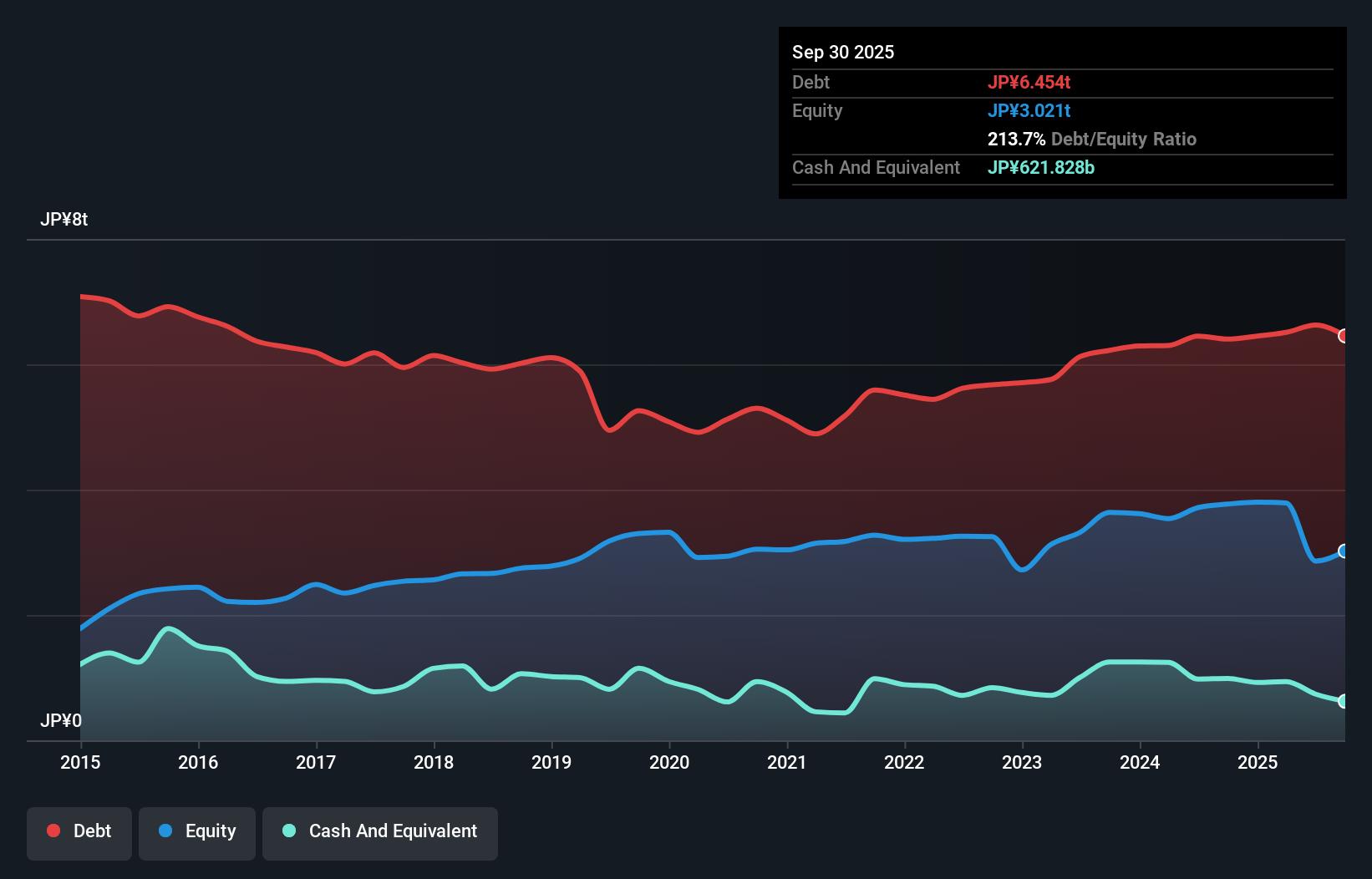
The chart below, which you can click on for greater detail, shows that Tokyo Electric Power Company Holdings had JP¥6.45t in debt in September 2025; about the same as the year before. However, it also had JP¥621.8b in cash, and so its net debt is JP¥5.83t.
A Look At Tokyo Electric Power Company Holdings' Liabilities
According to the last reported balance sheet, Tokyo Electric Power Company Holdings had liabilities of JP¥4.33t due within 12 months, and liabilities of JP¥7.39t due beyond 12 months. Offsetting these obligations, it had cash of JP¥621.8b as well as receivables valued at JP¥639.1b due within 12 months. So its liabilities outweigh the sum of its cash and (near-term) receivables by JP¥10t.
This deficit casts a shadow over the JP¥1.01t company, like a colossus towering over mere mortals. So we'd watch its balance sheet closely, without a doubt. After all, Tokyo Electric Power Company Holdings would likely require a major re-capitalisation if it had to pay its creditors today.
Check out our latest analysis for Tokyo Electric Power Company Holdings
In order to size up a company's debt relative to its earnings, we calculate its net debt divided by its earnings before interest, tax, depreciation, and amortization (EBITDA) and its earnings before interest and tax (EBIT) divided by its interest expense (its interest cover). The advantage of this approach is that we take into account both the absolute quantum of debt (with net debt to EBITDA) and the actual interest expenses associated with that debt (with its interest cover ratio).
Tokyo Electric Power Company Holdings has a rather high debt to EBITDA ratio of 9.2 which suggests a meaningful debt load. However, its interest coverage of 3.3 is reasonably strong, which is a good sign. The silver lining is that Tokyo Electric Power Company Holdings grew its EBIT by 105% last year, which nourishing like the idealism of youth. If it can keep walking that path it will be in a position to shed its debt with relative ease. When analysing debt levels, the balance sheet is the obvious place to start. But ultimately the future profitability of the business will decide if Tokyo Electric Power Company Holdings can strengthen its balance sheet over time. So if you're focused on the future you can check out this free report showing analyst profit forecasts.
Finally, a company can only pay off debt with cold hard cash, not accounting profits. So we always check how much of that EBIT is translated into free cash flow. Over the last three years, Tokyo Electric Power Company Holdings saw substantial negative free cash flow, in total. While investors are no doubt expecting a reversal of that situation in due course, it clearly does mean its use of debt is more risky.
Our View
On the face of it, Tokyo Electric Power Company Holdings's conversion of EBIT to free cash flow left us tentative about the stock, and its level of total liabilities was no more enticing than the one empty restaurant on the busiest night of the year. But at least it's pretty decent at growing its EBIT; that's encouraging. We should also note that Electric Utilities industry companies like Tokyo Electric Power Company Holdings commonly do use debt without problems. Overall, it seems to us that Tokyo Electric Power Company Holdings's balance sheet is really quite a risk to the business. So we're almost as wary of this stock as a hungry kitten is about falling into its owner's fish pond: once bitten, twice shy, as they say. When analysing debt levels, the balance sheet is the obvious place to start. However, not all investment risk resides within the balance sheet - far from it. For example - Tokyo Electric Power Company Holdings has 2 warning signs we think you should be aware of.
If, after all that, you're more interested in a fast growing company with a rock-solid balance sheet, then check out our list of net cash growth stocks without delay.
Have feedback on this article? Concerned about the content? Get in touch with us directly. Alternatively, email editorial-team (at) simplywallst.com.
This article by Simply Wall St is general in nature. We provide commentary based on historical data and analyst forecasts only using an unbiased methodology and our articles are not intended to be financial advice. It does not constitute a recommendation to buy or sell any stock, and does not take account of your objectives, or your financial situation. We aim to bring you long-term focused analysis driven by fundamental data. Note that our analysis may not factor in the latest price-sensitive company announcements or qualitative material. Simply Wall St has no position in any stocks mentioned.