
Is Ta Win Holdings Berhad (KLSE:TAWIN) Weighed On By Its Debt Load?
Howard Marks put it nicely when he said that, rather than worrying about share price volatility, 'The possibility of permanent loss is the risk I worry about... and every practical investor I know worries about.' When we think about how risky a company is, we always like to look at its use of debt, since debt overload can lead to ruin. We can see that Ta Win Holdings Berhad (KLSE:TAWIN) does use debt in its business. But is this debt a concern to shareholders?
What Risk Does Debt Bring?
Debt and other liabilities become risky for a business when it cannot easily fulfill those obligations, either with free cash flow or by raising capital at an attractive price. Part and parcel of capitalism is the process of 'creative destruction' where failed businesses are mercilessly liquidated by their bankers. However, a more frequent (but still costly) occurrence is where a company must issue shares at bargain-basement prices, permanently diluting shareholders, just to shore up its balance sheet. Of course, debt can be an important tool in businesses, particularly capital heavy businesses. When we think about a company's use of debt, we first look at cash and debt together.
What Is Ta Win Holdings Berhad's Net Debt?
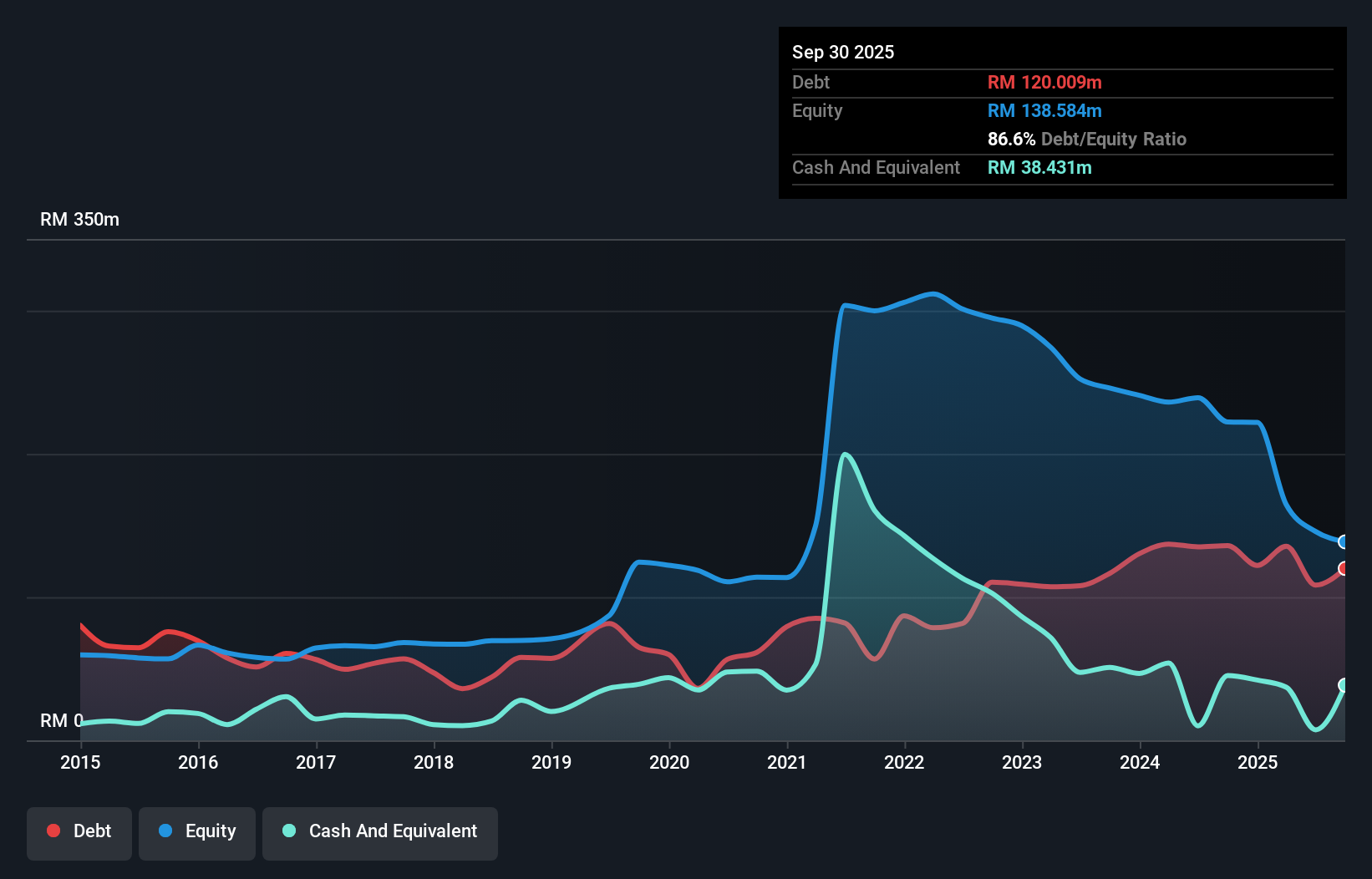
You can click the graphic below for the historical numbers, but it shows that Ta Win Holdings Berhad had RM120.0m of debt in September 2025, down from RM135.9m, one year before. However, because it has a cash reserve of RM38.4m, its net debt is less, at about RM81.6m.
A Look At Ta Win Holdings Berhad's Liabilities
According to the last reported balance sheet, Ta Win Holdings Berhad had liabilities of RM142.4m due within 12 months, and liabilities of RM19.1m due beyond 12 months. Offsetting this, it had RM38.4m in cash and RM64.2m in receivables that were due within 12 months. So its liabilities outweigh the sum of its cash and (near-term) receivables by RM58.8m.
When you consider that this deficiency exceeds the company's RM55.1m market capitalization, you might well be inclined to review the balance sheet intently. In the scenario where the company had to clean up its balance sheet quickly, it seems likely shareholders would suffer extensive dilution. There's no doubt that we learn most about debt from the balance sheet. But it is Ta Win Holdings Berhad's earnings that will influence how the balance sheet holds up in the future. So if you're keen to discover more about its earnings, it might be worth checking out this graph of its long term earnings trend.
See our latest analysis for Ta Win Holdings Berhad
Over 12 months, Ta Win Holdings Berhad made a loss at the EBIT level, and saw its revenue drop to RM517m, which is a fall of 32%. To be frank that doesn't bode well.
Caveat Emptor
Not only did Ta Win Holdings Berhad's revenue slip over the last twelve months, but it also produced negative earnings before interest and tax (EBIT). Its EBIT loss was a whopping RM73m. Considering that alongside the liabilities mentioned above make us nervous about the company. We'd want to see some strong near-term improvements before getting too interested in the stock. For example, we would not want to see a repeat of last year's loss of RM82m. And until that time we think this is a risky stock. There's no doubt that we learn most about debt from the balance sheet. But ultimately, every company can contain risks that exist outside of the balance sheet. For example, we've discovered 3 warning signs for Ta Win Holdings Berhad (2 don't sit too well with us!) that you should be aware of before investing here.
At the end of the day, it's often better to focus on companies that are free from net debt. You can access our special list of such companies (all with a track record of profit growth). It's free.
Have feedback on this article? Concerned about the content? Get in touch with us directly. Alternatively, email editorial-team (at) simplywallst.com.
This article by Simply Wall St is general in nature. We provide commentary based on historical data and analyst forecasts only using an unbiased methodology and our articles are not intended to be financial advice. It does not constitute a recommendation to buy or sell any stock, and does not take account of your objectives, or your financial situation. We aim to bring you long-term focused analysis driven by fundamental data. Note that our analysis may not factor in the latest price-sensitive company announcements or qualitative material. Simply Wall St has no position in any stocks mentioned.