
Do Indian Railway Finance's (NSE:IRFC) Earnings Warrant Your Attention?
Investors are often guided by the idea of discovering 'the next big thing', even if that means buying 'story stocks' without any revenue, let alone profit. But the reality is that when a company loses money each year, for long enough, its investors will usually take their share of those losses. A loss-making company is yet to prove itself with profit, and eventually the inflow of external capital may dry up.
In contrast to all that, many investors prefer to focus on companies like Indian Railway Finance (NSE:IRFC), which has not only revenues, but also profits. While profit isn't the sole metric that should be considered when investing, it's worth recognising businesses that can consistently produce it.
Indian Railway Finance's Improving Profits
Even when EPS earnings per share (EPS) growth is unexceptional, company value can be created if this rate is sustained each year. So EPS growth can certainly encourage an investor to take note of a stock. Indian Railway Finance has grown its trailing twelve month EPS from ₹4.98 to ₹5.23, in the last year. That amounts to a small improvement of 5.1%.
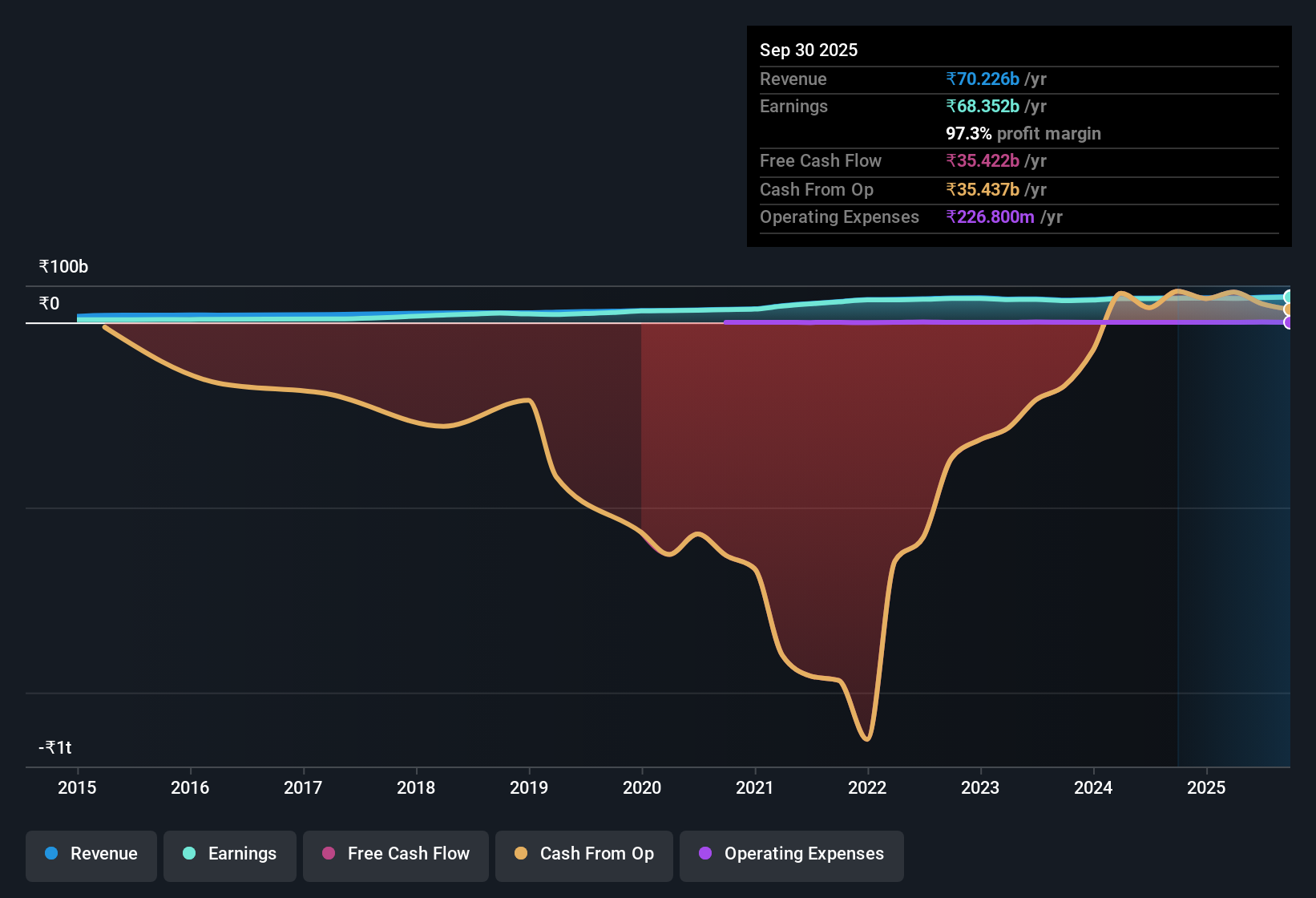
Top-line growth is a great indicator that growth is sustainable, and combined with a high earnings before interest and taxation (EBIT) margin, it's a great way for a company to maintain a competitive advantage in the market. EBIT margins for Indian Railway Finance remained fairly unchanged over the last year, however the company should be pleased to report its revenue growth for the period of 5.3% to ₹70b. That's progress.
You can take a look at the company's revenue and earnings growth trend, in the chart below. Click on the chart to see the exact numbers.
Check out our latest analysis for Indian Railway Finance
While it's always good to see growing profits, you should always remember that a weak balance sheet could come back to bite. So check Indian Railway Finance's balance sheet strength, before getting too excited.
Are Indian Railway Finance Insiders Aligned With All Shareholders?
Prior to investment, it's always a good idea to check that the management team is paid reasonably. Pay levels around or below the median, can be a sign that shareholder interests are well considered. The median total compensation for CEOs of companies similar in size to Indian Railway Finance, with market caps over ₹720b, is around ₹104m.
The Indian Railway Finance CEO received total compensation of only ₹4.0m in the year to March 2025. This total may indicate that the CEO is sacrificing take home pay for performance-based benefits, ensuring that their motivations are synonymous with strong company results. While the level of CEO compensation shouldn't be the biggest factor in how the company is viewed, modest remuneration is a positive, because it suggests that the board keeps shareholder interests in mind. Generally, arguments can be made that reasonable pay levels attest to good decision-making.
Should You Add Indian Railway Finance To Your Watchlist?
One important encouraging feature of Indian Railway Finance is that it is growing profits. On top of that, our faith in the board of directors is strengthened by the fact of the reasonable CEO pay. So based on its merits, the stock deserves further research, if not an addition to your watchlist. What about risks? Every company has them, and we've spotted 2 warning signs for Indian Railway Finance (of which 1 makes us a bit uncomfortable!) you should know about.
There's always the possibility of doing well buying stocks that are not growing earnings and do not have insiders buying shares. But for those who consider these important metrics, we encourage you to check out companies that do have those features. You can access a tailored list of Indian companies which have demonstrated growth backed by significant insider holdings.
Please note the insider transactions discussed in this article refer to reportable transactions in the relevant jurisdiction.
Have feedback on this article? Concerned about the content? Get in touch with us directly. Alternatively, email editorial-team (at) simplywallst.com.
This article by Simply Wall St is general in nature. We provide commentary based on historical data and analyst forecasts only using an unbiased methodology and our articles are not intended to be financial advice. It does not constitute a recommendation to buy or sell any stock, and does not take account of your objectives, or your financial situation. We aim to bring you long-term focused analysis driven by fundamental data. Note that our analysis may not factor in the latest price-sensitive company announcements or qualitative material. Simply Wall St has no position in any stocks mentioned.