
Capital Allocation Trends At HFCL (NSE:HFCL) Aren't Ideal
What trends should we look for it we want to identify stocks that can multiply in value over the long term? Amongst other things, we'll want to see two things; firstly, a growing return on capital employed (ROCE) and secondly, an expansion in the company's amount of capital employed. This shows us that it's a compounding machine, able to continually reinvest its earnings back into the business and generate higher returns. However, after investigating HFCL (NSE:HFCL), we don't think it's current trends fit the mold of a multi-bagger.
Understanding Return On Capital Employed (ROCE)
For those who don't know, ROCE is a measure of a company's yearly pre-tax profit (its return), relative to the capital employed in the business. Analysts use this formula to calculate it for HFCL:
Return on Capital Employed = Earnings Before Interest and Tax (EBIT) ÷ (Total Assets - Current Liabilities)
0.044 = ₹2.1b ÷ (₹80b - ₹32b) (Based on the trailing twelve months to September 2025).
So, HFCL has an ROCE of 4.4%. Ultimately, that's a low return and it under-performs the Telecom industry average of 16%.
View our latest analysis for HFCL
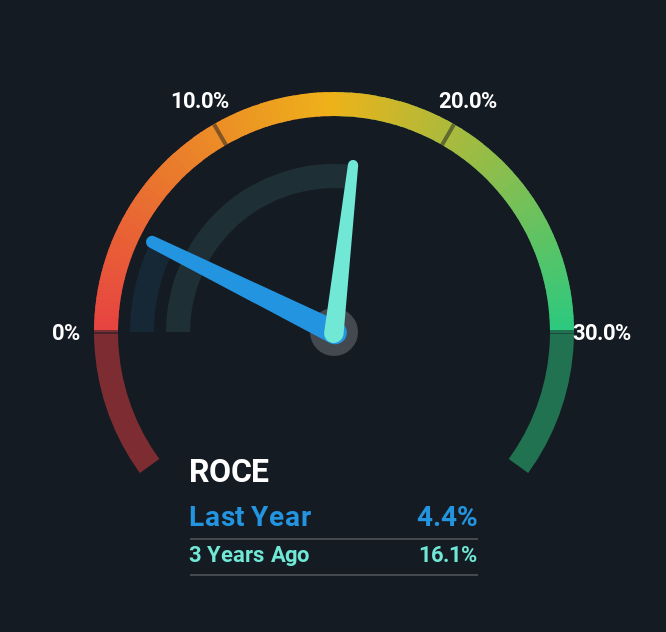
While the past is not representative of the future, it can be helpful to know how a company has performed historically, which is why we have this chart above. If you'd like to look at how HFCL has performed in the past in other metrics, you can view this free graph of HFCL's past earnings, revenue and cash flow.
What Can We Tell From HFCL's ROCE Trend?
When we looked at the ROCE trend at HFCL, we didn't gain much confidence. To be more specific, ROCE has fallen from 17% over the last five years. And considering revenue has dropped while employing more capital, we'd be cautious. This could mean that the business is losing its competitive advantage or market share, because while more money is being put into ventures, it's actually producing a lower return - "less bang for their buck" per se.
On a related note, HFCL has decreased its current liabilities to 40% of total assets. That could partly explain why the ROCE has dropped. What's more, this can reduce some aspects of risk to the business because now the company's suppliers or short-term creditors are funding less of its operations. Some would claim this reduces the business' efficiency at generating ROCE since it is now funding more of the operations with its own money.
Our Take On HFCL's ROCE
We're a bit apprehensive about HFCL because despite more capital being deployed in the business, returns on that capital and sales have both fallen. The market must be rosy on the stock's future because even though the underlying trends aren't too encouraging, the stock has soared 197%. Regardless, we don't feel too comfortable with the fundamentals so we'd be steering clear of this stock for now.
HFCL does have some risks, we noticed 2 warning signs (and 1 which is concerning) we think you should know about.
While HFCL may not currently earn the highest returns, we've compiled a list of companies that currently earn more than 25% return on equity. Check out this free list here.
Have feedback on this article? Concerned about the content? Get in touch with us directly. Alternatively, email editorial-team (at) simplywallst.com.
This article by Simply Wall St is general in nature. We provide commentary based on historical data and analyst forecasts only using an unbiased methodology and our articles are not intended to be financial advice. It does not constitute a recommendation to buy or sell any stock, and does not take account of your objectives, or your financial situation. We aim to bring you long-term focused analysis driven by fundamental data. Note that our analysis may not factor in the latest price-sensitive company announcements or qualitative material. Simply Wall St has no position in any stocks mentioned.