
Here's Why Parag Milk Foods (NSE:PARAGMILK) Can Manage Its Debt Responsibly
Legendary fund manager Li Lu (who Charlie Munger backed) once said, 'The biggest investment risk is not the volatility of prices, but whether you will suffer a permanent loss of capital.' When we think about how risky a company is, we always like to look at its use of debt, since debt overload can lead to ruin. We note that Parag Milk Foods Limited (NSE:PARAGMILK) does have debt on its balance sheet. But the more important question is: how much risk is that debt creating?
What Risk Does Debt Bring?
Debt is a tool to help businesses grow, but if a business is incapable of paying off its lenders, then it exists at their mercy. If things get really bad, the lenders can take control of the business. While that is not too common, we often do see indebted companies permanently diluting shareholders because lenders force them to raise capital at a distressed price. Of course, debt can be an important tool in businesses, particularly capital heavy businesses. The first thing to do when considering how much debt a business uses is to look at its cash and debt together.
What Is Parag Milk Foods's Net Debt?
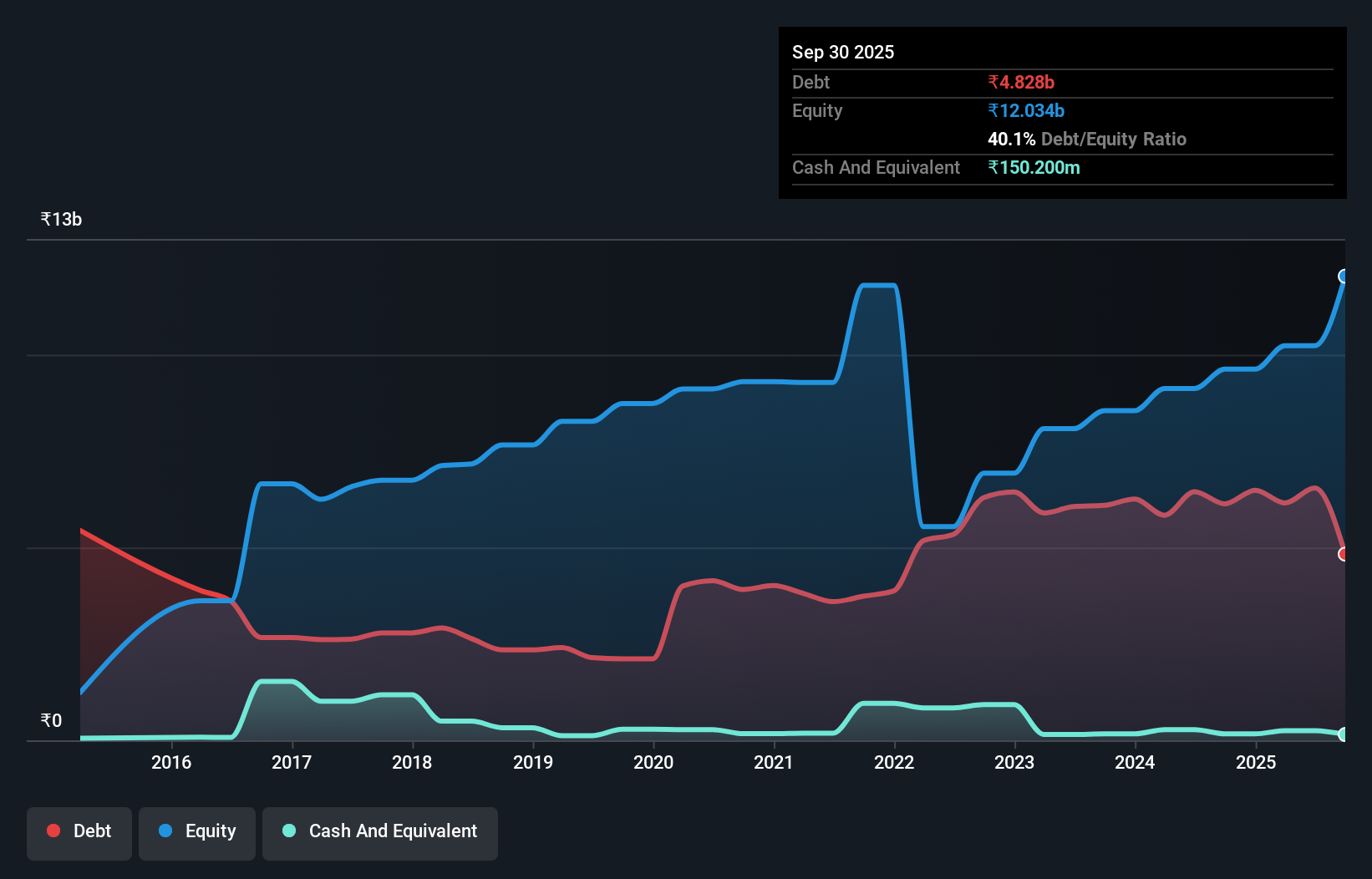
As you can see below, Parag Milk Foods had ₹4.83b of debt at September 2025, down from ₹6.13b a year prior. On the flip side, it has ₹150.2m in cash leading to net debt of about ₹4.68b.
A Look At Parag Milk Foods' Liabilities
According to the last reported balance sheet, Parag Milk Foods had liabilities of ₹8.10b due within 12 months, and liabilities of ₹2.22b due beyond 12 months. On the other hand, it had cash of ₹150.2m and ₹3.31b worth of receivables due within a year. So its liabilities outweigh the sum of its cash and (near-term) receivables by ₹6.86b.
Of course, Parag Milk Foods has a market capitalization of ₹37.7b, so these liabilities are probably manageable. But there are sufficient liabilities that we would certainly recommend shareholders continue to monitor the balance sheet, going forward.
View our latest analysis for Parag Milk Foods
In order to size up a company's debt relative to its earnings, we calculate its net debt divided by its earnings before interest, tax, depreciation, and amortization (EBITDA) and its earnings before interest and tax (EBIT) divided by its interest expense (its interest cover). This way, we consider both the absolute quantum of the debt, as well as the interest rates paid on it.
Parag Milk Foods's net debt is sitting at a very reasonable 1.7 times its EBITDA, while its EBIT covered its interest expense just 2.5 times last year. While these numbers do not alarm us, it's worth noting that the cost of the company's debt is having a real impact. Importantly, Parag Milk Foods grew its EBIT by 30% over the last twelve months, and that growth will make it easier to handle its debt. When analysing debt levels, the balance sheet is the obvious place to start. But ultimately the future profitability of the business will decide if Parag Milk Foods can strengthen its balance sheet over time. So if you want to see what the professionals think, you might find this free report on analyst profit forecasts to be interesting.
Finally, a business needs free cash flow to pay off debt; accounting profits just don't cut it. So it's worth checking how much of that EBIT is backed by free cash flow. Over the most recent three years, Parag Milk Foods recorded free cash flow worth 50% of its EBIT, which is around normal, given free cash flow excludes interest and tax. This cold hard cash means it can reduce its debt when it wants to.
Our View
Happily, Parag Milk Foods's impressive EBIT growth rate implies it has the upper hand on its debt. But the stark truth is that we are concerned by its interest cover. Looking at all the aforementioned factors together, it strikes us that Parag Milk Foods can handle its debt fairly comfortably. On the plus side, this leverage can boost shareholder returns, but the potential downside is more risk of loss, so it's worth monitoring the balance sheet. The balance sheet is clearly the area to focus on when you are analysing debt. However, not all investment risk resides within the balance sheet - far from it. To that end, you should be aware of the 2 warning signs we've spotted with Parag Milk Foods .
If you're interested in investing in businesses that can grow profits without the burden of debt, then check out this free list of growing businesses that have net cash on the balance sheet.
Have feedback on this article? Concerned about the content? Get in touch with us directly. Alternatively, email editorial-team (at) simplywallst.com.
This article by Simply Wall St is general in nature. We provide commentary based on historical data and analyst forecasts only using an unbiased methodology and our articles are not intended to be financial advice. It does not constitute a recommendation to buy or sell any stock, and does not take account of your objectives, or your financial situation. We aim to bring you long-term focused analysis driven by fundamental data. Note that our analysis may not factor in the latest price-sensitive company announcements or qualitative material. Simply Wall St has no position in any stocks mentioned.