
Parsons Corporation (NYSE:PSN) Shares May Have Slumped 26% But Getting In Cheap Is Still Unlikely
Parsons Corporation (NYSE:PSN) shares have had a horrible month, losing 26% after a relatively good period beforehand. The drop over the last 30 days has capped off a tough year for shareholders, with the share price down 35% in that time.
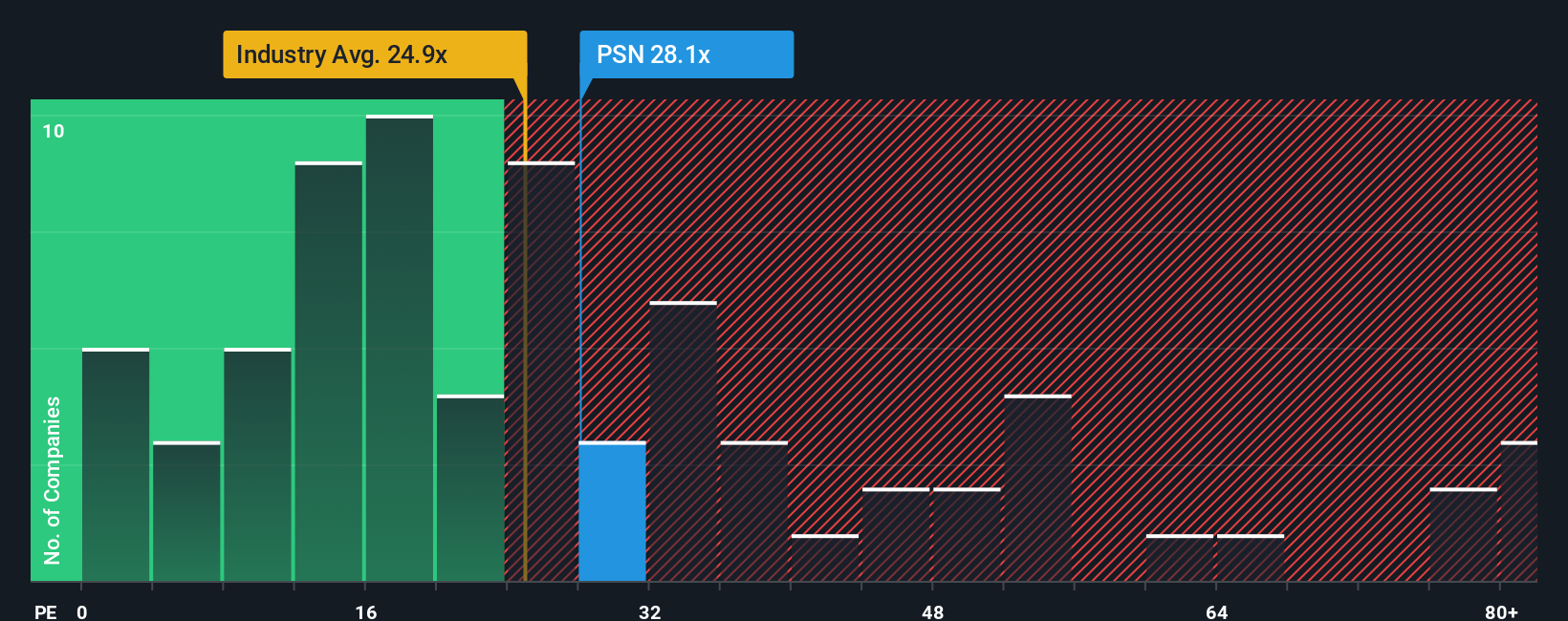
In spite of the heavy fall in price, Parsons may still be sending very bearish signals at the moment with a price-to-earnings (or "P/E") ratio of 28.1x, since almost half of all companies in the United States have P/E ratios under 18x and even P/E's lower than 11x are not unusual. Although, it's not wise to just take the P/E at face value as there may be an explanation why it's so lofty.
With earnings growth that's inferior to most other companies of late, Parsons has been relatively sluggish. One possibility is that the P/E is high because investors think this lacklustre earnings performance will improve markedly. You'd really hope so, otherwise you're paying a pretty hefty price for no particular reason.
See our latest analysis for Parsons
Does Growth Match The High P/E?
The only time you'd be truly comfortable seeing a P/E as steep as Parsons' is when the company's growth is on track to outshine the market decidedly.
Taking a look back first, we see that the company managed to grow earnings per share by a handy 5.4% last year. This was backed up an excellent period prior to see EPS up by 139% in total over the last three years. Therefore, it's fair to say the earnings growth recently has been superb for the company.
Looking ahead now, EPS is anticipated to climb by 14% during the coming year according to the eleven analysts following the company. With the market predicted to deliver 16% growth , the company is positioned for a weaker earnings result.
With this information, we find it concerning that Parsons is trading at a P/E higher than the market. It seems most investors are hoping for a turnaround in the company's business prospects, but the analyst cohort is not so confident this will happen. Only the boldest would assume these prices are sustainable as this level of earnings growth is likely to weigh heavily on the share price eventually.
What We Can Learn From Parsons' P/E?
Even after such a strong price drop, Parsons' P/E still exceeds the rest of the market significantly. Typically, we'd caution against reading too much into price-to-earnings ratios when settling on investment decisions, though it can reveal plenty about what other market participants think about the company.
We've established that Parsons currently trades on a much higher than expected P/E since its forecast growth is lower than the wider market. When we see a weak earnings outlook with slower than market growth, we suspect the share price is at risk of declining, sending the high P/E lower. This places shareholders' investments at significant risk and potential investors in danger of paying an excessive premium.
Many other vital risk factors can be found on the company's balance sheet. You can assess many of the main risks through our free balance sheet analysis for Parsons with six simple checks.
If P/E ratios interest you, you may wish to see this free collection of other companies with strong earnings growth and low P/E ratios.
Have feedback on this article? Concerned about the content? Get in touch with us directly. Alternatively, email editorial-team (at) simplywallst.com.
This article by Simply Wall St is general in nature. We provide commentary based on historical data and analyst forecasts only using an unbiased methodology and our articles are not intended to be financial advice. It does not constitute a recommendation to buy or sell any stock, and does not take account of your objectives, or your financial situation. We aim to bring you long-term focused analysis driven by fundamental data. Note that our analysis may not factor in the latest price-sensitive company announcements or qualitative material. Simply Wall St has no position in any stocks mentioned.