
From an 87% increase on the first day to a target price of HK$152, how did Zhuoyue Ruixin (02687) complete the Hong Kong Stock Connect entry sprint in 14 days?
On December 8, the educational technology company Zhuoyue Ruixin (02687) landed on the Hong Kong Stock Exchange, which closed with an impressive increase of 87% on the first day. The next day, its stock price did not recover like most IPOs; on the contrary, it continued to surge to HK$152 during the intraday period, a cumulative increase of more than 125% from the issue price of HK$67.5. At the close, the stock price remained stable at HK$146.6, with a total market capitalization approaching HK$10 billion.
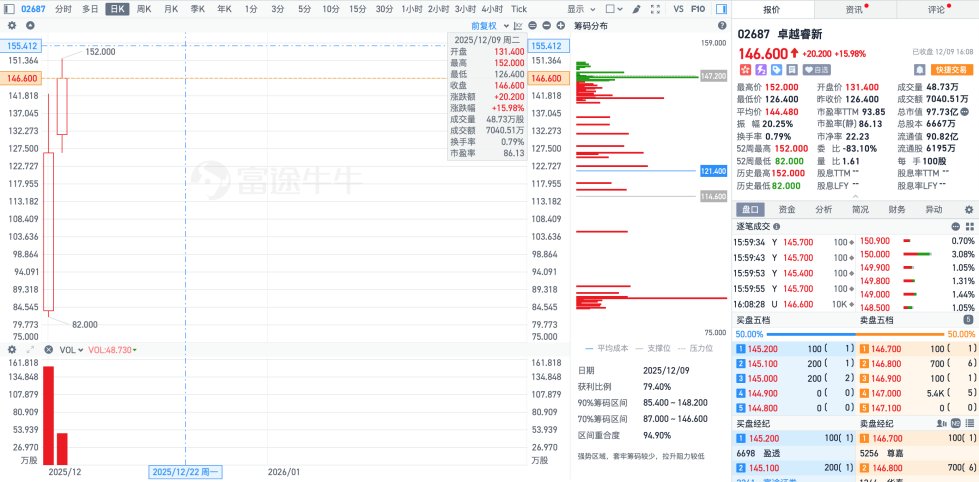
However, the market's eyes are not limited to its impressive increase. Keen observers have smelled a deeper level of strategic intent from its unique market trends, huge transactions, and key market capitalization figures — a capital drama aimed at impacting as quickly as possible and being included in the Hong Kong Stock Market Standard.
Market decoding - capital-driven pricing model
According to the Zhitong Finance App, excellent Ruixin's transaction data for the two days since its launch can be called a classic “capital-driven” script.
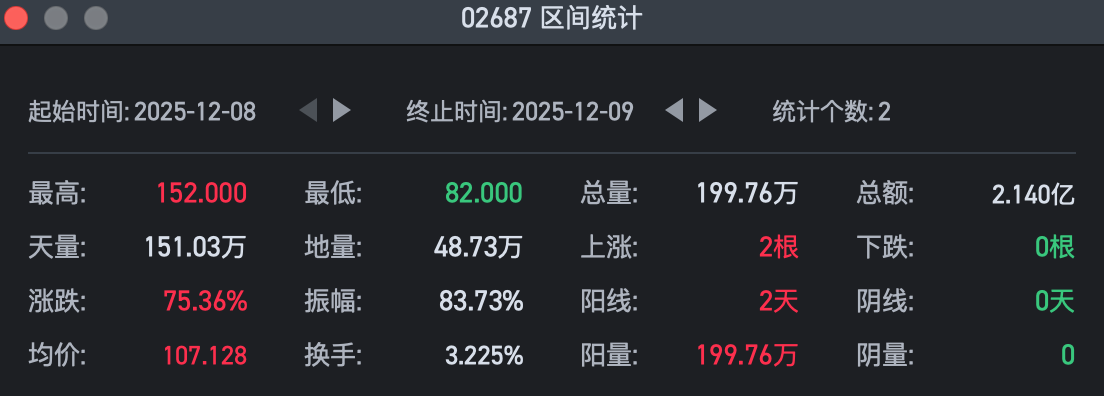
According to range statistics, in just two trading days, its stock price fluctuated as high as 83.73%, but closed all recorded a positive trend, with a cumulative increase of 75.36%. This pattern of “high amplitude, one-sided rise” is completely different from the general situation where long and short games are intense and the trend is divided after the listing of IPOs. It shows the strong ability to control the dominant capital and determination to raise it, and aims to push stock prices and market capitalization to a new platform in the shortest possible time.
Analysis of transaction data showed that large orders (with a single transaction amount exceeding HK$1 million) showed clear clusters in the time series, concentrated after the opening of early trading and the early afternoon market restart. This model is in line with the operating habits of institutional investors to strategically open positions or supply liquidity. At the same time, extremely high transaction concentration indicates that the supply of market liquidity has traces of active management during a specific period of time, and is not entirely driven by scattered investor decisions.
Although the 3.225% range turnover rate seems moderate in absolute value, it needs to be considered in the light of its actual circulation market. At the beginning of the listing, a large number of shares were locked in, and the actual tradable H share capital was limited. In this context, the cumulative turnover of HK$214 million over the two days means that the chips in circulation have experienced an efficient exchange of hands. What is particularly noteworthy is that almost all of the trading volume is “positive” (driven by active buying), which shows that not only is capital sufficient, but the intention to buy is firm, and the selling pressure on the market is quickly digested.
In short, its market microstructure and transaction data revealed a set of capital strategies with clear goals and precise execution: that is, through active liquidity guidance and price management, the shortest path to meet the market capitalization and liquidity thresholds included in the Hong Kong Stock Connect, thus strategically connecting southbound capital.
Strategy deconstruction—sprint path based on Hong Kong Stock Connect rules
The market generally interprets this stock price change as a “sprint” for the Hong Kong Stock Connect to be included in the standards. This judgment has a clear rule basis and strategic logic.
First, according to the Hong Kong Stock Connect inclusion rules, Excellent Innovation must meet the HK$9.3 billion market capitalization threshold strategy. For companies listed on December 8, the time window is extremely tight if they want to enter the scope of inspection before the inspection date of December 31. The core of the strategy is to drastically raise the market capitalization base at the beginning of the survey period by rapidly raising the market value to the threshold level in the first few trading days (such as the current nearly HK$10 billion). Even if the stock price falls naturally afterwards, its average daily moving average market value can be maintained above the safe margin. The calculation shows that if the current high market value is maintained, the daily average market value threshold required for the remaining trading days will be significantly reduced. The strategy aims to establish an adequate “market capitalization safety cushion”.
Specifically, the next review date for Hong Kong Stock Connect is December 31. There are only 14 days left until December 9. Currently, the average daily market value (H shares) is 7.830 billion yuan and 9.082 billion yuan respectively. The remaining days need to reach an average of 9.421 billion yuan per day, and the target share price is HK$152.1.
In addition to market capitalization, the inclusion of Hong Kong Stock Connect also has implicit requirements for stock liquidity, which is usually reflected in a certain level of trading activity. The concentrated increase in turnover at the beginning of the listing (approximately HK$214 million in two days) and high turnover helped to quickly meet relevant liquidity surveys and send sufficient signals of active trading activity to the market, attracting the attention of more institutional investors.
Furthermore, information such as “target share price of HK$152.1” and “next review date 2025/12/31” released by the company before and after listing essentially set a clear and quantifiable value anchor for the market. When the market price approaches this anchor point, it will strengthen the market consensus that “the company is working hard to meet Hong Kong stock access standards.” This convergence of consensus reduces market differences, attracts the participation of trend funds and event-based arbitrage funds, and forms a positive feedback cycle for upward prices.
In summary, the capital operation map of Zhuoyue Ruixin at the beginning of its listing is already clear: this is a precise sprint targeting Hong Kong Stock Connect entry conditions, aiming to achieve strategic market capitalization and liquidity requirements with minimal compliance time costs. Through quantitative price data and target guidance, the market has jointly interpreted a highly target-oriented pricing game.
In the short term, this sprint has achieved key price and market capitalization targets with strong capital execution, creating favorable conditions for entering the Hong Kong Stock Connect review period. The real challenge, however, begins when the standards are met. Whether the stock price can achieve a new balance at a high valuation level depends on two key variables: first, whether the south-bound capital “North Water” can arrive as scheduled and form continuous support; second, whether the company's fundamental growth performance quickly keeps up with the pace of valuation to achieve a smooth transition from “regular arbitrage valuation” to “growth value valuation.”