
Has Shell’s Recent Pullback Opened the Door for Further Upside in 2025?
- If you are wondering whether Shell remains attractive after its strong multi year run, or if the easy money has already been made, you are not alone. This breakdown addresses exactly that question.
- Despite a solid longer term record, with the share price up 12.9% over the last year and 143.5% over five years, Shell has cooled off recently, with a 1.9% drop in the past week and a 4.0% slide over the last month.
- Some of that pullback reflects shifting sentiment around oil prices and the broader energy transition, as investors weigh Shell's capital spending plans against its commitment to shareholder returns. At the same time, recent headlines about portfolio streamlining and buybacks have kept the debate alive over whether the market is fairly pricing Shell's future cash flows.
- On our numbers, Shell currently scores a 4 out of 6 on valuation checks, suggesting it appears undervalued on several important metrics. In the next sections we will unpack those methods, before finishing with a more powerful way to think about Shell's worth.
Find out why Shell's 12.9% return over the last year is lagging behind its peers.
Approach 1: Shell Discounted Cash Flow (DCF) Analysis
The Discounted Cash Flow model estimates what a company is worth by projecting the cash it can return to shareholders in the future and discounting those cash flows back to today. For Shell, this is done using a 2 Stage Free Cash Flow to Equity approach built on cash flow projections.
Shell generated trailing twelve month free cash flow of about $27.9 billion, which serves as the starting point for the forecast. Analysts provide explicit estimates for the next few years, with free cash flow expected to remain in the mid to high $20 billion range before transitioning to more modest growth assumptions that extend out to 10 years, where projected free cash flow is still over $21 billion in 2035 based on Simply Wall St extrapolations.
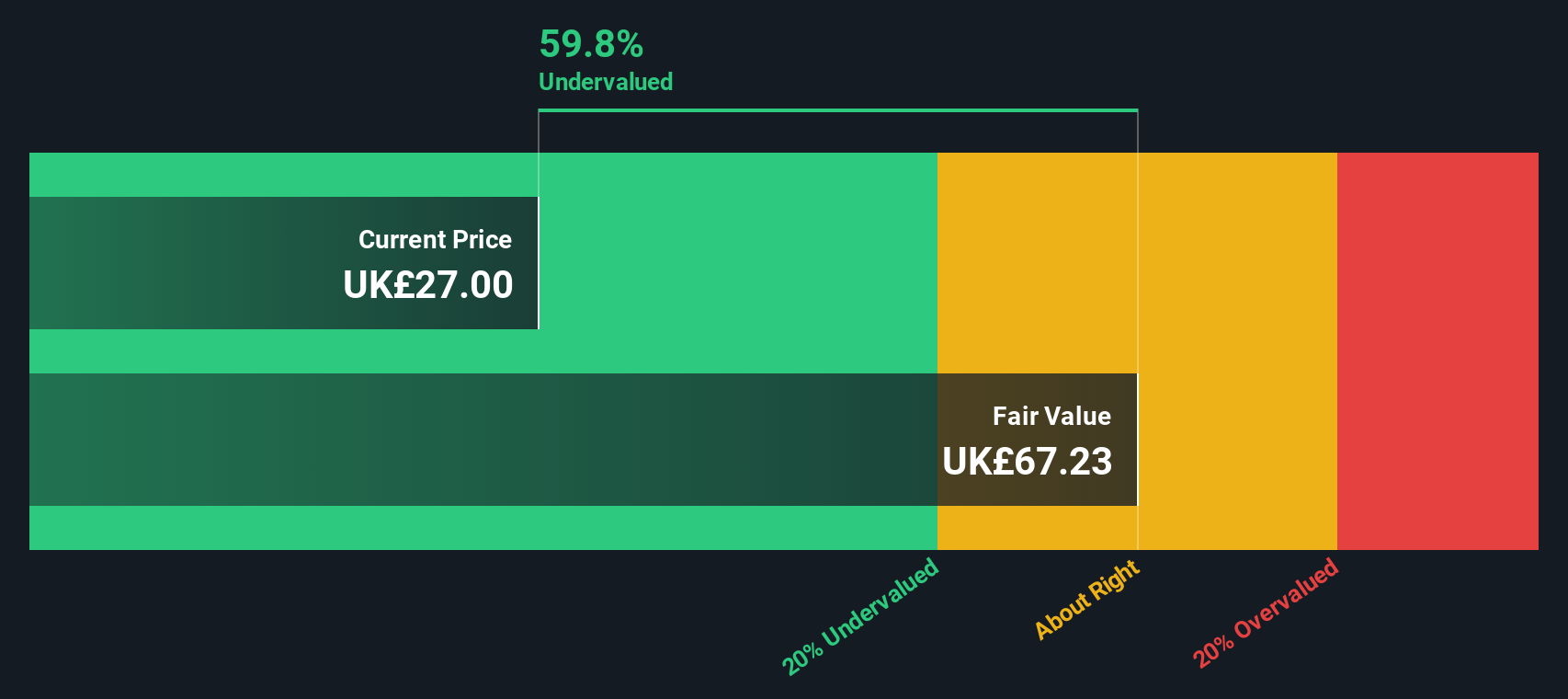
Discounting these projected cash flows back to today results in an estimated intrinsic value of $58.02 per share. Compared with the current market price, this implies a 52.9% discount, suggesting the shares are materially undervalued on cash flow grounds.
Result: UNDERVALUED
Our Discounted Cash Flow (DCF) analysis suggests Shell is undervalued by 52.9%. Track this in your watchlist or portfolio, or discover 903 more undervalued stocks based on cash flows.
Approach 2: Shell Price vs Earnings
For profitable companies like Shell, the price to earnings ratio is a straightforward way to gauge how much investors are willing to pay for each unit of current earnings. It captures the market’s view of the durability and growth potential of those profits, which is especially relevant for a mature, cash generative energy major.
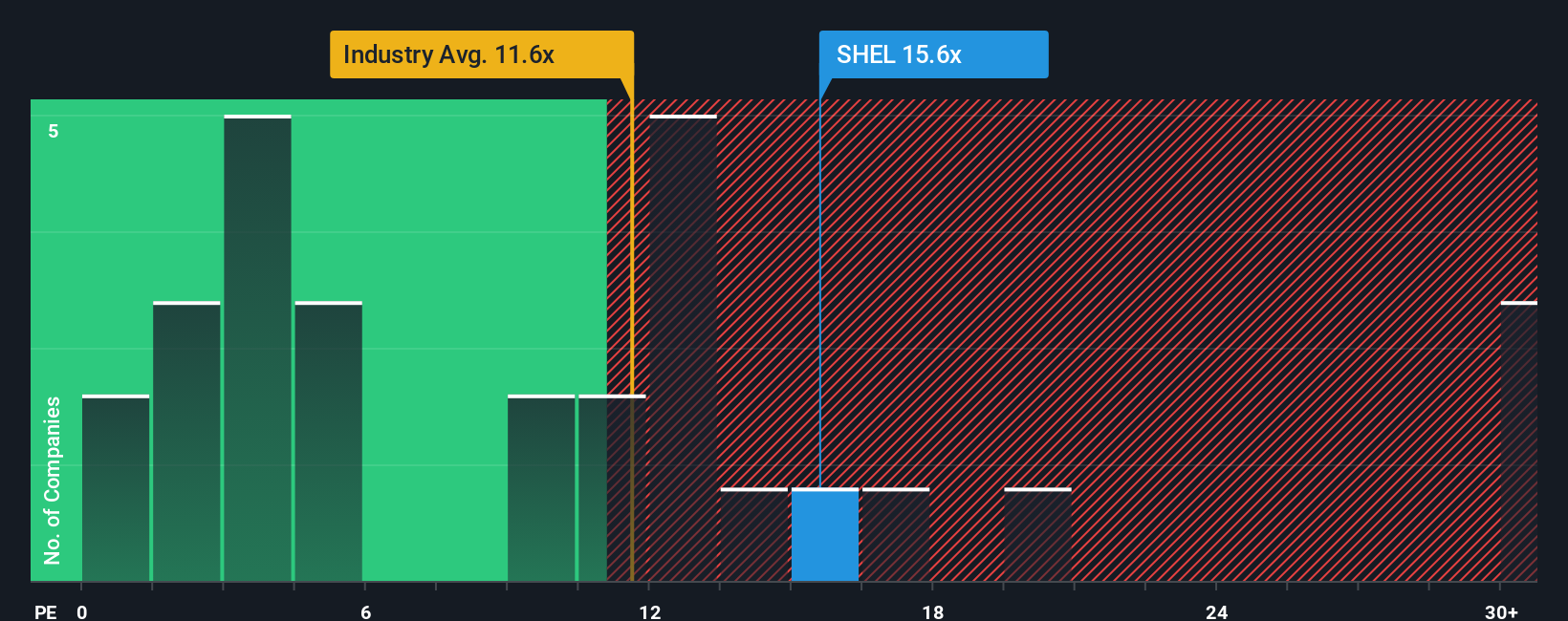
In general, faster growing and lower risk businesses are often associated with higher PE ratios, while slower growing or more volatile companies usually trade on lower multiples. Shell currently trades on a PE of 14.3x, slightly above the Oil and Gas industry average of 13.4x but slightly below its direct peer group at 15.3x. This suggests the market is pricing Shell roughly in line with sector norms, without assigning a large premium or discount relative to comparable energy names.
Simply Wall St’s Fair Ratio framework goes a step further by estimating what PE Shell could trade on after adjusting for its earnings growth outlook, profitability, scale and risk profile. On this basis, Shell’s Fair Ratio comes out at 18.5x, comfortably above the current 14.3x multiple. This indicates potential upside if the company delivers on expectations and the market narrows that gap.
Result: UNDERVALUED
PE ratios tell one story, but what if the real opportunity lies elsewhere? Discover 1450 companies where insiders are betting big on explosive growth.
Upgrade Your Decision Making: Choose your Shell Narrative
Earlier we mentioned that there is an even better way to understand valuation, so let us introduce you to Narratives, an easy tool on Simply Wall St’s Community page that lets millions of investors connect a clear story about a company to a full financial forecast and resulting fair value. For Shell, that might mean one investor building a bullish Narrative where LNG growth, rising margins, a 12.5x future PE and a fair value above £39.00 justify buying at today’s £26.94 price. Another investor might create a more cautious Narrative using slower revenue growth, lower earnings nearer $14.2 billion and a fair value closer to £27.00 that suggests holding or trimming. Both Narratives update dynamically as new earnings, news and risks emerge, and they make it simple to compare each Fair Value directly to the current Price to decide when to buy or sell.
Do you think there's more to the story for Shell? Head over to our Community to see what others are saying!
This article by Simply Wall St is general in nature. We provide commentary based on historical data and analyst forecasts only using an unbiased methodology and our articles are not intended to be financial advice. It does not constitute a recommendation to buy or sell any stock, and does not take account of your objectives, or your financial situation. We aim to bring you long-term focused analysis driven by fundamental data. Note that our analysis may not factor in the latest price-sensitive company announcements or qualitative material. Simply Wall St has no position in any stocks mentioned.
Have feedback on this article? Concerned about the content? Get in touch with us directly. Alternatively, email editorial-team@simplywallst.com