
We Think Some Shareholders May Hesitate To Increase Clean Energy Transition Inc.'s (CVE:TRAN) CEO Compensation
Key Insights
- Clean Energy Transition will host its Annual General Meeting on 17th of December
- Total pay for CEO Sean Joseph Samson includes CA$185.0k salary
- Total compensation is similar to the industry average
- Clean Energy Transition's EPS grew by 105% over the past three years while total shareholder loss over the past three years was 29%
Shareholders of Clean Energy Transition Inc. (CVE:TRAN) will have been dismayed by the negative share price return over the last three years. What is concerning is that despite positive EPS growth, the share price has not tracked the trend in fundamentals. The AGM coming up on the 17th of December could be an opportunity for shareholders to bring these concerns to the board's attention. They could also influence management through voting on resolutions such as executive remuneration. Here's our take on why we think shareholders may want to be cautious of approving a raise for the CEO at the moment.
See our latest analysis for Clean Energy Transition
Comparing Clean Energy Transition Inc.'s CEO Compensation With The Industry
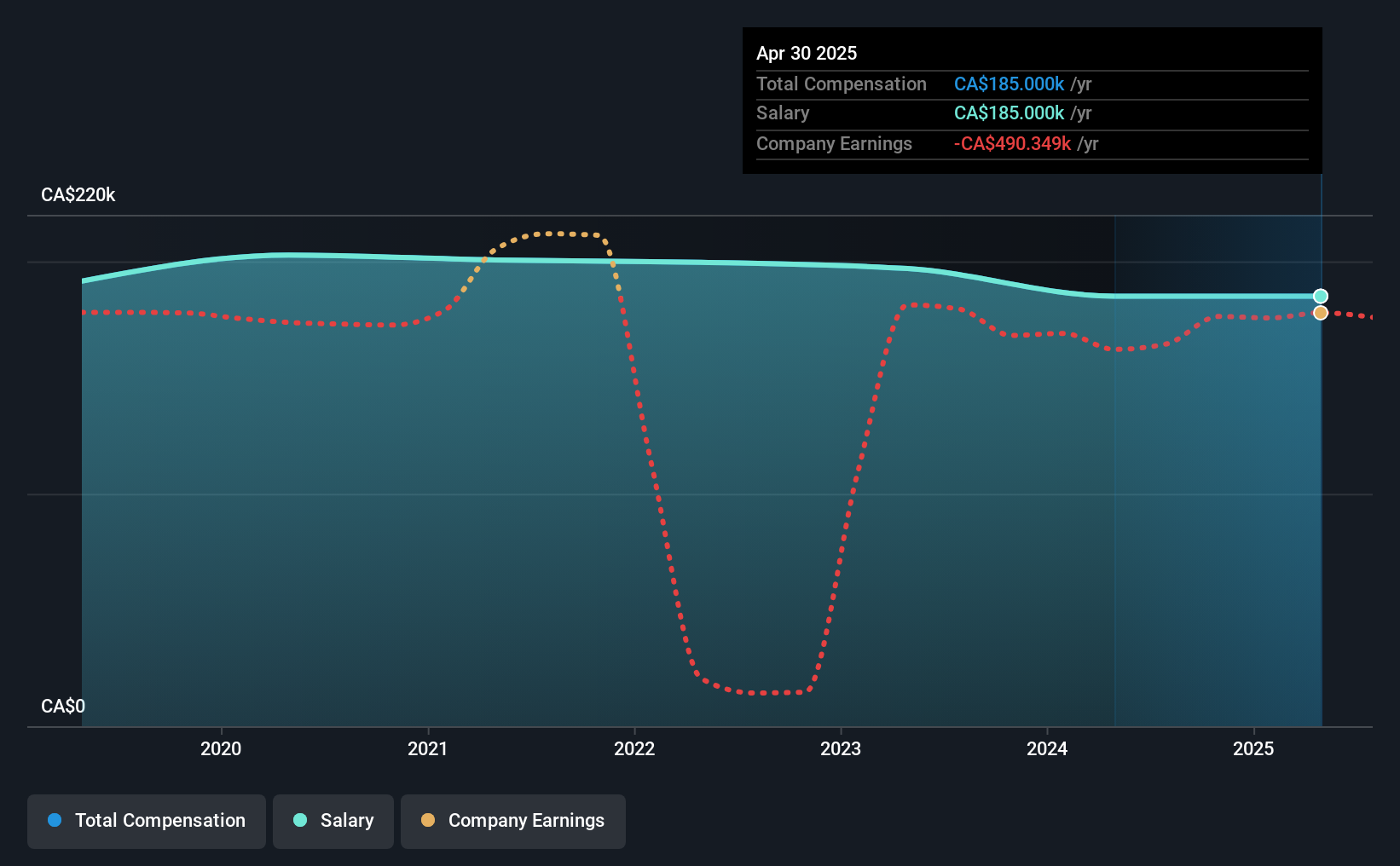
Our data indicates that Clean Energy Transition Inc. has a market capitalization of CA$1.0m, and total annual CEO compensation was reported as CA$185k for the year to April 2025. This was the same amount the CEO received in the prior year. It is worth noting that the CEO compensation consists entirely of the salary, worth CA$185k.
In comparison with other companies in the Canadian Metals and Mining industry with market capitalizations under CA$277m, the reported median total CEO compensation was CA$175k. From this we gather that Sean Joseph Samson is paid around the median for CEOs in the industry.
| Component | 2025 | 2024 | Proportion (2025) |
| Salary | CA$185k | CA$185k | 100% |
| Other | - | - | - |
| Total Compensation | CA$185k | CA$185k | 100% |
Speaking on an industry level, all of total compensation represents salary, while non-salary remuneration is completely ignored. On a company level, Clean Energy Transition prefers to reward its CEO through a salary, opting not to pay Sean Joseph Samson through non-salary benefits. If salary dominates total compensation, it suggests that CEO compensation is leaning less towards the variable component, which is usually linked with performance.
Clean Energy Transition Inc.'s Growth
Clean Energy Transition Inc. has seen its earnings per share (EPS) increase by 105% a year over the past three years. In the last year, its revenue is down 39%.
This demonstrates that the company has been improving recently and is good news for the shareholders. While it would be good to see revenue growth, profits matter more in the end. We don't have analyst forecasts, but you could get a better understanding of its growth by checking out this more detailed historical graph of earnings, revenue and cash flow.
Has Clean Energy Transition Inc. Been A Good Investment?
Since shareholders would have lost about 29% over three years, some Clean Energy Transition Inc. investors would surely be feeling negative emotions. Therefore, it might be upsetting for shareholders if the CEO were paid generously.
To Conclude...
Clean Energy Transition pays CEO compensation exclusively through a salary, with non-salary compensation completely ignored. Despite the growth in its earnings, the share price decline in the past three years is certainly concerning. The stock's movement is disjointed with the company's earnings growth, which ideally should move in the same direction. Shareholders would be keen to know what's holding the stock back when earnings have grown. At the upcoming AGM, shareholders will get the opportunity to discuss any issues with the board, including those related to CEO remuneration and assess if the board's plan will likely improve performance in the future.
While CEO pay is an important factor to be aware of, there are other areas that investors should be mindful of as well. We did our research and spotted 4 warning signs for Clean Energy Transition that investors should look into moving forward.
Switching gears from Clean Energy Transition, if you're hunting for a pristine balance sheet and premium returns, this free list of high return, low debt companies is a great place to look.
Have feedback on this article? Concerned about the content? Get in touch with us directly. Alternatively, email editorial-team (at) simplywallst.com.
This article by Simply Wall St is general in nature. We provide commentary based on historical data and analyst forecasts only using an unbiased methodology and our articles are not intended to be financial advice. It does not constitute a recommendation to buy or sell any stock, and does not take account of your objectives, or your financial situation. We aim to bring you long-term focused analysis driven by fundamental data. Note that our analysis may not factor in the latest price-sensitive company announcements or qualitative material. Simply Wall St has no position in any stocks mentioned.