
IPO News | Junsai Biotech Submits Hong Kong Stock Exchange Committed to Developing Innovative Cell Therapies and Innovative Drugs for Solid Tumors
The Zhitong Finance App learned that according to the Hong Kong Stock Exchange's disclosure on December 10, Shanghai Junsai Biotech Co., Ltd. (abbreviation: Junsai Biotech) submitted a listing application to the main board of the Hong Kong Stock Exchange, and CITIC Securities is its sole sponsor.

According to the prospectus, Junsai Biotech is a biotechnology company dedicated to the development of innovative cell therapies and innovative drugs for solid tumors. It focuses on developing safer, more effective, more accessible, and more affordable immunocyte therapies. It is not limited by any fixed molecular target, and covers the most common or most difficult solid tumors.
According to Frost & Sullivan, the company's core product, GC101, is the world's first tumor-infiltrating lymphocyte (TIL) therapy that does not require high-intensity cleansing chemotherapy or IL-2 administration, and is expected to be the first TIL therapy approved for marketing in China.
A single dose of TIL cell therapy can bring curative efficacy to some patients with advanced cancer. Clinical data shows that TIL therapy also brings long-term benefits to patients with various types of solid tumors such as advanced melanoma, non-small cell lung cancer, breast cancer, cholangiocarcinoma, cervical cancer, endometrial cancer, head and neck squamous cell carcinoma, and gastrointestinal tumors.
In terms of advantages and disadvantages, TIL therapy is an individualized therapy. Its core advantage is its breakthrough efficacy. The disadvantage is that the preparation process is complicated and the clinical plan is complicated, leading to excessive comprehensive cost and low accessibility, which limits its widespread application. In order for TIL therapy with high clinical value to benefit a wider range of patients, the company achieved innovation from the production side to the clinical side, simplified production processes and clinical plans on the premise of maintaining the curative opportunities of TIL therapy, and significantly improved the safety, accessibility and affordability of TIL cell therapy.
The company's core product, GC101, is the world's first new TIL cell drug that does not require high-intensity cleansing and does not require combined IL-2 injections. Phase I clinical trials for advanced metastatic solid tumors that failed various types of standard treatments have shown objective palliative efficacy in various solid tumors such as melanoma, non-small cell lung cancer, and cervical cancer.
Among them, the objective remission rate for 10 patients with advanced metastatic melanoma who failed standard treatment (median pre-treatment line was 3.5, 100% failed treatment with PD-1 antibodies) was 30%, and the median progression-free survival was 5.5 months. For 12 patients with advanced metastatic non-small cell lung cancer who failed standard treatment (median number of pre-treatment lines was 3), GC101 showed an objective remission rate of 41.7% at a median follow-up of 13.0 months, and the median duration of remission was not achieved; the 12-month overall survival rate was 66.7%, and the median survival was not achieved.
Currently, clinical trials of GC101 to treat melanoma are undergoing key phase II clinical trials, and it is expected that a biological product license application (BLA) will be submitted in 2026; the clinical pipeline of GC101 for the treatment of non-small cell lung cancer is currently in phase Ib clinical; early line combination treatment with multiple indications and adjuvant treatment after surgery have also been arranged.
Financial data
revenue
In 2023, 2024 and 2025 for the six months ended June 30, the company recorded revenue of 6.812 million yuan, 3.372 million yuan and 6.83 million yuan respectively.
Annual/period loss
In 2023, 2024, and 2025 for the six months ended June 30, the company recorded annual/period losses of RMB 94.391 million, RMB 164 million and RMB 97.58 million respectively.

Industry Overview
Oncology Drugs Market Size
The global oncology drug market has experienced strong growth in recent years. In 2024, the market size increased to US$253.3 billion, with a CAGR of 13.9% from 2020 to 2024. The market size is expected to expand further to US$452.5 billion by 2030, with a compound annual growth rate of 10.2% from 2024 to 2030, reaching US$702.7 billion by 2035, and a compound annual growth rate of 9.2% from 2030 to 2035.

In 2024, China's oncology drug market reached RMB 258.2 billion, with a compound annual growth rate of 6.9% from 2020 to 2024. The market is expected to accelerate in the next few years. By 2030, the market size will increase to RMB 527.3 billion, with a compound annual growth rate of 12.6% from 2024 to 2030. By 2035, the market size will further expand to RMB 1,042 billion, with a CAGR of 14.6% from 2030 to 2035.

Overview of tumor immunotherapy Tumor immunotherapy is broadly divided into three categories: immune checkpoint inhibitors (ICI) therapy, cancer vaccines, and transitive cellular immunotherapy (T-cell therapy). Among them, the field of tumor immunotherapy is growing particularly rapidly, accounting for 11.3% of the global oncology drug market in 2024. The sector is expected to continue its strong growth trend, accounting for 47.5% by 2035.
TIL therapy market size
In 2024, the global market for TIL therapy reached US$104 million and is expected to grow significantly in the next few years. The market size is expected to grow to US$1,692 billion by 2030. By 2035, the market size will further reach US$4.501 billion. The compound annual growth rate from 2024 to 2028 is 59.3%, and the compound annual growth rate from 2030 to 2035 is 21.6%.
China's first TIL therapy is expected to enter the commercial market around 2027, and the market size is expected to reach $200 million by 2030. In China, the TIL therapy market is expected to grow rapidly. The market size will reach 1,077 billion US dollars by 2035, and the compound annual growth rate from 2030 to 2035 is 40.0%, which exceeds the growth rate of the global market during the same period.

The TIL therapy market is expected to expand rapidly in the next few years, supported by multiple factors such as clinical, technical, regulatory, and funding. A number of macro- and industry-level trends are driving the popularization of TIL therapy and the acceleration of research and development. In addition, TIL therapy has also shown good results in many other fields, such as advanced melanoma, non-small cell lung cancer, breast cancer, gastrointestinal tumors, and other types of solid tumors.
Board Information
The board of directors of the company consists of 9 directors, including 4 executive directors, 2 non-executive directors and 3 independent non-executive directors. The term of directors is 3 years, and they can be re-elected.


Shareholding structure
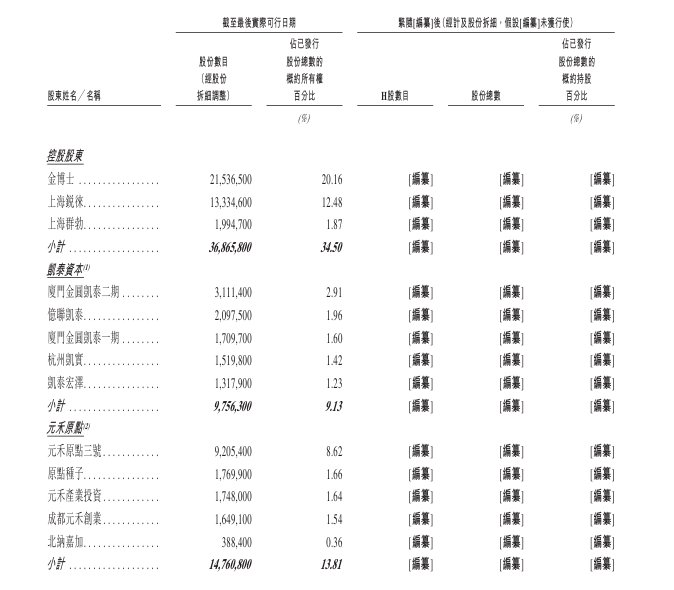
As of December 5, 2025, Shanghai Ruilai and Shanghai Qunbo are both controlled by Dr. Jin. According to securities and futures regulations, Dr. Jin is considered to have an interest in the shares held by these two entities. In total, Dr. Kim holds 34.5% of the shares. In addition, Kaitai Capital, Yuanhe Yuandian, and Mr. Huang Shizhuan held 9.13%, 13.81%, and 5.3% of the shares respectively. Meanwhile, Forong Investment and Sanfu Venture together held 5.23% of the shares.


Intermediary team
Sole sponsor: CITIC Securities (Hong Kong) Limited
Company Legal Adviser: On Hong Kong Law and US Law: Davis Polk & Wardwell; On Chinese Law: Jingtian Gongcheng Law Firm
Sole Sponsor's Legal Adviser: Hong Kong Law and US Law: Sullivan Cromwell (Hong Kong) Limited Liability Partnership; Regarding Chinese Law: King & Wood Mallesons
Auditors and reporting accountants: Ernst & Young
Industry Advisor: Frost & Sullivan (Beijing) Consulting Co., Ltd. Shanghai Branch
Compliance Advisor: First Shanghai Finance Co., Ltd.