
Eurozone economic growth resilience exceeds expectations! Lagarde's forecast: Next week may raise the outlook
The Zhitong Finance App learned that ECB President Lagarde said that the bank's latest forecast report to be released next week is likely to make a more optimistic assessment of economic growth prospects.
In a speech, Lagarde pointed out that in the face of the impact of US tariffs, the Eurozone, which consists of 20 countries, has shown more resilience than expected. In particular, she pointed out that the EU has not implemented retaliatory measures, while the euro exchange rate remains stable and the labor market continues to be strong.
In his speech on Wednesday, Lagarde said: “In our latest economic forecasting work, we have raised our growth expectations. I expect the December forecast may be raised again.”
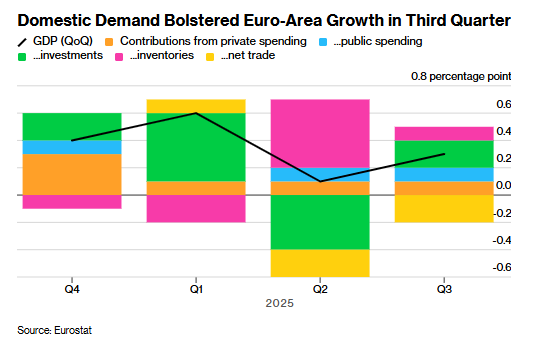
Affected by these remarks, Eurozone bond prices fell in response. The yield on French 10-year treasury bonds once rose above 3.60%, hitting a nine-month high, then the increase narrowed rapidly. The money market's probability expectation that the ECB will raise interest rates by 25 basis points next year has climbed to 40% from 30% on Tuesday.
Thanks to the resilient performance of the economy, ECB policymakers are increasingly convinced that the benchmark interest rate can remain unchanged at the current level for the foreseeable future. Eurozone gross domestic product (GDP) grew 0.3% month-on-month in the third quarter, higher than preliminary statistics.
Bank of Lithuania Governor Gediminas Simkus stated on Wednesday that he believes there is currently no need to cut interest rates further. This statement is a shift from its previous statement, indicating that policymakers increasingly believe that the level of inflation will not fall sharply below the ECB's target range. ECB Executive Committee member Isabel Schnabel also said that she agreed with the view that investors are betting on the central bank's next move to raise interest rates.
A series of official statements have made investors completely dismiss their expectations that the ECB will cut interest rates next year. This market sentiment has also spread globally. As the market anticipates that the multi-country interest rate cut cycle from the US to Australia may soon come to an end, global treasury bond yields have climbed to a high point since 2009.
Lagarde said, “Considering that the inflation rate has stabilized at around 2%, and the medium-term forecast also points to 2%, I would like to repeat once again that we are in the ideal policy range.” At the same time, she pointed out that the Eurozone economy “is already very close to its potential growth level.”
Lagarde also responded to French President Emmanuel Macron's initiative to “adjust the framework for monetary policy in the Eurozone to balance economic growth and employment while focusing on inflation.” Unlike the Federal Reserve's multiple policy goals, maintaining price stability is the ECB's core mission.
Lagarde said, “This is a discussion worth carrying out, and it is also very meaningful to explore the possibility of amending the relevant treaties.” However, at the same time, she stressed that the current policy framework has given the ECB enough room to include issues such as economic growth, employment, innovation, productivity, and climate change in decision-making.
She said, “Governments initially gave central banks the mission of maintaining monetary order in specific regions. The responsibility of central banks and their policymakers was to focus on fulfilling this core goal. And our policy mission is very clear.”
Furthermore, Lagarde positively evaluated the EU's latest plan to use frozen Russian assets to aid Ukraine's defense.
She pointed out that the plan currently being negotiated “is the most consistent with the rules of international law I have ever seen”. She stressed, “If we can clearly explain our current position, I believe investors in euro assets and the European market will understand. This move is not about arbitrarily disposing of other people's assets or disposing of sovereign assets out of their own interests; it is a very special case.”