
Deutsche Post AG (ETR:DHL) Looks Inexpensive But Perhaps Not Attractive Enough
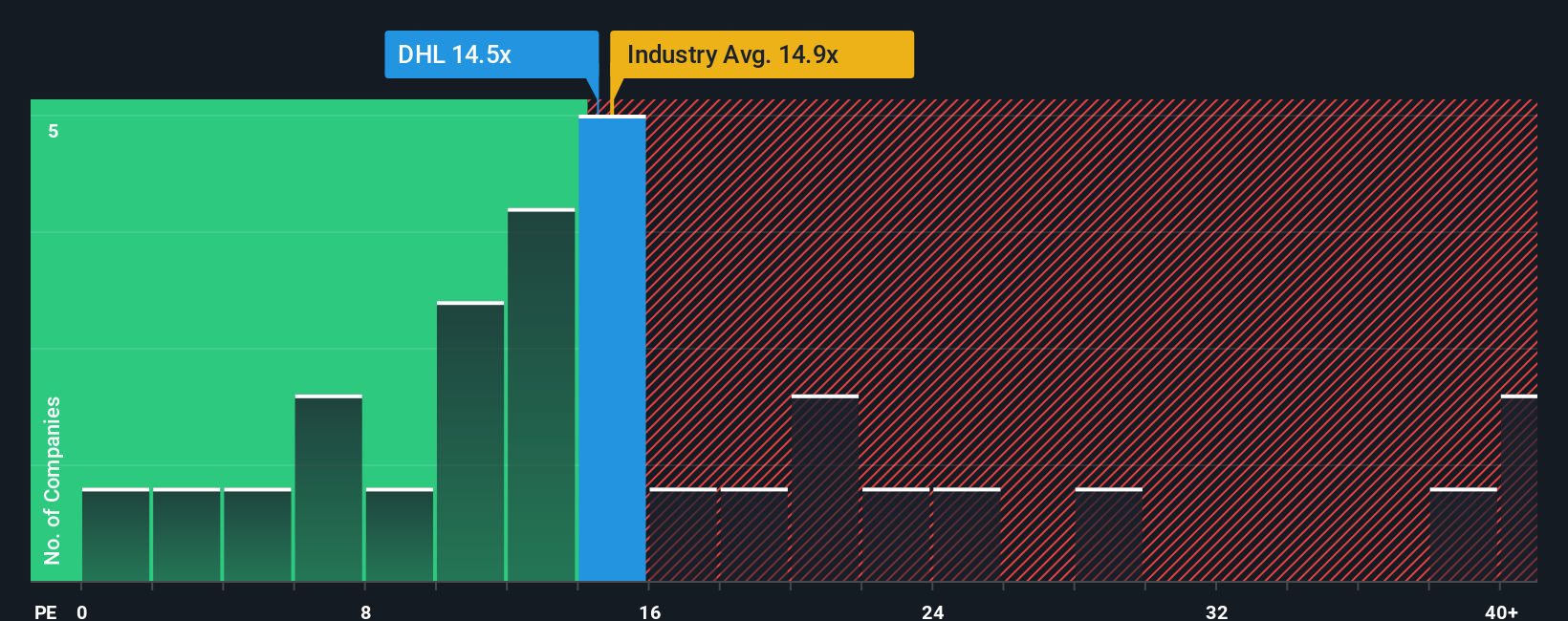
With a price-to-earnings (or "P/E") ratio of 14.5x Deutsche Post AG (ETR:DHL) may be sending bullish signals at the moment, given that almost half of all companies in Germany have P/E ratios greater than 18x and even P/E's higher than 34x are not unusual. However, the P/E might be low for a reason and it requires further investigation to determine if it's justified.
Recent times have been advantageous for Deutsche Post as its earnings have been rising faster than most other companies. One possibility is that the P/E is low because investors think this strong earnings performance might be less impressive moving forward. If not, then existing shareholders have reason to be quite optimistic about the future direction of the share price.
View our latest analysis for Deutsche Post
How Is Deutsche Post's Growth Trending?
There's an inherent assumption that a company should underperform the market for P/E ratios like Deutsche Post's to be considered reasonable.
If we review the last year of earnings growth, the company posted a worthy increase of 13%. Ultimately though, it couldn't turn around the poor performance of the prior period, with EPS shrinking 30% in total over the last three years. Accordingly, shareholders would have felt downbeat about the medium-term rates of earnings growth.
Shifting to the future, estimates from the analysts covering the company suggest earnings should grow by 7.6% per annum over the next three years. That's shaping up to be materially lower than the 17% each year growth forecast for the broader market.
In light of this, it's understandable that Deutsche Post's P/E sits below the majority of other companies. It seems most investors are expecting to see limited future growth and are only willing to pay a reduced amount for the stock.
The Final Word
Typically, we'd caution against reading too much into price-to-earnings ratios when settling on investment decisions, though it can reveal plenty about what other market participants think about the company.
As we suspected, our examination of Deutsche Post's analyst forecasts revealed that its inferior earnings outlook is contributing to its low P/E. At this stage investors feel the potential for an improvement in earnings isn't great enough to justify a higher P/E ratio. It's hard to see the share price rising strongly in the near future under these circumstances.
It's always necessary to consider the ever-present spectre of investment risk. We've identified 1 warning sign with Deutsche Post, and understanding should be part of your investment process.
Of course, you might find a fantastic investment by looking at a few good candidates. So take a peek at this free list of companies with a strong growth track record, trading on a low P/E.
Have feedback on this article? Concerned about the content? Get in touch with us directly. Alternatively, email editorial-team (at) simplywallst.com.
This article by Simply Wall St is general in nature. We provide commentary based on historical data and analyst forecasts only using an unbiased methodology and our articles are not intended to be financial advice. It does not constitute a recommendation to buy or sell any stock, and does not take account of your objectives, or your financial situation. We aim to bring you long-term focused analysis driven by fundamental data. Note that our analysis may not factor in the latest price-sensitive company announcements or qualitative material. Simply Wall St has no position in any stocks mentioned.