
Performance Comparison: Apple And Competitors In Technology Hardware, Storage & Peripherals Industry
In the dynamic and fiercely competitive business environment, conducting a thorough analysis of companies is crucial for investors and industry enthusiasts. In this article, we will perform an extensive industry comparison, evaluating Apple (NASDAQ:AAPL) in relation to its major competitors in the Technology Hardware, Storage & Peripherals industry. By closely examining crucial financial metrics, market position, and growth prospects, we aim to offer valuable insights for investors and shed light on company's performance within the industry.
Apple Background
Apple is among the largest companies in the world, with a broad portfolio of hardware and software products targeted at consumers and businesses. Apple's iPhone makes up a majority of the firm sales, and Apple's other products like Mac, iPad, and Watch are designed around the iPhone as the focal point of an expansive software ecosystem. Apple has progressively worked to add new applications, like streaming video, subscription bundles, and augmented reality. The firm designs its own software and semiconductors while working with subcontractors like Foxconn and TSMC to build its products and chips. Slightly less than half of Apple's sales come directly through its flagship stores, with a majority of sales coming indirectly through partnerships and distribution.
| Company | P/E | P/B | P/S | ROE | EBITDA (in billions) | Gross Profit (in billions) | Revenue Growth |
|---|---|---|---|---|---|---|---|
| Apple Inc | 37.16 | 55.55 | 9.99 | 39.36% | $35.55 | $48.34 | 7.94% |
| Western Digital Corp | 23.88 | 9.84 | 6.09 | 20.57% | $1.48 | $1.23 | 27.4% |
| NetApp Inc | 20.44 | 23.56 | 3.61 | 31.11% | $0.47 | $1.23 | 2.83% |
| Pure Storage Inc | 184.61 | 16.43 | 6.89 | 4.03% | $0.09 | $0.6 | 12.02% |
| Super Micro Computer Inc | 27.57 | 3.20 | 1.06 | 2.62% | $0.25 | $0.47 | -15.49% |
| Logitech International SA | 27.01 | 8.38 | 3.80 | 7.99% | $0.22 | $0.51 | 6.27% |
| Diebold Nixdorf Inc | 48.59 | 2.13 | 0.67 | 3.73% | $0.11 | $0.25 | 1.95% |
| Turtle Beach Corp | 16.17 | 2.51 | 0.87 | 1.51% | $0.01 | $0.03 | -14.74% |
| Average | 49.75 | 9.44 | 3.28 | 10.22% | $0.38 | $0.62 | 2.89% |
By analyzing Apple, we can infer the following trends:
The Price to Earnings ratio of 37.16 is 0.75x lower than the industry average, indicating potential undervaluation for the stock.
The elevated Price to Book ratio of 55.55 relative to the industry average by 5.88x suggests company might be overvalued based on its book value.
With a relatively high Price to Sales ratio of 9.99, which is 3.05x the industry average, the stock might be considered overvalued based on sales performance.
The company has a higher Return on Equity (ROE) of 39.36%, which is 29.14% above the industry average. This suggests efficient use of equity to generate profits and demonstrates profitability and growth potential.
Compared to its industry, the company has higher Earnings Before Interest, Taxes, Depreciation, and Amortization (EBITDA) of $35.55 Billion, which is 93.55x above the industry average, indicating stronger profitability and robust cash flow generation.
The company has higher gross profit of $48.34 Billion, which indicates 77.97x above the industry average, indicating stronger profitability and higher earnings from its core operations.
The company is experiencing remarkable revenue growth, with a rate of 7.94%, outperforming the industry average of 2.89%.
Debt To Equity Ratio
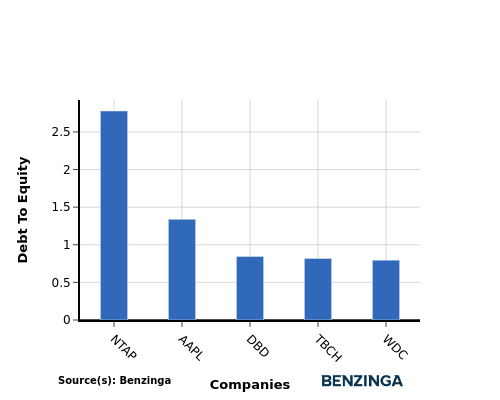
The debt-to-equity (D/E) ratio is a measure that indicates the level of debt a company has taken on relative to the value of its assets net of liabilities.
Considering the debt-to-equity ratio in industry comparisons allows for a concise evaluation of a company's financial health and risk profile, aiding in informed decision-making.
When assessing Apple against its top 4 peers using the Debt-to-Equity ratio, the following comparisons can be made:
Apple falls in the middle of the list when considering the debt-to-equity ratio.
This indicates that the company has a moderate level of debt relative to its equity with a debt-to-equity ratio of 1.34, suggesting a balanced financial structure with a reasonable debt-equitymix.
Key Takeaways
For Apple, the PE ratio is low compared to peers, indicating potential undervaluation. The high PB and PS ratios suggest the market values the company's assets and sales highly. Apple's high ROE, EBITDA, gross profit, and revenue growth reflect strong financial performance relative to industry competitors. Overall, Apple appears to be attractively priced based on its earnings multiples, while also demonstrating robust profitability and growth metrics within the sector.
This article was generated by Benzinga's automated content engine and reviewed by an editor.