
Is Ball Turning Into a Value Opportunity After Portfolio Streamlining and Share Price Slump?
- If you have been wondering whether Ball is quietly turning into a value opportunity or just a value trap, you are in the right place to unpack what the current share price is really telling us.
- Despite being down 9.6% year to date and 13.8% over the last year, the stock has shown some short term resilience, with a 0.7% gain over the past week and a 4.1% rise over the last month from its recent close around $49.21.
- Recent headlines have focused on Ball sharpening its portfolio and capital structure, including ongoing moves to streamline operations and concentrate on higher margin packaging businesses. At the same time, analysts and investors have been revisiting the long term demand outlook for sustainable aluminum packaging, which helps explain why sentiment has been improving even after a tough multi year stretch.
- On our checks, Ball scores a full 6/6 valuation score, suggesting it screens as undervalued across every metric we track. In the rest of this article, we will unpack what that actually means using different valuation lenses, before finishing with a more complete way to think about the company’s true worth.
Approach 1: Ball Discounted Cash Flow (DCF) Analysis
A Discounted Cash Flow model estimates what a business is worth by projecting the cash it can generate in the future and discounting those cash flows back to today in dollar terms.
For Ball, the 2 Stage Free Cash Flow to Equity model starts from a weak base, with last twelve month free cash flow of around $206.8 million in the red, reflecting recent restructuring and portfolio changes. Analysts then expect cash flows to recover sharply, with projections rising to about $1.02 billion in 2026 and $1.32 billion by 2035, with the later years extrapolated by Simply Wall St once explicit analyst estimates run out.
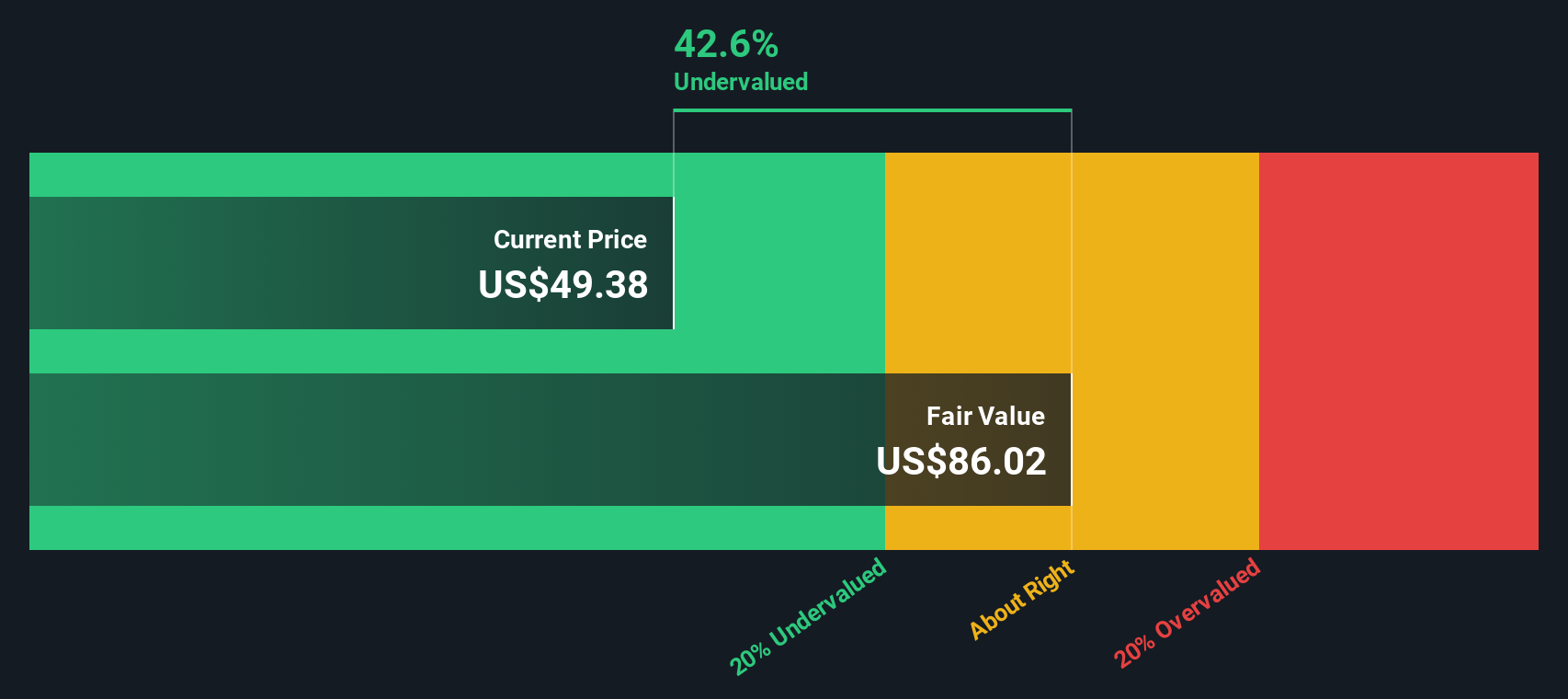
When all of those future dollar cash flows are discounted back, the model arrives at an intrinsic value of roughly $85.09 per share. Compared to the recent share price near $49, this implies Ball is about 42.2% undervalued on a DCF basis.
Result: UNDERVALUED
Our Discounted Cash Flow (DCF) analysis suggests Ball is undervalued by 42.2%. Track this in your watchlist or portfolio, or discover 905 more undervalued stocks based on cash flows.
Approach 2: Ball Price vs Earnings
For profitable companies like Ball, the price to earnings ratio is a straightforward way to gauge how much investors are willing to pay today for each dollar of current profits. It captures not just today’s earnings, but also what the market collectively expects about future growth and the risks around those expectations.
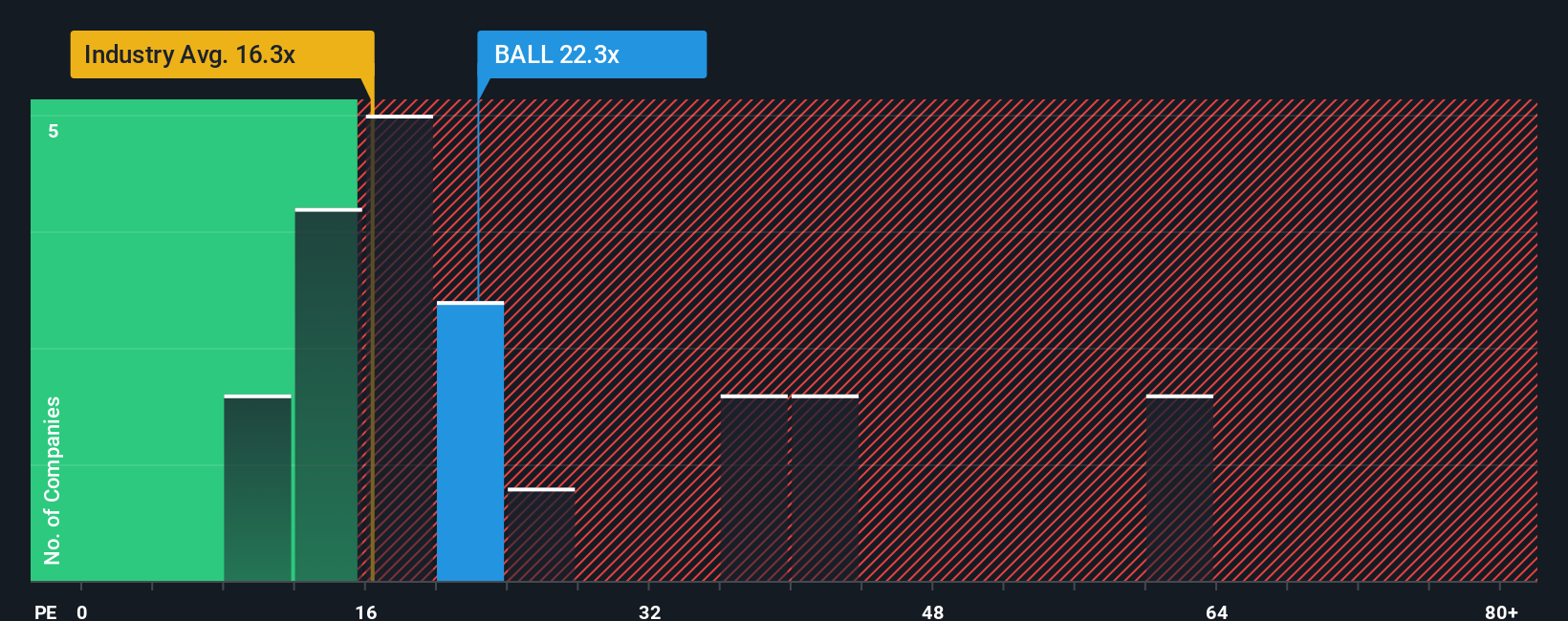
In general, faster and more reliable earnings growth justifies a higher PE, while slower growth, more volatile results, or higher risk usually call for a lower PE. Ball currently trades on a PE of about 18.5x, sitting above the Packaging industry average of roughly 15.5x, but well below the broader peer group average near 59.7x. That broader group includes some much faster growing or more speculative names.
Simply Wall St’s Fair Ratio framework estimates that, given Ball’s specific mix of earnings growth, profit margins, industry positioning, market cap and risk profile, a PE closer to 20.9x would be appropriate. This stock specific Fair Ratio is more useful than a simple peer or industry comparison because it adjusts for the company’s own fundamentals instead of assuming all packagers deserve the same multiple. With Ball trading below its Fair Ratio estimate, the shares screen as undervalued on a PE basis.
Result: UNDERVALUED
PE ratios tell one story, but what if the real opportunity lies elsewhere? Discover 1445 companies where insiders are betting big on explosive growth.
Upgrade Your Decision Making: Choose your Ball Narrative
Earlier we mentioned that there is an even better way to understand valuation. Let us introduce you to Narratives, which are simple, story driven forecasts that allow you to spell out your view of Ball’s future revenues, earnings and margins. You can link that story to a financial model and arrive at your own fair value, all within the Narratives tool on Simply Wall St’s Community page. Millions of investors use this tool to decide whether to buy or sell by comparing their fair value to the current share price. Each Narrative automatically updates as new news or earnings are released so your thesis never goes stale. For example, one Ball investor might build an optimistic Narrative that leans into accelerating demand for sustainable aluminum and expects the shares to reach something closer to the bullish analyst target of $84. Another might create a more cautious Narrative that assumes margin pressure and slower growth and lands nearer the bearish $54 view. This illustrates how the same company can support very different, but clearly articulated, investment decisions.
Do you think there's more to the story for Ball? Head over to our Community to see what others are saying!

This article by Simply Wall St is general in nature. We provide commentary based on historical data and analyst forecasts only using an unbiased methodology and our articles are not intended to be financial advice. It does not constitute a recommendation to buy or sell any stock, and does not take account of your objectives, or your financial situation. We aim to bring you long-term focused analysis driven by fundamental data. Note that our analysis may not factor in the latest price-sensitive company announcements or qualitative material. Simply Wall St has no position in any stocks mentioned.
Have feedback on this article? Concerned about the content? Get in touch with us directly. Alternatively, email editorial-team@simplywallst.com