
Zhang Yidong: China's stock market opportunities are comparable to real estate after 1998. Investors are advised to lay out two main lines and be patient and go long
On December 3, the 10th Zhitong Financial Capital Market Annual Conference was held in Nanshan, Shenzhen. At the conference, Societe Generale Securities's Global Chief Strategy Analyst and Co-Director of the Institute of Economics and Finance shared his views on “the bull market, rain or shine, and be patient.” Taken together, Zhang Yidong believes that the background of the current “great power game” era forms the core logic of allocating major types of assets. On the one hand, the US relies on debt expansion to prosper the market. The federal government's debt is high, the leverage ratio has exceeded 120%, and faces tremendous pressure to repay debt and interest every year. Therefore, from a monetary perspective, demand for interest rate cuts in the US is strong. It is expected that the US dollar will continue to weaken next year, and the Federal Reserve will further ease; on the other hand, technology has become America's “Noah's Ark” to maintain long-term economic competitiveness, and AI-related investments have contributed more than 40% of its actual GDP growth rate. Seen from this perspective, behind America's prosperity model driven by debt expansion, there is actually a risk of crisis. This wave of AI technology is likely to form a “rigid bubble” in the US to whitewash Taiping. In contrast to this, the stage where the most severe drag on real estate in China is probably about to pass, and China is facing major historical development opportunities.
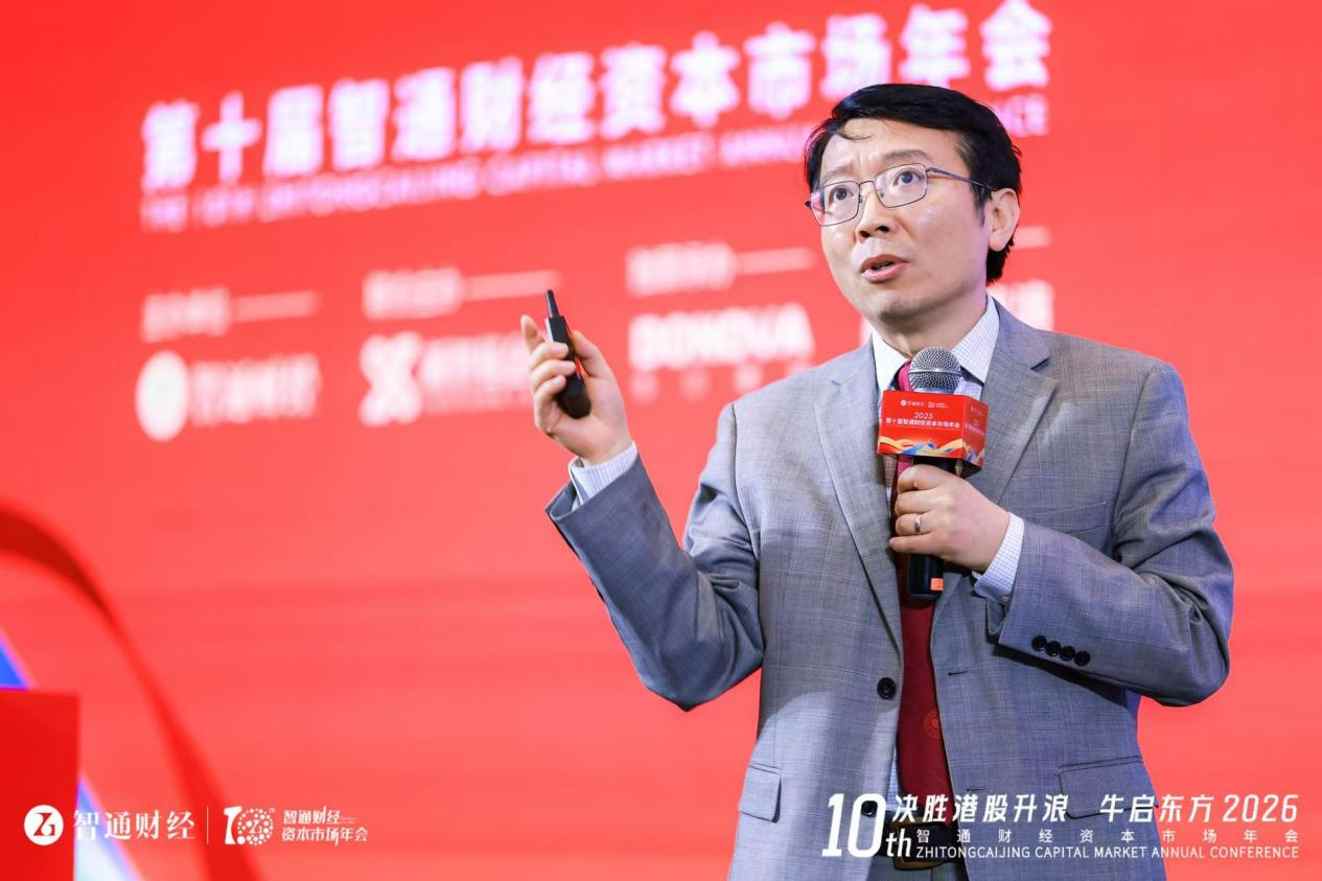
Selected speech content:
America's hegemony under debt shackles relies more on AI technology. The background of the era of large-scale asset allocation is a game of great powers
Let's take a look at America first. America is no longer the “supremacy” of the past 30 years. After Trump comprehensively considered the costs and benefits of maintaining hegemony, the expression of hegemony changed from a lighthouse model of “making rules and using rules” to an American priority that pursues the “art of trading without rules”; in fact, it is unilateralism and realism.
What is the US economic context behind this transformation? The US federal government is heavily indebted, and the pressure to repay debt and interest is huge every year. Against the backdrop of an overall leverage ratio of over 120%, it pays trillions of dollars in interest every year, which has become the focus of the US government's internal and external games.
It's hard to go back to when the Super League dominated in the 90s. At that time, the US fiscal surplus was still in deficit. From a monetary perspective, the demand for interest rate cuts is very strong. Trump always wants to change the chairman of the Federal Reserve. The reason behind this is that the entire US government debt and government leverage ratio are too high.
The US government's domestic and foreign policies are clearly “transactional”. They release water domestically to deal with vote politics and gain more support through water release. In terms of monetary and fiscal policies, Trump's demands are actually all relaxed and he wants the stock market to rise; externally, it is trying to open source through tariffs, so they can make a profit trade if they can.
Behind the prosperity path of US debt expansion is the structural difficulties and concerns of the US economy
If we look at US stocks, the US we see has always been a path of prosperity driven by debt expansion, but this path of prosperity has been accompanied by the shadow of a crisis. On the one hand, we can see the center of inflation throughout the US and the West. Compared with the era of globalization — the 90s to 2020, which is the globalization period of the past 30 years — it has improved in recent years.
On the other hand, the US manufacturing industry is hollowing out, and there are no labor dividends or engineer dividends in the manufacturing industry. The US manufacturing industry accounts for about 30% of the non-farm payrolls in the 40s, but now it's only 8%, and the US lacks sufficient talent reserves. Expecting the return of the US middle- and low-end manufacturing industry? It's impossible.
The US economy now basically depends on both sides: one is service consumption, which is the dominant force; the other is advanced technological manufacturing, which is an emerging force and future.
Technology has become America's “Noah's Ark” to maintain long-term economic competitiveness
Societe Generale Securities's macro team made a statistic. In a narrow sense, the capital expenses of the four major tech giants — Google, Meta, Nvidia, and Microsoft — have contributed more than 20% to the real GDP growth rate of the US.
If we take the AI related investment in the US a little more broadly, including AMD, Oracle, etc., and add up all of these information processing technology software, hardware and software, and the construction of data centers, it can be found that the contribution of these AI-related investments to the year-on-year growth rate of US GDP is close to half, reaching more than 40%.
The development of AI in the US is inseparable from the US stock market's bulls. The US government now promotes the capital market through fiscal expansion and monetary expansion, and then provides property income to the US residential sector through the capital market, and this portion of property income supports its disposable income, thereby supporting US consumption, which in turn supports the US economy by promoting consumption that accounts for more than 70% of US GDP.
In fact, the high-tech AI wave has become the core driving force for US stock market leaders in recent years, driving US stocks to whitewash the US government. Therefore, technology has actually become Noah's Ark to maintain long-term competitiveness in the US stock market and economy.
The AI tech wave is likely to be a rigid bubble
In terms of this logic, the current wave of AI technology in the US is probably a “rigid bubble” — let's just say it's a bubble in quotes, because the bubble can be understood at many levels. For example, the 2008 subprime mortgage crisis was a financial bubble; when the Internet bubble burst in 2000, it was actually a technology bubble.
However, until now, AI technology is still in the early stages of a major cycle. If we had to compare it to the 90s, we think it was 1997 and 1998 at most, far less than 1999 or 2000. We have seen high structural valuations or financial risks, such as Oracle and Open AI, and we have also observed the phenomenon of circular transactions. There is indeed a risk of a structural bubble.
But this time was different from 2008 and 2000. Since the 90s, America has been in a dominant position in the Super League, and is not afraid of a crisis at all. Every time an American crisis occurs, the whole world pays for it. But now that America is catching up with a strong competitor, it doesn't have enough confidence to simply burst the bubble.
Once this tech bubble is falsified or bursting, the US sovereign debt crisis may soon hit, because it is now heavily indebted. Conversely, if the technological wave lasts longer, America's technological hegemony, economic hegemony, and even monetary hegemony can continue for a longer period of time.
The bubble thing doesn't necessarily mean that if there is a bubble, it will collapse soon; it depends on the development trend. The current AI bubble theory is very similar to the property market bubble theory in 2005. At the time, many Western economists said that housing prices in Shanghai would collapse, and that the return on rent and housing price to income ratio were all outrageous. It far exceeded the level of other emerging markets in history, and even surpassed the level of developed countries at the time. At that time, housing prices in Shanghai were 5,000 yuan per square meter. By 2020, housing prices in Shanghai's inner ring could reach 150,000 square meters.
I think this AI wave combines the characteristics of the Internet wave in the 90s and Star Wars plans in the 80s when the US and Soviet Union fought for supremacy. The Star Wars Project was a national effort between the US and the Soviet Union to compete in science and technology through the plan, but it did not actually come to the application side. However, the TOB and TOC applications of AI are now gradually being commercialized.
The AI market in the short-term capital market will be adjusted if the valuation is expensive, but the technological wave brought about by AI should not be taken lightly or underestimated. Whether the progress of AI technology itself continues to exceed expectations, or the heavily indebted US is trying to rely heavily on AI to do miracles.
The most painful stage of switching between old and new kinetic energy in China has passed. Building a socialist modern power is a historical opportunity
The US uses government debt expansion as a starting point to stimulate the economy, attaches importance to the capital market, and drives technological development through strong US stocks. However, China is not releasing large amounts of water; instead, it is seeking steady progress and focusing on high-quality development. Currently, the Chinese stock market has also ushered in a period of historical opportunity.
This period of historical opportunity is to achieve the goal of becoming a socialist modern power by the middle of this century. It is divided into two steps:
The first step is to basically achieve a per capita GDP of 20,000 US dollars by 2035. We estimate that the GDP growth rate in the next ten years will only need to be maintained at 4.17%, and there is no need to reach 5%. In this decade, we will have to practice high-quality development until at least 2035, and we can achieve a real GDP level of around 4.17% per year.
However, if China continues to follow the growth model of the past 30 years, it will still be difficult. What's the level of difficulty? The reason is that China's balance sheet shows structural differences. The extensive development model driven by debt expansion is inefficient and unworkable: the central government's balance sheet is very good and very clean, but the balance sheets of local governments, the residential sector, and the enterprise sector are not ideal.
Corporate sector debt leverage ratio — Debt accounts for more than 140% of GDP, which is about twice the leverage ratio of US corporate sector debt. This means that the original expansionary debt expansion growth model has significant sequelae. Even when the base currency is invested, effective credit demand is insufficient, and credit expansion is also worrisome, and the results are very poor.
Under such circumstances, it is expected that the central government will expand significantly. On the one hand, it is necessary to consider efficiency issues, and on the other hand, it is also necessary to consider policy orientation. The central government has strong strategic strength. Instead of flooding with heavy water, it must develop with high quality.
From the perspective of bottom-line thinking, the central government's chart — the current balance of treasury bonds is about 34.5 trillion yuan, accounting for about 26% of GDP, which is only a fraction of the US (the US is over 120%; we are over 20%). In other words, the US central government debt leverage ratio is several times ours, and we only have a fraction of it. This is like a strategic weapon displayed during the 1993 military parade. It has more than enough cover but is not necessarily used frequently. Looking at this chart, we should not be too pessimistic about the Chinese economy, nor should we let a systemic crisis occur.
Judging from the data, China has gradually come out of the most painful stage of switching between old and new kinetic energy. In the past four years, from 2022 to 2025 this year, regardless of the extent of the decline in the area of newly completed real estate construction or residents' housing investment as a share of GDP, several indicators suggest that the stage where real estate, as an old momentum, has dragged down the economy the most may soon be over. Currently, the overall real estate market has entered the bottom zone. Real estate-related revenue, which previously accounted for about 40% of the first two accounts, has now dropped to around 20%. The real estate industry's contribution to GDP fell from a peak of more than 25% to close to 30%, to about 13%.
Real estate is the main support for old momentum, and its drag factors still exist, and it can also be seen that recent data is still relatively sluggish. This is like a person shifting from acute risk such as cerebral infarction or myocardial infarction to the risk of chronic diseases, which needs to be gradually resolved over time. You can't expect immediate cure for a “trifecta”, chronic illness, or diabetes, let alone abuse hormones for quick results. Similarly, if real estate is forcibly stimulated by releasing large amounts of water, not only is it useless, but it may also lead to more serious sequelae.
China's stock market ushered in historic opportunities — high-quality development from expanding debt to revitalizing assets, from land finance to equity finance
China's rapid economic growth stage over the past 30 years has relied on debt expansion, driven by indirect bank financing, and urbanization and industrialization. In the future, for the high-quality development of the Chinese economy, we need to develop our economic potential, shift our focus to the other end of the balance sheet — the asset side, revitalize the cash flow statement by revitalizing the asset side, and then boost the profit statement through the cash flow statement.
Therefore, revitalizing the asset side of the balance sheet will be the key to digging deeper into economic potential and improving quality and efficiency. It is a key gripper for achieving high-quality development goals in 2035 and even 2049. In this process, the Chinese stock market, like real estate after 1998, has become a hub and engine that spurs the whole body.
Observing changes in the central balance sheet, it can be seen that the central bank's claims to other financial companies have expanded significantly since the central financial work conference in the fourth quarter of 2023. Other financial corporate claims include an important institution: Central Remittance Fund. In 2024, on the one hand, Huijin will buy ETFs such as the Shanghai and Shenzhen 300. Prior to the 2023 Central Financial Work Conference, Huijin held only 5% to 8% of all equity ETFs in the market; however, after the conference, it had jumped to 29% in the first half of 2024. Note that the “924” policy was introduced in the second half of 2024, then this ratio was further expanded, reaching 37% in the first half of this year. Note that ETFs held by the Bank of Japan account for more than 60% of ETFs in the Japanese stock market.
The 2023 Central Financial Work Conference clearly proposed to “unswervingly move away from the path of financial development with Chinese characteristics”: “The path of financial development with Chinese characteristics is fundamentally different from the Western financial model.” “Adhere to the people-centered value orientation and insist on financial services to the real economy as the fundamental purpose.” Since then, the central government has repeatedly emphasized “continuing to stabilize and revitalize the capital market.”
Since 2024, the four major banks of Hong Kong stocks, the three major operators, and the special valuation sector of A-shares have continued to break out of the independent market. The rise in valuations and asset revaluation of central and state-owned enterprises is essentially revitalizing the asset side of the central government's balance sheet.
Looking at local governments, their development ideas are also changing: in the past, they relied on land finance, used land investment to attract capital, and expanded balance sheets through land, which actually didn't work. Now the whole country is beginning to pay attention to equity finance. Among them, one of the cities with the most obvious performance is Hefei. The Yangtze River Delta, Pearl River Delta, and even the Northeast region are following suit. I recently visited Changchun for research and felt that the local community is already thinking about how to use its natural resources, energy, minerals, and scientific research resources — including research results from universities and research institutes — to connect with funds from the Yangtze River Delta, Pearl River Delta, and the South.
The capitalization of state-owned resources, securitization of state-owned assets, and leveraging of state-owned capital have gradually become the consensus of various local governments to explore new development models. The core of this consensus is equity finance, and the key hub of equity finance is the stock market — capital markets such as A-shares and Hong Kong stocks, through which assets are revitalized.
For example, a city holds shares in a semiconductor company. If not listed, it can only be calculated at the cost price; once listed, the equity value may be re-estimated several times. Regardless of whether the ban is directly lifted and holdings are reduced, profits can be realized on the one hand, and fiscal revenue on the other. With the funds obtained from reduced holdings, it is possible to continue to invest in other projects, forming a virtuous cycle.
Let ordinary investors participate in the capital market through the expansion of ETFs
Another balance sheet is the residents' balance sheet. Are you paying attention? Shenzhen is the best in terms of zero social growth rate and consumption indicators for China's first-tier cities this year, followed by Shanghai, and Beijing is relatively far behind. The data for Shenzhen and Shanghai is much better. It is related to the wealth effect of the stock market. Shenzhen benefits from the Hong Kong Stock Exchange and the Shenzhen Stock Exchange, while Shanghai has the Shanghai Stock Exchange. This is similar to the situation in the US.
The property income of American residents has passed the 401K plan, so that the general public can benefit from the prosperity of the capital market. It has an instructive effect on us. What should we do to increase residents' property income in the future?
Frankly speaking this year, as can be seen from the data, it is not obvious that China's deposits are moving to the stock market. Ordinary investors are not the main players in the market; on the contrary, many small and medium-sized investors are redeeming funds. The market leader this year is actually patient capital, such as pensions, corporate pensions, social security, insurance, etc.
We believe that in the future, on the one hand, it is likely that ordinary investors will participate in the capital market through ETF expansion; on the other hand, regardless of whether the general public is willing or friendly to the capital market, everyone will always participate in the five insurances and one fund, and this patient capital will also enter the stock market.
In the future, China will improve the balance sheets of ordinary people through the strong position of the capital market. After the epidemic, the stock market declined, and the marginal consumption of Chinese residents fell to a level, but it can be seen that there has been a recovery from 2024 as the capital market becomes more active. Therefore, we believe that in the future, as the money-making effect of the Chinese stock market continues, social wealth will be reallocated, and consumer confidence and ability will continue to improve.
The Chinese stock market continues to be stable and active, which is conducive to forming positive feedback on the profitability of Chinese companies
The third balance sheet relates to the corporate sector. As a socialist country, China can accelerate mergers, acquisitions and restructuring through the capital market, optimize its balance sheet, and reshape its balance sheet, thereby improving its cash flow statement and increasing its profit statement.
Since last year, China's supervisory authorities have continued to optimize mergers, acquisitions and restructuring mechanisms. The China Securities Regulatory Commission has continued to optimize mergers, acquisitions and restructuring: on the one hand, it has strengthened industry integration support, and on the other hand, optimized the review mechanism. In addition, innovation in payment instruments, innovation in efficient allocation of resources, and improvement in the competitiveness of the industrial chain have all accompanied policy support for mergers, acquisitions and restructuring.
We believe that in the next few years, especially starting next year, mergers, acquisitions and restructuring will be very important in the process of integrating traditional industries with emerging industries. What changes will this bring? Take industrial value added as an example. When the capital market is active, high-tech development will be smoother. A few years ago, some people said that private entrepreneurs were lying flat. In particular, private entrepreneurs in traditional industries couldn't see significant opportunities. However, as the wealth effect of the capital market became apparent, the entrepreneurs' spirit of innovation and hard work returned.
Therefore, we should not completely deny the short-term bubble. The short-term bubble is sometimes benign. Just like the example I just gave. When the housing price in Shanghai was 5,000 yuan in 2005, many people said it was a bubble. At the end of 2005, a new property was 100,000 yuan per square meter. Everyone thought it was ridiculous, just as we now look at some semiconductors, storage companies, or AI-related companies in China.
But what's the problem? This is an imprint of the times, reflecting major trends through the capital market. It is this wealth effect that stimulates entrepreneurship and makes them willing to invest in innovation.
China's economic growth model is shifting to high-quality development, and the capital market will be a volatile bully in the future
Let's sum it up, why are we optimistic about the long bulls in the future?
Precisely because it corresponds to changes in China's economic growth model — high-quality development. The core logic of high-quality development includes scientific and technological innovation, and revitalizing assets to tap potential. Under this logic, the capital market, like real estate over the past 20 years, is in a pivotal position, revitalizing finance, industry, and economy. Therefore, this capital market must be a bully, and it is fluctuating upward. It is not a crazy bull or a fast bull, it is not a short-term rapid rise or fall; it is definitely not like the 2014 or 2015 market. This is one aspect.
On the other hand, from the perspective of allocating major types of assets, the reallocation of China's social wealth is enough to drive a round of long-term growth. This can actually be verified using real estate: A few cities, such as Shanghai and Shenzhen, have foreign investors, but the vast majority of cities have been growing in real estate for more than 20 years from 1998 to 2020. Did they rely on foreign investment to buy them? No, it's still up to us. Therefore, everyone should be confident that China's ability to allocate various types of assets is the core force of China's asset revaluation.
Currently, the dividend rate of the A-share dividend index is about 4%; the dividend rate level of the Hong Kong stock high dividend index is about 6%, far exceeding the 10-year treasury bond yield (about 1.8%). From a valuation perspective, whether it's the Hang Seng Index, Hang Seng Technology, Shanghai and Shenzhen 300, or even GEM, it's certainly not expensive; currently, at most, it's reasonable, or reasonably low.
China's social wealth will further shift to the stock market next year
Observing the bond market, although there are broad policy expectations and liquidity, the overall economy is weak against the backdrop that the old momentum represented by real estate is still weak, and the overall bond market is weak and volatile. The weak recovery of the economy and weak recovery of inflation next year will be bad for the bond market. However, at the same time, the old momentum is still being dragged down, and the bond market is not much stronger. Generally speaking, the bond market is volatile, and the overall investment cost ratio is not as good as the stock market.
Looking at the property market again, the short-term allocation of the property market is less attractive. The property market attention index and second-hand housing interest index have been getting lower and lower since 2022, like a deflated ball. The future of the property market is to promote high-quality development. There is no big risk of stabilizing the property market. Housing prices are shrinking and bottoming out. From the perspective of allocating major types of assets and investments, the next two or three years may not be a key consideration for ordinary investors.
The conclusion is that next year, China's social wealth will be further reallocated from safe-haven assets — pure safe-haven assets such as bonds and monetary funds — to the Chinese stock market represented by A-shares and Hong Kong stocks. This is the general trend.
Among them, Hong Kong stocks, we believe, not only benefit from the above logic, but also have unique advantages. This unique advantage is that the central government has steadfastly consolidated and enhanced Hong Kong's status as an international financial center. Central policy support is the driving force for the Hong Kong stock market to thrive.
For example, mainland regulation encourages listing in Hong Kong and optimizes connectivity; while the reform of the Hong Kong Stock Exchange system, in particular the “new mechanism” represented by FINI (Fast Interface for New Interfaces), has significantly increased the carrying capacity of the Hong Kong stock market and has significantly increased the breadth and depth of the Hong Kong stock market, which means that more good assets to attract global capital — many A-shares have proven to be good assets — can be moved to the Hong Kong stock market for a second time; in addition, there are also a series of emerging fields, whether AI-related, robotics-related, or Technologies such as biotech, as well as new consumption, have sprung up in Hong Kong stock IPOs.
The highlight of China's economy next year is the 15th Five-Year Plan. The main fundamental line of resonance between China and the US is still AI
Looking at medium-term fundamentals, AI is still one of the most determined mainlines in the global stock market in 2026. From a global perspective, the fundamental aspect of the Sino-US resonance is AI. We should move beyond short-term discussions about whether stock prices are in a bubble and move to major industry trends. The 2026 US tech wave isn't 2000, or more like 1996-1998. As the AI business model is further implemented, considering US fiscal and monetary easing next year, US AI technology may add fuel to the fire.
China's biggest highlight next year is the 15th Five-Year Plan. If AI is the fire of the times, then the 15th Five-Year Plan is the flame of our 2026 policy, spreading the spark. These two fires will push China's capital market to a higher level.
Regarding the 15th Five-Year Plan, it is important to note that it not only covers emerging industries; in fact, it includes four aspects: first, upgrading traditional industries to promote their transformation and upgrading; second, expanding emerging industries and future industries; third, promoting the efficient development of the service industry; and fourth, building a modern infrastructure system. Therefore, the most important point for next year is the 15th Five-Year Plan.
In short, the 2026 Fifteenth Five-Year Plan will be the focus of concerted efforts from all over China, and the first task in the plan is to build a modern industrial system. This will be a policy orientation, and it is also where we invest.
In this context, technological innovation, represented by technology, as the key to developing new quality productivity, remains the main logic of the A-share and Hong Kong stock bull market trends. It will continue for a longer period of time. In particular, the AI strategy is becoming more and more clear.
On the other hand, for traditional industries, next year's opportunities are definitely greater than in 2025. Because traditional industries will face financial debt, anti-domestic investment, high-quality development, and overseas expansion next year, in particular, the 15th Five-Year Plan will drive the transformation and upgrading of these traditional industries — through mergers and acquisitions, asset injection, or through industrial chain revaluation and supply chain breakthroughs. Take steel as an example. It was originally limited by people at the level of iron ore, but with the mass production of the Simandou mine in the fourth quarter, the valuation logic of China's steel stocks will change greatly next year.
The focus of traditional industries next year is not demand-driven; essentially, supply-side optimization will be achieved through improvements in the competitive landscape of the industry. Taking this as a guide, this is more like the logic of state-owned enterprise reform from 1998 to early 2001: optimizing the competitive pattern of the industry through the capital market, improving industry efficiency, and improving the quality of listed companies. This is the intrinsic logic of optimizing traditional industries in 2026.
Further segmentation research on emerging industries focusing on technological growth, with a special focus on new consumption. Looking at the share of various types of consumption in the US and Japanese residential sectors, we can draw a clear conclusion: after per capita GDP exceeded 12,000 US dollars, the share of service consumption increased in a trend. Therefore, future consumption needs to be divided into two categories: the first category is “old consumption,” which can be viewed as a deep value stock with high dividend dividends; the other type is new consumption by Xiaodeng, which should be viewed in the same way as technology growth stocks, according to the logic of booming growth stocks.
The US dollar will continue to weaken next year, and the Federal Reserve will continue to cut interest rates
From a financial perspective, we believe that the most decisive factor for the Chinese stock market next year is the easing of US dollar liquidity, and the second is the reallocation of Chinese social wealth. Among them, further US easing is critical to the Chinese and US stock markets.
From the perspective of the US dollar, US debt is high. How can we continue to survive the current AI wave? Back then, whether it was the collapse of the 2008 subprime mortgage crisis bubble or the collapse of the Internet bubble in 2000, there was a necessary condition — the Federal Reserve's continued interest rate hike completely detonated the crisis. Now, in turn, next year coincides with the US changing the chairman of the Federal Reserve. The US will enter a cycle of interest rate cuts, and may even restart asset purchases (QE) or yield curve control (YCC). The US government's appeal is to maintain its hegemony. It needs to drive capital expenditure through debt expansion, and drive the technology bubble and technological development. This requires low interest rates and a weak dollar environment. The timing for next year is just right.
As mentioned before, the big game has entered the stage of strategic compatibility, and it is more difficult for the US to endure the crisis than in the past 30 years. In the past, the US crisis was paid for by the world, but now it's different — he fears that if it actually collapses, we will be able to overtake cars and win without a fight. Therefore, in turn, the US is unlikely to let itself be easily exploited. Just like during the Battle of Guandu, Cao Cao faced a food and grass crisis and continued to send people to work on food and grass, but far enough water couldn't quench his thirst. What should I do? Killed Wang Yi, the Food Transport Officer. Next year, Trump will replace his close friend as the chairman of the Federal Reserve to push the Federal Reserve to continue to cut interest rates. In particular, easing may be even stronger in the second half of next year.
The US dollar will continue to weaken next year, and the appreciation of the RMB is expected to return to the beginning of the sixth character, which is beneficial to the attractiveness of the global allocation of the Chinese stock market.
The return of global capital is likely to show clear signs early next year
We are now at the end of the year and the beginning of the year. Recently, market sentiment has been sluggish. In particular, Hong Kong stocks have declined markedly in the short term. However, it is at this time that we should clearly consider long-term logic, medium-term fundamentals, and financial aspects. What should I do now? Buying should now be done calmly and with leeway; the Chinese stock market will benefit from next year's fundamentals and capital.
Next year, we believe that not only will domestic capital continue to lean towards A-shares and Hong Kong stocks in the allocation of various types of assets, but foreign capital will also return. Foreign investment need not be viewed as too mysterious. Marx said that capital is profit-seeking. If there is money to be made here, foreign capital will still come back.
Foreign capital has begun to return structurally this year. In particular, the return of ETF funds is quite obvious; in addition, US dollar capital has first returned from East Asia, Southeast Asia, and even Belt and Road related regions — that is, funds from the Chinese circle of friends and the Chinese community have returned first. The trend of reducing foreign holdings in the US and the West has basically stopped, but the return is not strong.
Next year, we believe that with Trump's visit to China, Sino-US relations will enter a rare period of friendship. Foreign investment may see more obvious signs of a return in the first quarter, and at least in the first quarter, there will be short cover back-up by foreign hedge funds.
Looking forward to the future, when foreign investors return, priority is probably the technological narrative they are most familiar with, such as AI, the Internet, consumption, and advanced manufacturing unique to China.
The conclusion of choosing a short-term time is: You should be patient and do more now. The layout at the end of the year and the beginning of the year can be called “sowing tears.” Waiting for subsequent incremental capital to gradually enter the market as fundamentals and capital improvements improve, the market sentiment is likely to be fully optimistic and happy by March next year.
What to buy? Patiently lay out the two main lines. 2026 will usher in a resonance between domestic and foreign investors
Currently, patient layout, main line 1 is still the direction of growth. The biggest main line of growth is still the technology line represented by AI, including the Hong Kong Stock Internet, leading companies in the fields of AI applications and AI infrastructure in China, semiconductors, and military technology.
The Internet market will resonate with domestic and foreign investors in 2026. At the end of the year, the market may start with a short cover, and then there may be momentum for growth. Especially as China's economy recovers weakly next year and inflation improves weakly — although these are all weak improvements, this is a positive change. Unlike weakening inflation this year compounded internal volumes, many Internet companies are being greatly hampered. Next year, the main logic of the Internet market will shift from internal volume trends to technological trends.
2026 will also usher in opportunities related to the AI industry chain, such as end-side AI (especially consumer electronics, humanoid robots), AI power energy dividends (such as energy storage, solid state batteries, etc.), AI applications (such as media, games, cloud services, advertising, e-commerce, financial technology, etc.), and intelligent assisted driving. These directions will all have opportunities next year.
The third direction of technological growth is future technology, such as advanced semiconductors, optical chips, and quantum computing. We believe that next year is also promising. This is in line with the layout of future industries ahead of schedule in the 15th Five-Year Plan.
Furthermore, next year's military industry will also be important, especially military technology, such as aerospace, precise guidance, underwater equipment, unmanned intelligence, etc.
The direction of growth, in addition to technology, also includes new consumption and innovative drugs. It is recommended to look for alpha opportunities and take advantage of the bargain layout.
Finally, let's talk about another main line — value direction, which is divided into three aspects:
The first line is deep value deep value, mainly high-dividend sectors, such as finance (especially Hong Kong stock insurance), energy resources, real estate property management, Hong Kong local stocks, Macau gaming, etc.;
The second line is strategic assets. Gold, rare earths, and military industries that have benefited from the era of power games are recommended not to follow suit; it is recommended not to follow the trend and allocate them calmly;
The third line is the reversal of the plight of leading companies in traditional industries next year. The combination of US fiscal and monetary easing, improved Sino-US relations, weak recovery in China's economy, and weak improvement in inflation is enough for good companies in traditional industries to usher in a wave of rebound. This involves areas related to anti-domestic sales, overseas chains, and stabilizing domestic demand, especially in areas where gross margins have begun to improve markedly, such as beauty, steel, media, utilities, and non-ferrous chemicals. We believe that the leaders in these industries will bring a surprise next year.
The best conclusion is not to worry about the K-line of the short-term market. Because of the ghost stories of various adverse factors, it is easy for people to crawl over and think about cutting meat. You must restrain your inner fears caused by short-term market sentiment. Thus, based on medium- to long-term logic, you can calmly and comfortably invest in the Chinese bull market and cheer for the Chinese bull market.