
Mundial - Produtos de Consumo (BVMF:MNDL3) Use Of Debt Could Be Considered Risky
Some say volatility, rather than debt, is the best way to think about risk as an investor, but Warren Buffett famously said that 'Volatility is far from synonymous with risk.' So it might be obvious that you need to consider debt, when you think about how risky any given stock is, because too much debt can sink a company. As with many other companies Mundial S.A. - Produtos de Consumo (BVMF:MNDL3) makes use of debt. But should shareholders be worried about its use of debt?
What Risk Does Debt Bring?
Debt and other liabilities become risky for a business when it cannot easily fulfill those obligations, either with free cash flow or by raising capital at an attractive price. If things get really bad, the lenders can take control of the business. While that is not too common, we often do see indebted companies permanently diluting shareholders because lenders force them to raise capital at a distressed price. Of course, debt can be an important tool in businesses, particularly capital heavy businesses. The first thing to do when considering how much debt a business uses is to look at its cash and debt together.
What Is Mundial - Produtos de Consumo's Net Debt?
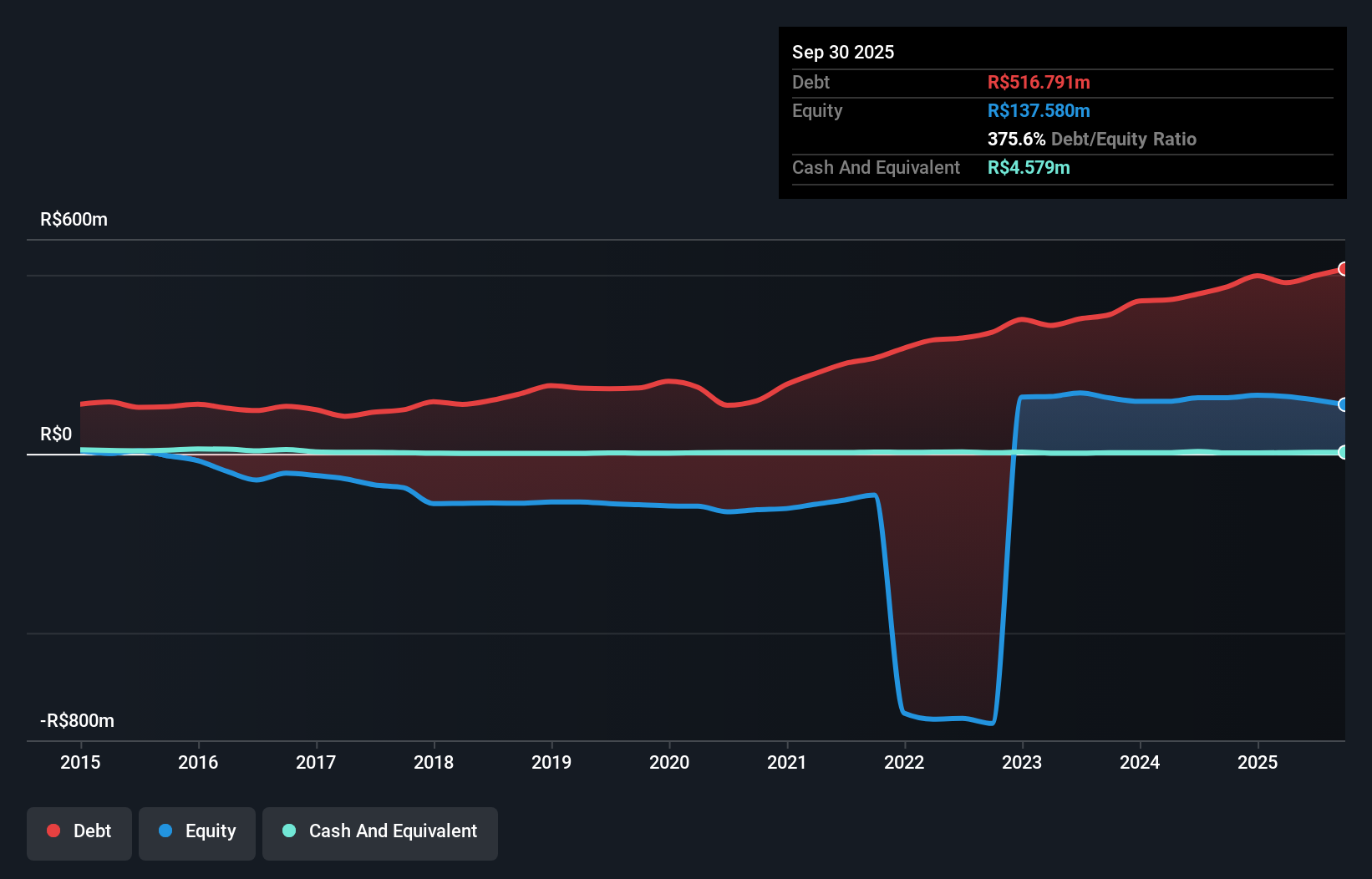
As you can see below, at the end of September 2025, Mundial - Produtos de Consumo had R$516.8m of debt, up from R$466.8m a year ago. Click the image for more detail. And it doesn't have much cash, so its net debt is about the same.
A Look At Mundial - Produtos de Consumo's Liabilities
The latest balance sheet data shows that Mundial - Produtos de Consumo had liabilities of R$768.5m due within a year, and liabilities of R$529.4m falling due after that. On the other hand, it had cash of R$4.58m and R$334.3m worth of receivables due within a year. So its liabilities total R$959.0m more than the combination of its cash and short-term receivables.
The deficiency here weighs heavily on the R$183.4m company itself, as if a child were struggling under the weight of an enormous back-pack full of books, his sports gear, and a trumpet. So we definitely think shareholders need to watch this one closely. At the end of the day, Mundial - Produtos de Consumo would probably need a major re-capitalization if its creditors were to demand repayment.
View our latest analysis for Mundial - Produtos de Consumo
In order to size up a company's debt relative to its earnings, we calculate its net debt divided by its earnings before interest, tax, depreciation, and amortization (EBITDA) and its earnings before interest and tax (EBIT) divided by its interest expense (its interest cover). This way, we consider both the absolute quantum of the debt, as well as the interest rates paid on it.
While we wouldn't worry about Mundial - Produtos de Consumo's net debt to EBITDA ratio of 4.8, we think its super-low interest cover of 0.78 times is a sign of high leverage. So shareholders should probably be aware that interest expenses appear to have really impacted the business lately. Another concern for investors might be that Mundial - Produtos de Consumo's EBIT fell 13% in the last year. If that's the way things keep going handling the debt load will be like delivering hot coffees on a pogo stick. The balance sheet is clearly the area to focus on when you are analysing debt. But you can't view debt in total isolation; since Mundial - Produtos de Consumo will need earnings to service that debt. So if you're keen to discover more about its earnings, it might be worth checking out this graph of its long term earnings trend.
Finally, a business needs free cash flow to pay off debt; accounting profits just don't cut it. So we always check how much of that EBIT is translated into free cash flow. During the last three years, Mundial - Produtos de Consumo burned a lot of cash. While that may be a result of expenditure for growth, it does make the debt far more risky.
Our View
To be frank both Mundial - Produtos de Consumo's conversion of EBIT to free cash flow and its track record of staying on top of its total liabilities make us rather uncomfortable with its debt levels. And furthermore, its net debt to EBITDA also fails to instill confidence. Considering all the factors previously mentioned, we think that Mundial - Produtos de Consumo really is carrying too much debt. To our minds, that means the stock is rather high risk, and probably one to avoid; but to each their own (investing) style. When analysing debt levels, the balance sheet is the obvious place to start. But ultimately, every company can contain risks that exist outside of the balance sheet. For example Mundial - Produtos de Consumo has 3 warning signs (and 1 which is concerning) we think you should know about.
If you're interested in investing in businesses that can grow profits without the burden of debt, then check out this free list of growing businesses that have net cash on the balance sheet.
Have feedback on this article? Concerned about the content? Get in touch with us directly. Alternatively, email editorial-team (at) simplywallst.com.
This article by Simply Wall St is general in nature. We provide commentary based on historical data and analyst forecasts only using an unbiased methodology and our articles are not intended to be financial advice. It does not constitute a recommendation to buy or sell any stock, and does not take account of your objectives, or your financial situation. We aim to bring you long-term focused analysis driven by fundamental data. Note that our analysis may not factor in the latest price-sensitive company announcements or qualitative material. Simply Wall St has no position in any stocks mentioned.