
We Think Shenzhou International Group Holdings (HKG:2313) Can Manage Its Debt With Ease
Legendary fund manager Li Lu (who Charlie Munger backed) once said, 'The biggest investment risk is not the volatility of prices, but whether you will suffer a permanent loss of capital.' It's only natural to consider a company's balance sheet when you examine how risky it is, since debt is often involved when a business collapses. We note that Shenzhou International Group Holdings Limited (HKG:2313) does have debt on its balance sheet. But the more important question is: how much risk is that debt creating?
What Risk Does Debt Bring?
Debt is a tool to help businesses grow, but if a business is incapable of paying off its lenders, then it exists at their mercy. Ultimately, if the company can't fulfill its legal obligations to repay debt, shareholders could walk away with nothing. However, a more common (but still painful) scenario is that it has to raise new equity capital at a low price, thus permanently diluting shareholders. Of course, debt can be an important tool in businesses, particularly capital heavy businesses. When we think about a company's use of debt, we first look at cash and debt together.
What Is Shenzhou International Group Holdings's Debt?
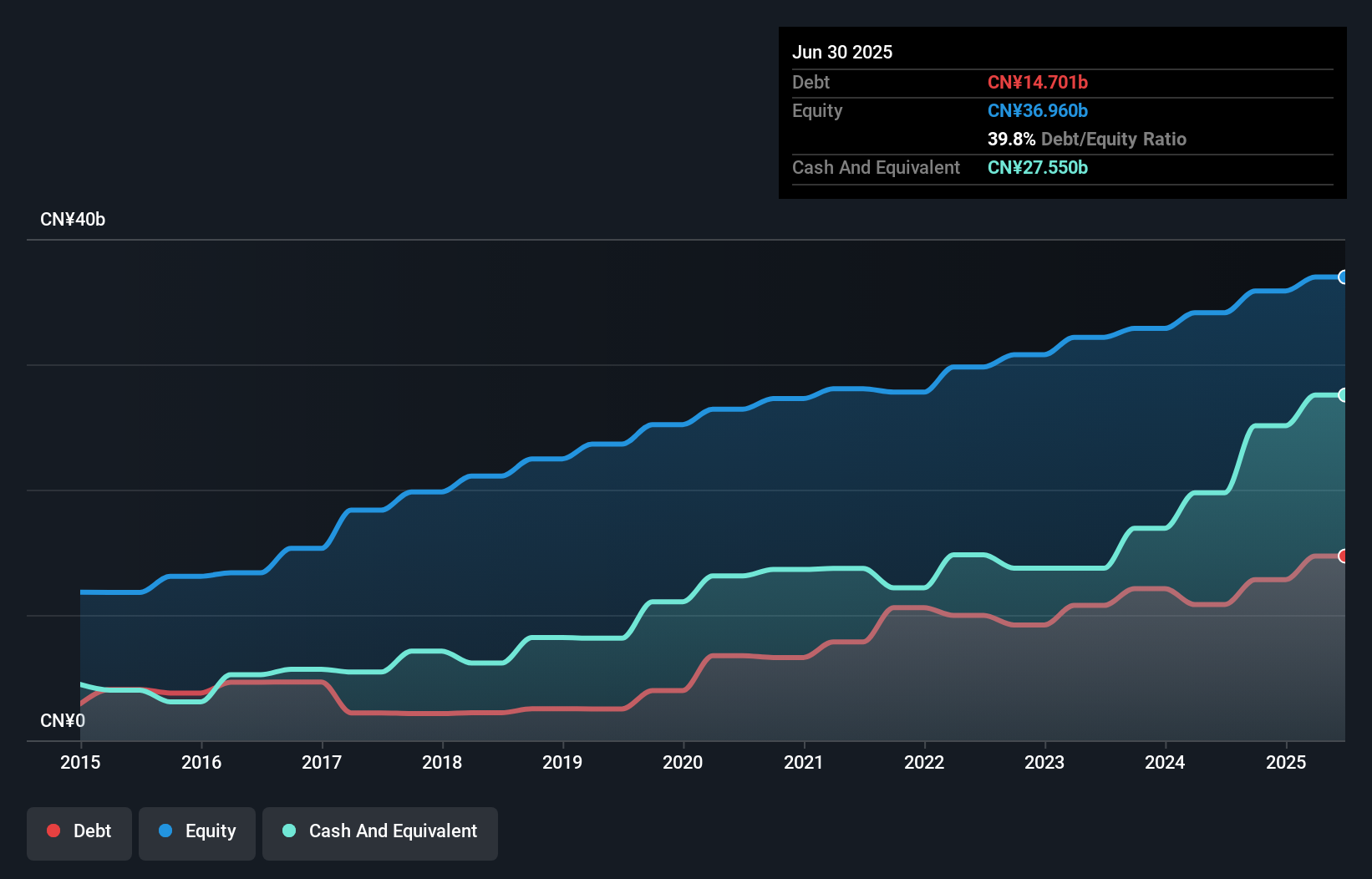
As you can see below, at the end of June 2025, Shenzhou International Group Holdings had CN¥14.7b of debt, up from CN¥10.8b a year ago. Click the image for more detail. However, it does have CN¥27.6b in cash offsetting this, leading to net cash of CN¥12.8b.
A Look At Shenzhou International Group Holdings' Liabilities
The latest balance sheet data shows that Shenzhou International Group Holdings had liabilities of CN¥18.8b due within a year, and liabilities of CN¥415.5m falling due after that. Offsetting these obligations, it had cash of CN¥27.6b as well as receivables valued at CN¥6.80b due within 12 months. So it actually has CN¥15.1b more liquid assets than total liabilities.
This excess liquidity suggests that Shenzhou International Group Holdings is taking a careful approach to debt. Because it has plenty of assets, it is unlikely to have trouble with its lenders. Succinctly put, Shenzhou International Group Holdings boasts net cash, so it's fair to say it does not have a heavy debt load!
See our latest analysis for Shenzhou International Group Holdings
Also good is that Shenzhou International Group Holdings grew its EBIT at 16% over the last year, further increasing its ability to manage debt. The balance sheet is clearly the area to focus on when you are analysing debt. But ultimately the future profitability of the business will decide if Shenzhou International Group Holdings can strengthen its balance sheet over time. So if you want to see what the professionals think, you might find this free report on analyst profit forecasts to be interesting.
Finally, a business needs free cash flow to pay off debt; accounting profits just don't cut it. While Shenzhou International Group Holdings has net cash on its balance sheet, it's still worth taking a look at its ability to convert earnings before interest and tax (EBIT) to free cash flow, to help us understand how quickly it is building (or eroding) that cash balance. Over the last three years, Shenzhou International Group Holdings recorded free cash flow worth a fulsome 90% of its EBIT, which is stronger than we'd usually expect. That positions it well to pay down debt if desirable to do so.
Summing Up
While we empathize with investors who find debt concerning, you should keep in mind that Shenzhou International Group Holdings has net cash of CN¥12.8b, as well as more liquid assets than liabilities. The cherry on top was that in converted 90% of that EBIT to free cash flow, bringing in CN¥3.7b. So we don't think Shenzhou International Group Holdings's use of debt is risky. There's no doubt that we learn most about debt from the balance sheet. But ultimately, every company can contain risks that exist outside of the balance sheet. For instance, we've identified 1 warning sign for Shenzhou International Group Holdings that you should be aware of.
When all is said and done, sometimes its easier to focus on companies that don't even need debt. Readers can access a list of growth stocks with zero net debt 100% free, right now.
Have feedback on this article? Concerned about the content? Get in touch with us directly. Alternatively, email editorial-team (at) simplywallst.com.
This article by Simply Wall St is general in nature. We provide commentary based on historical data and analyst forecasts only using an unbiased methodology and our articles are not intended to be financial advice. It does not constitute a recommendation to buy or sell any stock, and does not take account of your objectives, or your financial situation. We aim to bring you long-term focused analysis driven by fundamental data. Note that our analysis may not factor in the latest price-sensitive company announcements or qualitative material. Simply Wall St has no position in any stocks mentioned.