
Subdued Growth No Barrier To Maxis Berhad's (KLSE:MAXIS) Price
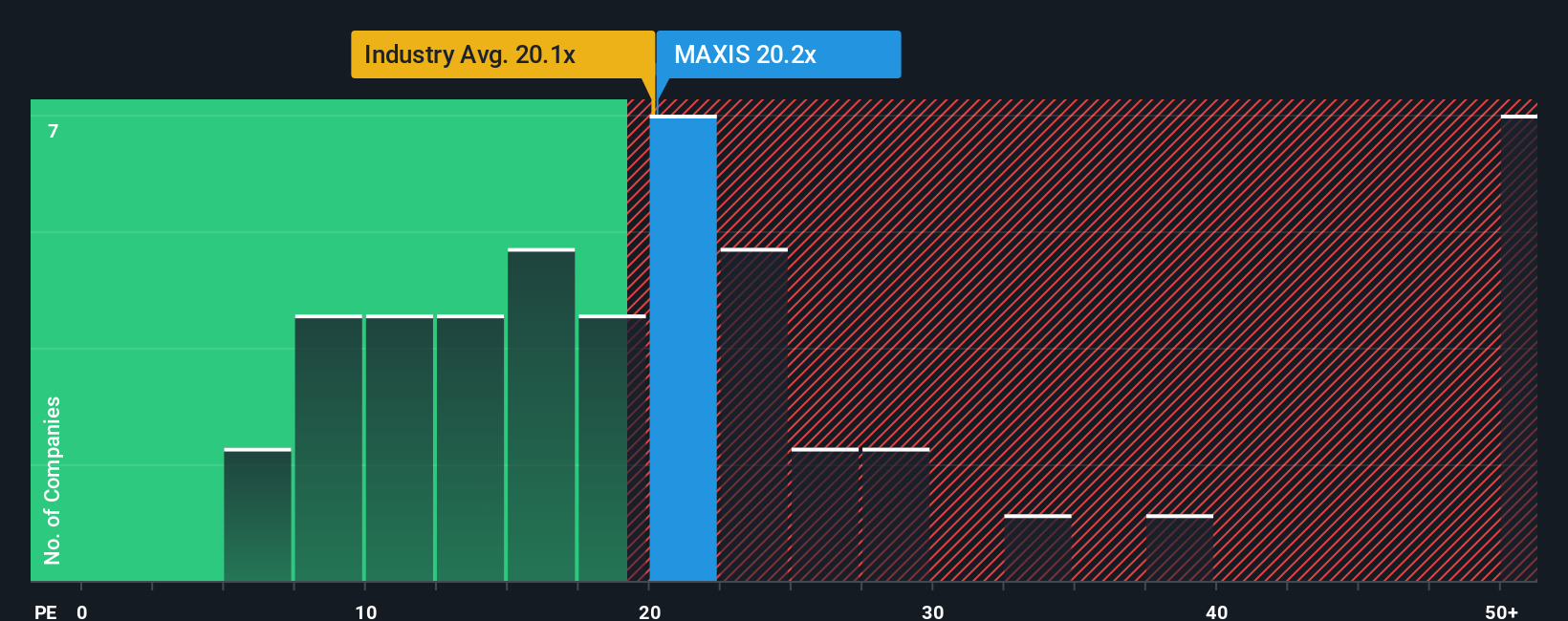
Maxis Berhad's (KLSE:MAXIS) price-to-earnings (or "P/E") ratio of 20.2x might make it look like a sell right now compared to the market in Malaysia, where around half of the companies have P/E ratios below 13x and even P/E's below 8x are quite common. Although, it's not wise to just take the P/E at face value as there may be an explanation why it's as high as it is.
With earnings growth that's superior to most other companies of late, Maxis Berhad has been doing relatively well. The P/E is probably high because investors think this strong earnings performance will continue. You'd really hope so, otherwise you're paying a pretty hefty price for no particular reason.
View our latest analysis for Maxis Berhad
Does Growth Match The High P/E?
In order to justify its P/E ratio, Maxis Berhad would need to produce impressive growth in excess of the market.
Retrospectively, the last year delivered an exceptional 33% gain to the company's bottom line. EPS has also lifted 24% in aggregate from three years ago, mostly thanks to the last 12 months of growth. Therefore, it's fair to say the earnings growth recently has been respectable for the company.
Turning to the outlook, the next three years should generate growth of 6.3% per annum as estimated by the analysts watching the company. That's shaping up to be materially lower than the 18% per annum growth forecast for the broader market.
In light of this, it's alarming that Maxis Berhad's P/E sits above the majority of other companies. It seems most investors are hoping for a turnaround in the company's business prospects, but the analyst cohort is not so confident this will happen. There's a good chance these shareholders are setting themselves up for future disappointment if the P/E falls to levels more in line with the growth outlook.
The Key Takeaway
It's argued the price-to-earnings ratio is an inferior measure of value within certain industries, but it can be a powerful business sentiment indicator.
We've established that Maxis Berhad currently trades on a much higher than expected P/E since its forecast growth is lower than the wider market. When we see a weak earnings outlook with slower than market growth, we suspect the share price is at risk of declining, sending the high P/E lower. This places shareholders' investments at significant risk and potential investors in danger of paying an excessive premium.
Plus, you should also learn about these 2 warning signs we've spotted with Maxis Berhad.
You might be able to find a better investment than Maxis Berhad. If you want a selection of possible candidates, check out this free list of interesting companies that trade on a low P/E (but have proven they can grow earnings).
Have feedback on this article? Concerned about the content? Get in touch with us directly. Alternatively, email editorial-team (at) simplywallst.com.
This article by Simply Wall St is general in nature. We provide commentary based on historical data and analyst forecasts only using an unbiased methodology and our articles are not intended to be financial advice. It does not constitute a recommendation to buy or sell any stock, and does not take account of your objectives, or your financial situation. We aim to bring you long-term focused analysis driven by fundamental data. Note that our analysis may not factor in the latest price-sensitive company announcements or qualitative material. Simply Wall St has no position in any stocks mentioned.