
Does Banco Products (India) (NSE:BANCOINDIA) Have A Healthy Balance Sheet?
The external fund manager backed by Berkshire Hathaway's Charlie Munger, Li Lu, makes no bones about it when he says 'The biggest investment risk is not the volatility of prices, but whether you will suffer a permanent loss of capital.' It's only natural to consider a company's balance sheet when you examine how risky it is, since debt is often involved when a business collapses. We note that Banco Products (India) Limited (NSE:BANCOINDIA) does have debt on its balance sheet. But should shareholders be worried about its use of debt?
What Risk Does Debt Bring?
Generally speaking, debt only becomes a real problem when a company can't easily pay it off, either by raising capital or with its own cash flow. Part and parcel of capitalism is the process of 'creative destruction' where failed businesses are mercilessly liquidated by their bankers. While that is not too common, we often do see indebted companies permanently diluting shareholders because lenders force them to raise capital at a distressed price. Of course, plenty of companies use debt to fund growth, without any negative consequences. The first step when considering a company's debt levels is to consider its cash and debt together.
What Is Banco Products (India)'s Net Debt?
As you can see below, at the end of September 2025, Banco Products (India) had ₹4.91b of debt, up from ₹2.34b a year ago. Click the image for more detail. However, it also had ₹1.88b in cash, and so its net debt is ₹3.03b.
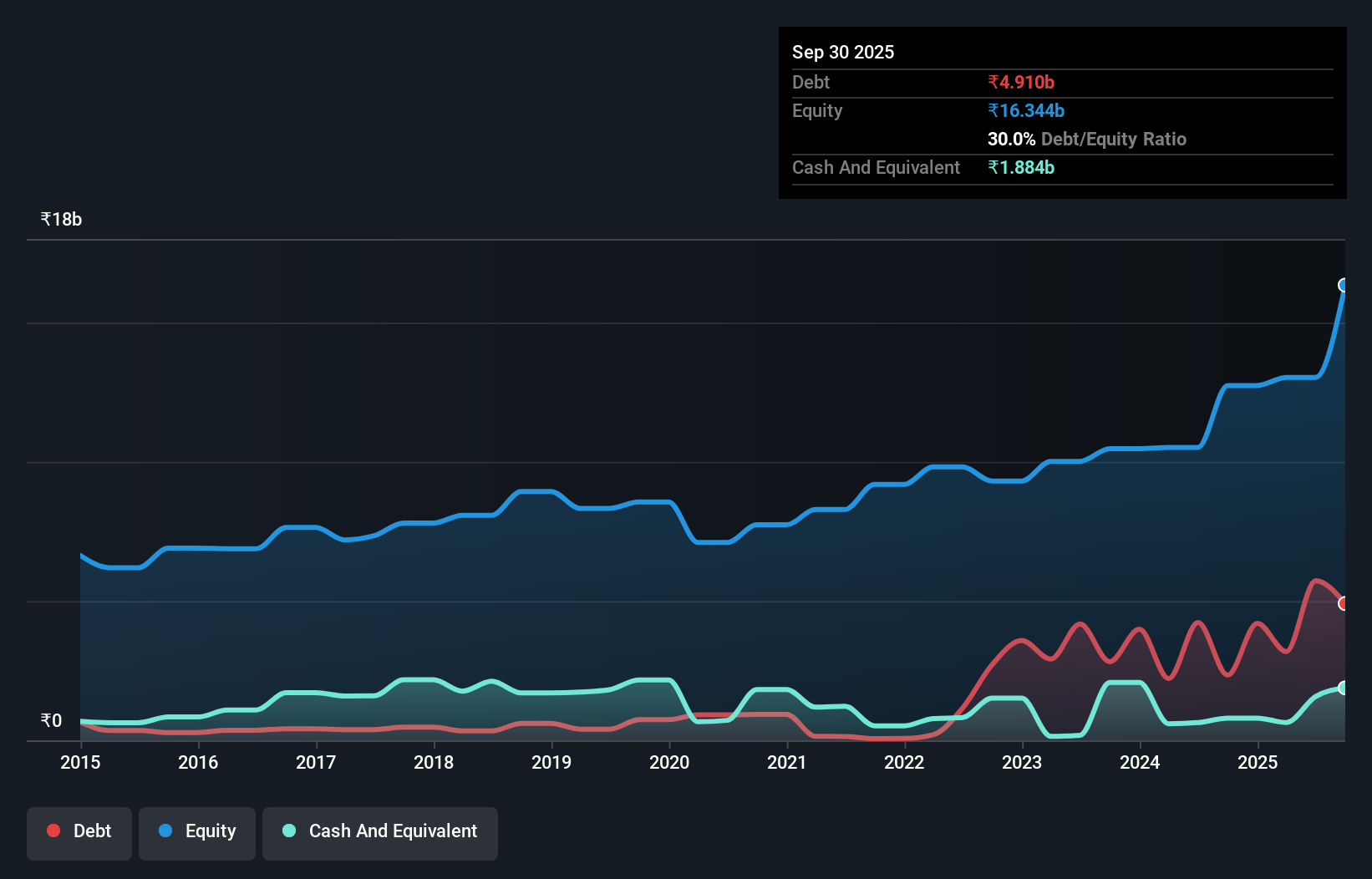
How Strong Is Banco Products (India)'s Balance Sheet?
Zooming in on the latest balance sheet data, we can see that Banco Products (India) had liabilities of ₹10.3b due within 12 months and liabilities of ₹4.18b due beyond that. On the other hand, it had cash of ₹1.88b and ₹7.69b worth of receivables due within a year. So its liabilities total ₹4.86b more than the combination of its cash and short-term receivables.
Since publicly traded Banco Products (India) shares are worth a total of ₹101.6b, it seems unlikely that this level of liabilities would be a major threat. However, we do think it is worth keeping an eye on its balance sheet strength, as it may change over time.
See our latest analysis for Banco Products (India)
We measure a company's debt load relative to its earnings power by looking at its net debt divided by its earnings before interest, tax, depreciation, and amortization (EBITDA) and by calculating how easily its earnings before interest and tax (EBIT) cover its interest expense (interest cover). Thus we consider debt relative to earnings both with and without depreciation and amortization expenses.
Banco Products (India) has a low net debt to EBITDA ratio of only 0.55. And its EBIT covers its interest expense a whopping 22.0 times over. So you could argue it is no more threatened by its debt than an elephant is by a mouse. Fortunately, Banco Products (India) grew its EBIT by 7.6% in the last year, making that debt load look even more manageable. When analysing debt levels, the balance sheet is the obvious place to start. But you can't view debt in total isolation; since Banco Products (India) will need earnings to service that debt. So if you're keen to discover more about its earnings, it might be worth checking out this graph of its long term earnings trend.
But our final consideration is also important, because a company cannot pay debt with paper profits; it needs cold hard cash. So it's worth checking how much of that EBIT is backed by free cash flow. Looking at the most recent three years, Banco Products (India) recorded free cash flow of 29% of its EBIT, which is weaker than we'd expect. That's not great, when it comes to paying down debt.
Our View
Happily, Banco Products (India)'s impressive interest cover implies it has the upper hand on its debt. But truth be told we feel its conversion of EBIT to free cash flow does undermine this impression a bit. Looking at all the aforementioned factors together, it strikes us that Banco Products (India) can handle its debt fairly comfortably. Of course, while this leverage can enhance returns on equity, it does bring more risk, so it's worth keeping an eye on this one. When analysing debt levels, the balance sheet is the obvious place to start. But ultimately, every company can contain risks that exist outside of the balance sheet. For example Banco Products (India) has 3 warning signs (and 2 which are potentially serious) we think you should know about.
At the end of the day, it's often better to focus on companies that are free from net debt. You can access our special list of such companies (all with a track record of profit growth). It's free.
Have feedback on this article? Concerned about the content? Get in touch with us directly. Alternatively, email editorial-team (at) simplywallst.com.
This article by Simply Wall St is general in nature. We provide commentary based on historical data and analyst forecasts only using an unbiased methodology and our articles are not intended to be financial advice. It does not constitute a recommendation to buy or sell any stock, and does not take account of your objectives, or your financial situation. We aim to bring you long-term focused analysis driven by fundamental data. Note that our analysis may not factor in the latest price-sensitive company announcements or qualitative material. Simply Wall St has no position in any stocks mentioned.