
How Expectations for a Higher ROE and Lower Payout Ratio Will Impact Fidelity National Financial (FNF) Investors
- In the past week, Fidelity National Financial drew attention as investors reacted to its 14% return on equity, slightly above the 13% industry average, despite multi-year earnings declines.
- Expectations that the company’s payout ratio could fall to 30% and potentially lift future ROE to 18% are shaping a more optimistic view of its earnings power.
- We’ll now examine how expectations for a higher future ROE may influence Fidelity National Financial’s broader investment narrative and risk profile.
Find companies with promising cash flow potential yet trading below their fair value.
Fidelity National Financial Investment Narrative Recap
To own Fidelity National Financial, you need to believe the company can translate its solid, if not exceptional, ROE into durable earnings in a cyclical, real estate linked business. The recent discussion around a potential shift to a 30% payout ratio and a forecast ROE of about 18% supports the near term earnings catalyst of improved profitability, but does not materially change the biggest risk right now, which remains subdued title transaction volumes if U.S. real estate activity stays soft.
Among recent announcements, the ongoing share repurchase activity, including roughly US$159 million of buybacks in Q2 2025, is most relevant to this ROE focused narrative. By modestly shrinking the share count while earnings recover, these buybacks can enhance per share metrics and complement the expected lift in returns, although they do not offset structural pressures from low volumes or rising costs if those conditions persist.
Yet, investors should be aware that if title order volumes stay weak for longer than expected, then...
Read the full narrative on Fidelity National Financial (it's free!)
Fidelity National Financial’s narrative projects $15.9 billion revenue and $2.1 billion earnings by 2028. This requires 5.3% yearly revenue growth and roughly a $1.0 billion earnings increase from $1.1 billion today.
Uncover how Fidelity National Financial's forecasts yield a $70.25 fair value, a 26% upside to its current price.
Exploring Other Perspectives
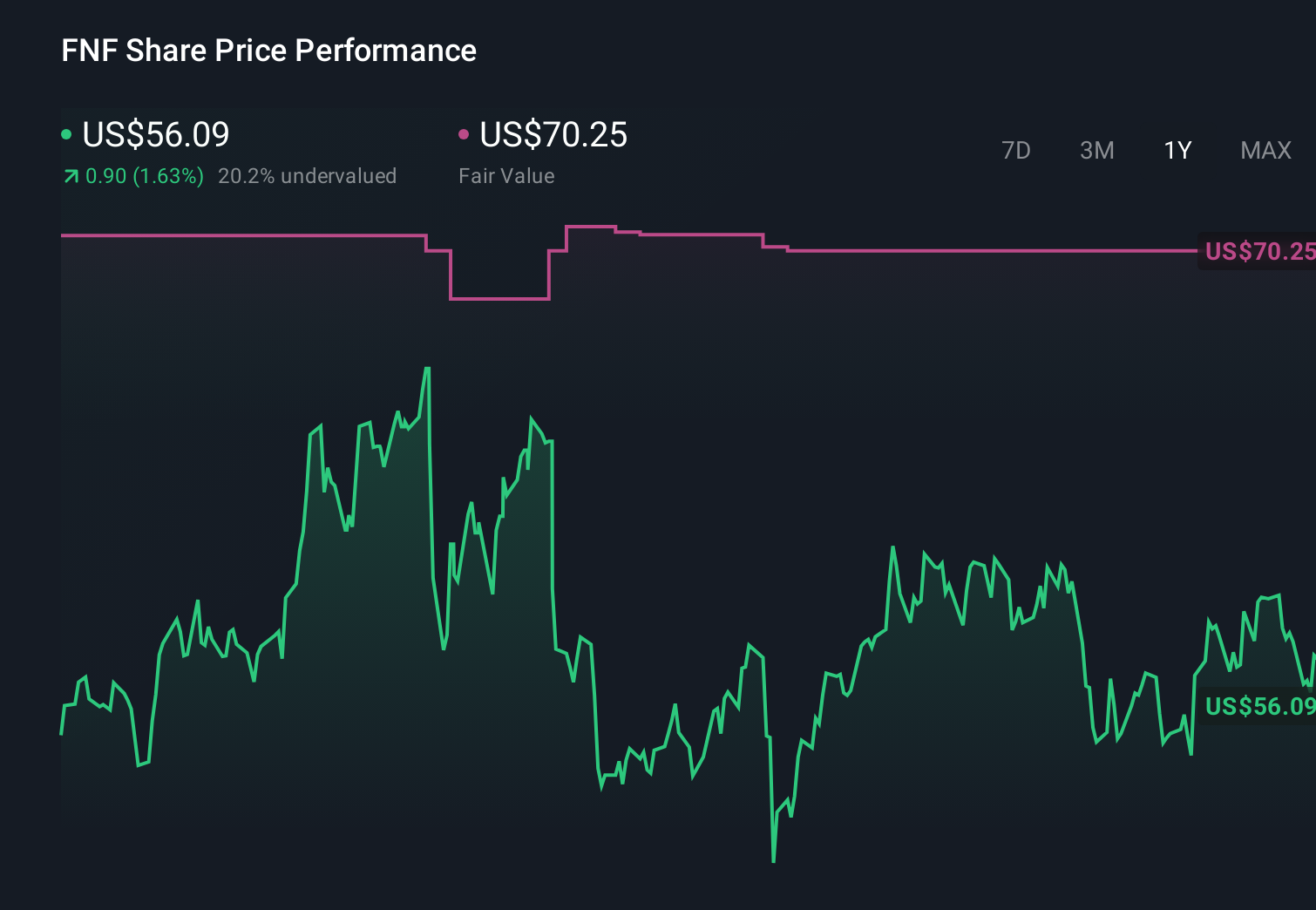
Five fair value estimates from the Simply Wall St Community range widely, from US$35.42 to about US$91.64, underscoring how far apart views on FNF can be. Against this backdrop, the key risk that prolonged weakness in U.S. real estate transaction volumes could cap revenue and earnings reminds you to weigh these differing opinions against the company’s exposure to a still fragile housing market.
Explore 5 other fair value estimates on Fidelity National Financial - why the stock might be worth 37% less than the current price!
Build Your Own Fidelity National Financial Narrative
Disagree with existing narratives? Create your own in under 3 minutes - extraordinary investment returns rarely come from following the herd.
- A great starting point for your Fidelity National Financial research is our analysis highlighting 6 key rewards that could impact your investment decision.
- Our free Fidelity National Financial research report provides a comprehensive fundamental analysis summarized in a single visual - the Snowflake - making it easy to evaluate Fidelity National Financial's overall financial health at a glance.
Looking For Alternative Opportunities?
Right now could be the best entry point. These picks are fresh from our daily scans. Don't delay:
- Rare earth metals are an input to most high-tech devices, military and defence systems and electric vehicles. The global race is on to secure supply of these critical minerals. Beat the pack to uncover the 35 best rare earth metal stocks of the very few that mine this essential strategic resource.
- These 10 companies survived and thrived after COVID and have the right ingredients to survive Trump's tariffs. Discover why before your portfolio feels the trade war pinch.
- Trump's oil boom is here - pipelines are primed to profit. Discover the 22 US stocks riding the wave.
This article by Simply Wall St is general in nature. We provide commentary based on historical data and analyst forecasts only using an unbiased methodology and our articles are not intended to be financial advice. It does not constitute a recommendation to buy or sell any stock, and does not take account of your objectives, or your financial situation. We aim to bring you long-term focused analysis driven by fundamental data. Note that our analysis may not factor in the latest price-sensitive company announcements or qualitative material. Simply Wall St has no position in any stocks mentioned.
Have feedback on this article? Concerned about the content? Get in touch with us directly. Alternatively, email editorial-team@simplywallst.com