
IPO Foresight | From closed scenarios to global coverage, how can Mainline Technology tell the story of “advanced smart driving”?
The advanced smart driving sector of Hong Kong stocks is expected to welcome a “vital force” again.
The Zhitong Finance App learned that according to the Hong Kong Stock Exchange disclosure on December 11, Mainline Technology (Beijing) Co., Ltd. (abbreviation: Mainline Technology) submitted the Hong Kong Stock Exchange main board, and Cathay Pacific Haitong is its sole sponsor. As a pioneer in the domestic L4 autonomous truck field, Mainline Technology is trying to accelerate the large-scale commercialization process through capital market empowerment with its first-mover advantage in closed scenarios and the accumulation of cross-scenario technology.
China's leading autonomous driving solution service provider
According to the prospectus, Mainline Technology was established in Beijing in 2017 and is an L4 autonomous truck and solution provider. The company has built a “car-end-cloud” integrated product ecosystem to form a full-stack solution covering the three core scenarios of logistics hubs, highway logistics, and urban transportation.
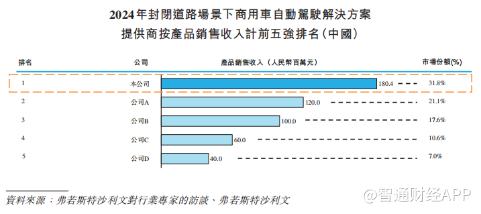
According to Frost & Sullivan data, based on 2024 product sales revenue, Mainline Technology is China's largest L4 autonomous truck and solution provider in the closed road scenario, with a market share of 31.8%, far exceeding 21.1%, which is the second-largest in the industry. As of the last practical date (December 5, 2025), the company has delivered a total of 830 AITruck smart trucks and 349 AIBox smart terminals, and received intended orders for 821 AITruck units and 920 AIBox sets.
In terms of business structure, the company's core product matrix includes three modules: AItruck (smart truck), AIbox (smart terminal), and AIcloud (smart cloud service), which correspond to the three major application scenarios of TrunkPort (logistics hub), TrunkPilot (road logistics), and TrunkCity (urban transportation).
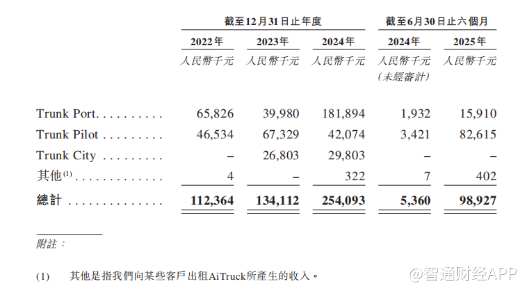
Among them, the logistics hub scenario contributed 182 million yuan in revenue in 2024 (RMB, same below), accounting for 71.6% of total revenue; the first half of 2025 achieved revenue of about 15.9 million yuan, accounting for 16.1% of total revenue. The highway logistics scenario contributed about 42.1 million yuan in revenue in 2024, accounting for 16.6% of total revenue; in the first half of 2025, revenue was about 82.6 million yuan, accounting for 83.5% of total revenue. The urban traffic scenario is in the early stages of commercialization, with cumulative revenue of about 56.6 million yuan in 2023-2024; since ongoing projects have not yet been completed for delivery and final acceptance, no revenue from the urban traffic scene business has been realized for the six months ending 2024 and June 30, 2025.
Profits have not been corrected, and there is a risk that major customers will rely on it
In terms of performance, Mainline Technology is at a stage of development where revenue is growing rapidly but has not yet achieved profit. Financial data shows typical characteristics of technology startups: high revenue growth, high R&D investment, and continuous losses.
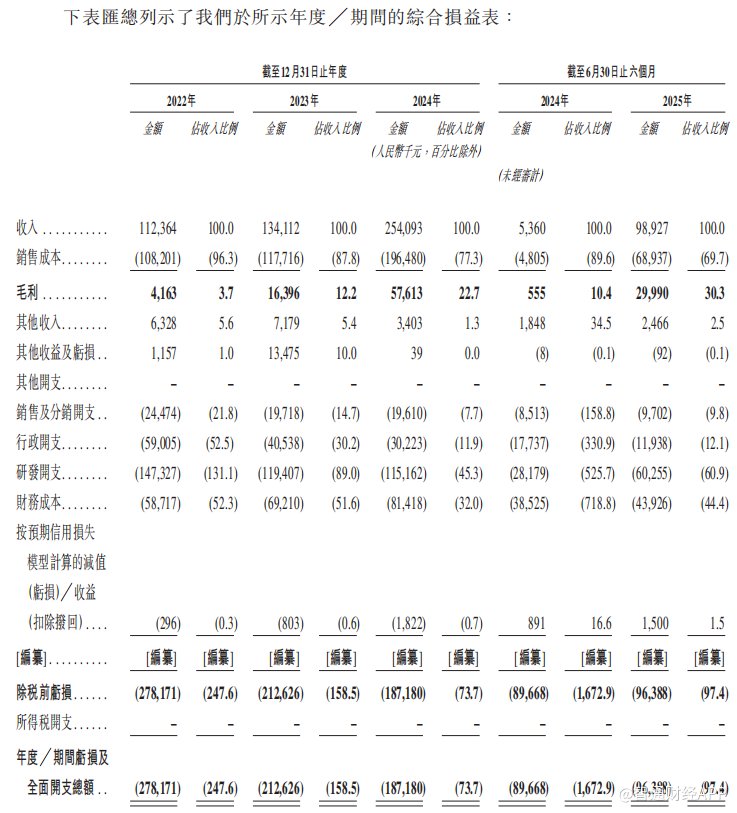
The company's revenue increased from 112 million yuan in 2022 to 254 million yuan in 2024, with a compound annual growth rate of more than 50%; revenue for the first half of 2025 was 98.927 million yuan, a year-on-year increase of more than 1,700%. The growth was mainly driven by the implementation of large-scale projects and product structure optimization in the highway logistics scenario.
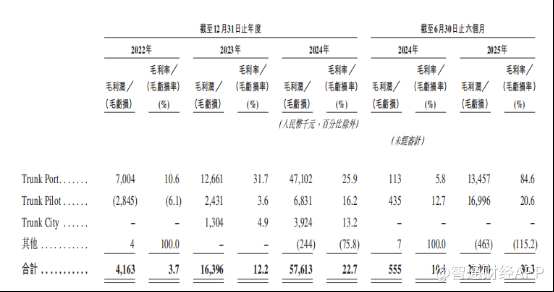
The company's gross margin level increased steadily from 3.7% in 2022 to 22.7% in 2024, reaching 30.3% in the first half of 2025, mainly reflecting the increasing adoption of the company's solutions in logistics hubs, road logistics and urban transportation. By business, the gross margin of the logistics hub scenario was the highest, reaching 25.9% and 84.6% in 2024 and the first half of 2025, respectively; in the same period, the gross margin of the road logistics scenario was 16.2% and 20.6%, respectively.
On the profit side, the company has not escaped from losing money. Net losses for 2022 to 2024 were $278 million, $213 million, and $187 million respectively, and net loss for the first half of 2025 was $96 million. The main causes of the company's losses include continuous investment in R&D resources, large financial expenses mainly composed of interest expenses arising from redemption liabilities related to preferred shares and interest costs related to loans and lease liabilities, and initial commercialization operating expenses exceeding gross profit.
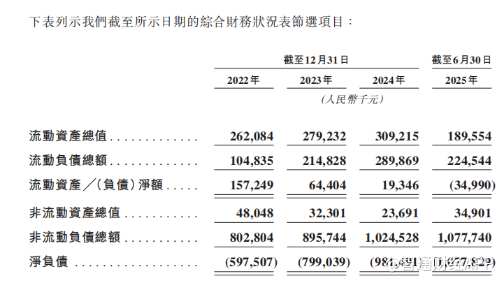
Specifically, total R&D expenditure reached 382 million yuan from 2022 to 2024; R&D expenditure in the first half of 2025 was 60 million yuan, accounting for 60.9% of current revenue. Financial expenses reached 81 million yuan in 2024; 43 million yuan in the first half of 2025, an increase of 14.2% over the previous year. In terms of balance and liability structure, as of June 30, 2025, the company's current assets were about 190 million yuan, non-current assets were about 35 million yuan, total liabilities exceeded 1.3 billion yuan, and net liabilities were about 1,078 billion yuan. However, after the company's listing, the redemption debt will be converted into equity, which is expected to significantly optimize the financial structure.
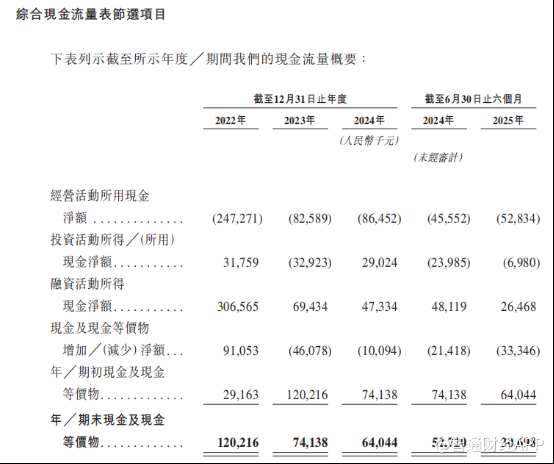
It is worth noting that mainline technology is at risk of a high concentration of customers and suppliers. In 2024, the top five customers accounted for 67.9% of revenue, and the five major suppliers accounted for 54.3% of procurement. The revenue share of the top five customers rose further to 73.7% in the first half of 2025, while the concentration of suppliers reached 69.1%. This centralized pattern may cause the company to be in a passive position in bargaining negotiations, and changes in the business of a single customer or supplier may have a significant impact on the company's operations. In addition, the company's operating cash flow continues to be negative, with a cumulative net outflow of about 416 million yuan from 2022 to 2024, and a net outflow of about 53 million yuan in the first half of 2025. It is highly dependent on external financing. If financing channels are tightened in the future, it may affect the pace of business expansion.
Opportunities and challenges in the 100 billion market space
The commercial vehicle autonomous driving industry, where Mainline Technology is located, is entering a golden period of development. Policy support, technological breakthroughs and market demand have formed a triple resonance, providing the company with broad room for growth and is expected to help the company improve its financial situation.
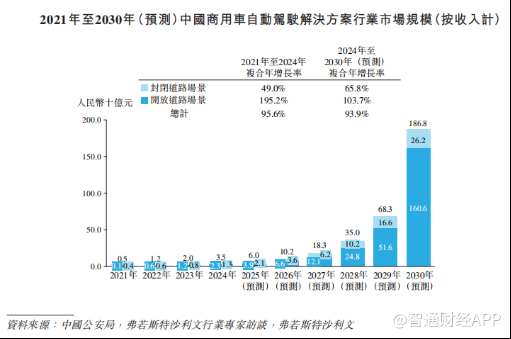
Judging from the scale of the industry, the commercial vehicle autonomous driving solutions market is showing an explosive growth trend. According to Frost & Sullivan data, the market size of China's closed road scenario will grow from 400 million yuan in 2021 to 1.3 billion yuan in 2024, with a compound annual growth rate of 49%, and is expected to reach 26.2 billion yuan in 2030, with a compound annual growth rate of 65.8%; the open road scenario is growing more rapidly, from 100 million yuan in 2021 to 2.3 billion yuan in 2024, with a compound annual growth rate of 195.2%. It is expected to rise to 160.6 billion yuan in 2030, with a compound annual growth rate of 103.7%.
As a key link connecting production and consumption, autonomous driving technology for commercial vehicles can effectively solve pain points such as shortage of drivers, high operating costs, and frequent safety accidents in the logistics industry, and market demand continues to be strong. The policy side provided strong support for the development of the industry. At the national level, policies such as the “14th Five-Year Plan” for the Development of Modern Integrated Transportation Systems and the “Smart Vehicle Innovation and Development Strategy” clearly encourage the development of autonomous driving technology. At the local level, Beijing, Shandong, Jiangsu and other places have opened autonomous driving test sections, and the Beijing-Tianjin-Hebei region has issued technical standards for vehicle-road collaborative infrastructure, laying the foundation for large-scale deployment. In 2025, the Ministry of Industry and Information Technology, together with seven ministries and commissions, jointly issued the “Work Plan for Steady Growth of the Automobile Industry (2025-2026)”, which clearly states that it is necessary to promote the admission of intelligent connected vehicles and pilot road operation, conditionally approve L3 vehicle production permits, and speed up the improvement of laws and regulations related to road traffic safety and insurance. These policies mark a new stage in the development of advanced autonomous driving technology — from early technical verification and pilot testing to mass production, on-road operation, and commercial application.
Technological iteration and infrastructure improvements further accelerate the implementation of advanced autonomous driving. The integrated vehicle-road-cloud collaborative architecture is becoming more mature. Technologies such as 5G communication, high-precision positioning, and edge computing are deeply integrated with autonomous driving algorithms, which has significantly improved system reliability; the localization rate of core hardware such as lidar and domain controllers has increased, driving costs to continue to decline and creating conditions for large-scale applications. At the same time, the gradual improvement of the industry standard system will also promote the development of industry standards.
However, the development of the industry still faces multiple challenges. At the technical level, complex traffic environments in open road scenarios place higher demands on algorithm robustness, and it will still take time to verify the safety of fully unmanned operations. At the commercialization level, the economic benefits of some scenarios have not been fully verified, and there are differences in customer acceptance of the new technology. At the regulatory level, laws and regulations such as the division of responsibilities for autonomous driving and data security are still being improved. At the competitive level, traditional car companies and technology companies are entering the market one after another, and market competition is becoming more and more intense. For mainline technology, how to maintain its leading edge in technology, expand its customer base, and optimize its financial structure will be the key to seizing industry opportunities.
Overall, as a pioneer in the field of L4 autonomous vehicles, Mainline Technology has strong competitiveness in the industry with mature commercialization experience in closed scenarios, full-stack technology research and development capabilities, and rapidly growing revenue scale. However, at the same time, risks such as continued losses, concentration of customers and suppliers, and dependence on external financing cannot be ignored. As the Hong Kong stock listing process progresses, the company is expected to receive financial support to accelerate technology iteration and market expansion, and seize a larger share in the vast field of autonomous commercial vehicle driving. Investors should continue to pay attention to the results of their commercialization, improvements in financial conditions, and changes in the competitive landscape of the industry, and rationally evaluate the value of their investments.