
Betting on the third pole of global computing power: Nvidia, xAI, and Lenovo Saudi investments have entered a period of harvest
In the Saudi Special Integrated Logistics Zone (SILZ), just a 15-minute drive from Riyadh International Airport, Lenovo Group's new plant is being intensively prepared for official operation. Ten months ago, this was still a desert Gobi, and now it is one of the earliest completed projects of Saudi AI strategy. In the future, the 200,000 square meter factory is expected to produce millions of “Saudi made” laptops, desktops, and servers per year.
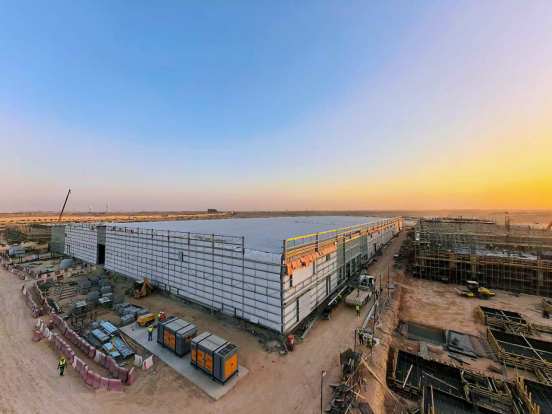
Lenovo's Saudi plant under construction
Saudi Arabia, an empire that has dominated the global energy market for decades with its oil wealth, is mobilizing all of its sovereign capital to make a big gamble about the country's future: betting on high-performance computing and cutting-edge technology. This plan, codenamed “Vision 2030,” far exceeds industrial upgrading in the traditional sense. It is a strategic deployment built by Riyadh to hedge against the risk of long-term changes in the energy structure and ensure the country's economic resilience — the plan is to position Saudi Arabia as a global computing power hub, making it the third largest computing power center in the world after the US and China.
To describe Saudi Arabia's economic transformation in a fashionable way is a strategic shift from “carbon-based” to “silicon-based.”
This reform has attracted global tech giants to the Middle East — companies such as Nvidia, AMD, Amazon AWS, xAI, and Microsoft have all reached a series of cooperation agreements with Saudi Arabia, including chip supply, data center construction, and Arabic AI model development.
Crown Prince heads up to build an “AI powerhouse”
The Saudi Public Investment Fund (PIF) is the core driver of this AI transformation, and it also plays the role of both a funder and a super customer.
PIF built a “manufacturing+computing power” two-wheel drive system through two major subsidiaries of Alat and Humain: Alat Enet is positioned as an “intelligent technology industry group” focusing on computing power hardware manufacturing; Humain is responsible for AI technology and computing power infrastructure coordination.
Alat Ennett is personally chaired by the Crown Prince himself. The core of its strategy is to enhance Saudi Arabia's manufacturing capabilities in nine major business segments, including semiconductors, smart devices, smart buildings, smart healthcare, and next-generation and high-performance computing infrastructure. The $2 billion cooperation reached with Lenovo Group in May 2024 is a typical implementation of this strategy — the two sides will build a server production base in Riyadh. The production capacity is expected to be put into operation in 2026, which is just right in line with the delivery pace of Saudi Arabia's first batch of hyperscale data centers. At the same time, Alat promised to train 10,000 local professionals to reserve human capital for this technological transformation.
Unlike Alat, which focuses on hardware manufacturing, Humain is a company under PIF that focuses on providing global full-stack technology solutions, and is a key player in Saudi Arabia's promotion of large-scale computing power infrastructure. Humain acts as a bridge for cooperation with international tech giants, such as its collaboration with Amazon Cloud Technology (AWS) and NVIDIA (NVIDIA), which aims to turn Saudi Arabia into an international computing power, with the goal of co-deploying up to 1GW of AI infrastructure with partners by 2030.
This dual-core structure (Alat dominates manufacturing, Humain dominates the application of computing power) ensures the integrity of Saudi AI strategy: hardware production and computing power applications are simultaneously promoted under national control, making the technology stack fully controllable from the underlying hardware to the upper model.
Global tech giants pour into the Middle East
Under the leadership of PIF, global tech giants poured into Saudi Arabia with large-scale cheap capital, abundant energy reserves, and a broad market with strategic value.
Nvidia's collaboration with Saudi Arabia is the most notable. Humain plans to build an AI factory within the next five years, using hundreds of thousands of Nvidia's most advanced GPUs to build an AI factory. The project is expected to have a total capacity of up to 500MW, and the first phase will deploy a supercomputer composed of 18,000 GB200 Grace Blackwell chips.
In order to diversify the dependency on a single chip supplier, Saudi Arabia has adopted a diversified procurement strategy. Humain has partnered with Nvidia's competitor AMD and networking giant Cisco to jointly deploy up to 1GW of AI infrastructure by 2030. This strategy shows that Saudi Arabia is seeking supply chain flexibility in key technologies to avoid being completely locked in by any American giant.
In addition to chips, Saudi Arabia is also seeking top AI models. Elon Musk's xAI selected Riyadh as its first major computing center outside the US and collaborated with Humain to build a 500+ MW facility. The partnership will not only build data centers; the two sides will also deploy XAI's Grok model across Saudi Arabia and integrate it into Humain's proxy platform.
Amazon AWS collaborates more extensively with Saudi Humain. The two sides will not only set up a data center facility called AI Zone in Riyadh, deploy Nvidia GB300 superchips and Amazon's self-developed Trainium series chips, but also promise to accelerate the application of AI in the public and private sectors, develop advanced large-scale Arabic language models, and provide a unified AI agent market for the government. AWS plans to invest more than 5 billion US dollars in Saudi Arabia to build the world's first “AI special zone” to provide dedicated high-performance AI infrastructure.
Meanwhile, hardware giant Lenovo, with the support of Alat's $2 billion interest-free convertible bonds, has established clean energy-driven manufacturing centers and regional headquarters in Saudi Arabia, focusing on localized production of key equipment such as servers and PCs. Alibaba and Huawei have also participated in smart city construction and Arabic-language technology development through a cooperation agreement with the Saudi Data and Artificial Intelligence Authority.
These deals are not only commercial partnerships, but also collective strategic endorsements of Saudi Arabia's national strategy by global tech giants. At the same time, this multi-party cooperation situation ensures that Saudi Arabia has a wide range of options for acquiring AI capabilities and has promoted market competition.
Lenovo in the Saudi AI Strategy Puzzle
After the influx of giants, Saudi Arabia's AI strategy puzzle also gradually became clear: upstream computing power (chips), midstream models (algorithms), and downstream systems integration and infrastructure delivery.
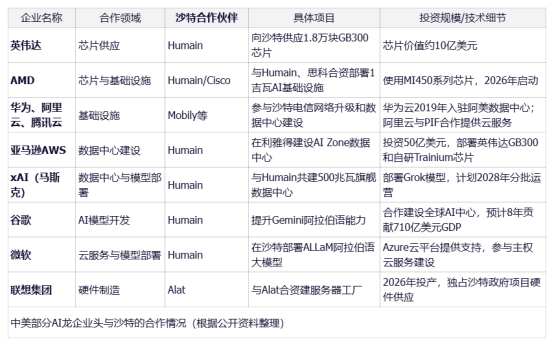
Nvidia and AMD provide the “brain,” xAI, Google, etc. provide the “nervous system,” while Lenovo plays an indispensable role as a “bone and muscle” at the supply chain and system implementation level.
As a joint venture partner of Alat, a subsidiary of PiF, Lenovo has built a manufacturing base for servers, PCs and other equipment in Riyadh, and has set up headquarters in the Middle East and Africa. It is scheduled to be put into operation in 2026, just in line with the delivery time of the first batch of data centers planned by Humain. However, Lenovo's special status stems from Saudi policy stipulating that government projects must purchase locally manufactured hardware. After the Lenovo Riyadh factory is put into operation in 2026, it will become the only enterprise in the Middle East with large-scale server and terminal production capabilities, ensuring that key hardware — AI servers and PCs — can be “made in Saudi Arabia.” At the same time, Lenovo is not only an important partner of Nvidia, AMD, and Microsoft, but also holds the trusted status of “Made in Saudi Arabia” as an Alat joint venture. This dual status makes it a key bridge between high-end chips/models in the US and the implementation of local manufacturing in Saudi Arabia.
For Lenovo itself, partnering with Alat is an important step in its globalization strategy and an effective way to hedge against supply chain risks. The Riyadh factory can further expand Lenovo's global layout, enhance the resilience of the global supply chain, and diversify the production layout regionally, diversifying the production layout, and diversifying geopolitical and transportation risks on the basis of the existing more than 30 locations around the world.
Additionally, Alat provided Lenovo with a $2 billion three-year interest-free convertible bond. From a financial perspective, this structure is equivalent to Saudi Arabia providing Lenovo with pure capital subsidies, saving the company about $100 million in interest expenses every year. For tech giants that require significant capital investment, this is a financial optimization solution that is hard to refuse. At the same time, PIF's strategic investment also acts as a “general key to market entry” and a passport for Lenovo to explore markets with huge growth potential in the Middle East and Africa (MEA). PIF and its subsidiaries are shareholders of many large Saudi state-owned enterprises. By cooperating with PIF, tech giants can reach and lock in contracts with the Saudi government and large customers more quickly and effectively, providing a low-risk path into the entire Saudi economy.
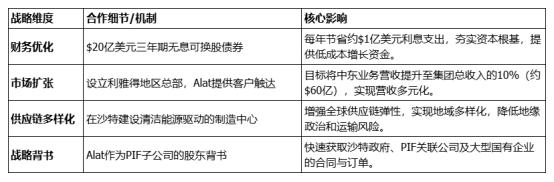
Lenovo's value to the Saudi and Middle Eastern markets is not about hardware sales and supply chains. Lenovo's “AI Solution Service” is solving the actual implementation problems faced by emerging AI markets such as Saudi Arabia. For Saudi companies and government agencies, there is a huge gap between owning Nvidia chips and actually deploying AI applications that generate economic value. Lenovo provides a full suite of solution services, covering AI readiness assessments, infrastructure deployment, and implementation of actual industry applications, to help customers overcome infrastructure and implementation challenges. This end-to-end capability makes Lenovo a reliable long-term partner in the eyes of PIF and local businesses.
Yang Yuanqing, Chairman and CEO of Lenovo Group, clearly stated that through this strategic cooperation, Lenovo aims to increase the share of the Middle East business in the Group's total revenue from about 2% (about 1.25 billion US dollars) to close to 10% (about 6 billion US dollars). This goal highlights the importance of the Middle East market for diversifying the revenue growth of tech giants.
The huge potential of the Middle East AI market
Saudi Arabia is not only the core of the Middle East AI market; it is more like a booster and anchor for the digital transformation and geo-economic repositioning of the entire region.
For global tech giants such as Lenovo, Amazon, Google, and Nvidia, their influx into Saudi Arabia is not just focused on the Saudi domestic market, but rather sees it as an irreplaceable regional “computing power export hub” and a strategic gateway to the entire Middle East and North Africa (MENA). At the same time, it is also a testing ground for future growth, geo-strategic position, and new digital governance.
According to PricewaterhouseCoopers, the total economic impact of artificial intelligence on the Middle East and North Africa (MENA) region is expected to reach $320 billion by 2030. Among them, Saudi Arabia will reap the greatest benefits on an absolute scale, and AI is expected to account for 12.4% of Saudi Arabia's GDP in 2030. Saudi rival the United Arab Emirates (UAE) has a higher relative influence and is expected to account for nearly 14% of its 2030 GDP. Additionally, in other Gulf Cooperation Council (GCC) countries, including Bahrain, Kuwait, Oman, and Qatar, AI is also expected to contribute $45.9 billion (8.2% of their combined GDP).
Meanwhile, spending on AI technology across the Middle East, Turkey, and Africa (MEA) region is growing at an alarming rate. Information technology spending in the Middle East and North Africa (MENA) region (MENA) is expected to reach $169 billion in 2026, up 8.9% from 2025, according to the latest forecast from international consulting firm Gartner. Obviously, Saudi Arabia, the United Arab Emirates, etc. are transforming from traditional energy exporters to global AI computing power exporters.
As a result, Lenovo Group's ambitious goal of increasing revenue in the Middle East to 6 billion US dollars reflects the strategic desire of technology giants for emerging markets in the context of the gradual saturation of traditional global markets. Strong growth in the Middle East and Africa will provide significant revenue growth and profit opportunities for all business groups.
Furthermore, PIF built an entire industry chain layout covering “computing power infrastructure - AI model - industry application” through two major platforms, Humain and Alat, which also enabled global technology giants to form a new cluster effect here. For Chinese companies represented by Lenovo, it is an important opportunity for Chinese companies represented by Lenovo to integrate more quickly into the global AI market.
For Saudi Arabia, these collaborations are the key to breaking away from the “oil economy” path and achieving the “Vision 2030.” The Middle East no longer only dominates the global energy market; it is rapidly developing into a key strategic highland for global computing resources, supply chain resilience, and digital sovereignty games using its financial advantages and geographical location.