
Obayashi (TSE:1802) Has Announced A Dividend Of ¥41.00
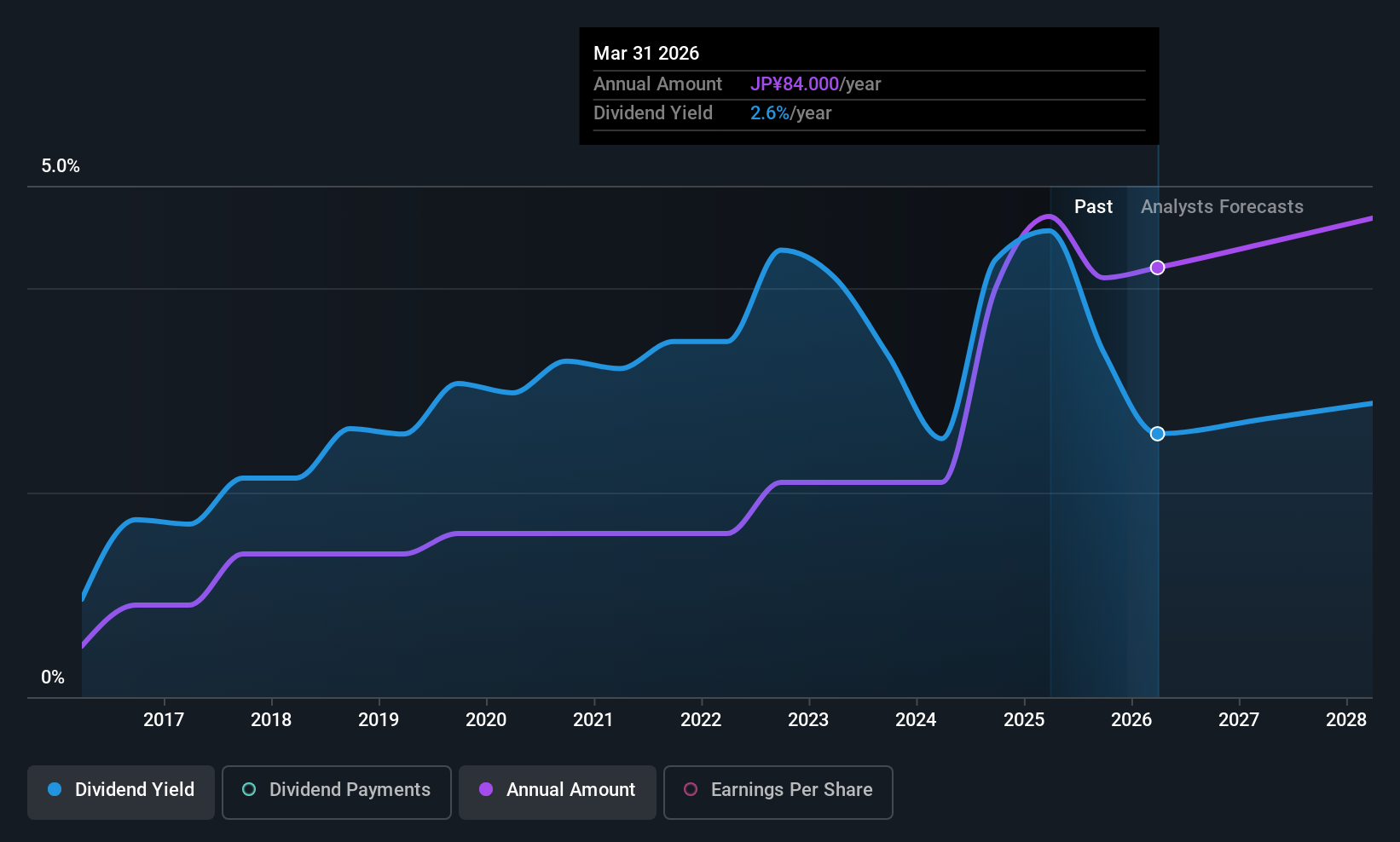
Obayashi Corporation's (TSE:1802) investors are due to receive a payment of ¥41.00 per share on 29th of June. This means the dividend yield will be fairly typical at 2.5%.
While the dividend yield is important for income investors, it is also important to consider any large share price moves, as this will generally outweigh any gains from distributions. Investors will be pleased to see that Obayashi's stock price has increased by 32% in the last 3 months, which is good for shareholders and can also explain a decrease in the dividend yield.
Obayashi's Future Dividend Projections Appear Well Covered By Earnings
We like to see a healthy dividend yield, but that is only helpful to us if the payment can continue. However, Obayashi's earnings easily cover the dividend. This means that most of what the business earns is being used to help it grow.
Looking forward, earnings per share is forecast to rise by 1.1% over the next year. Assuming the dividend continues along recent trends, we think the payout ratio could be 38% by next year, which is in a pretty sustainable range.
Check out our latest analysis for Obayashi
Dividend Volatility
The company's dividend history has been marked by instability, with at least one cut in the last 10 years. Since 2015, the dividend has gone from ¥8.00 total annually to ¥82.00. This means that it has been growing its distributions at 26% per annum over that time. It is great to see strong growth in the dividend payments, but cuts are concerning as it may indicate the payout policy is too ambitious.
The Dividend Looks Likely To Grow
With a relatively unstable dividend, it's even more important to evaluate if earnings per share is growing, which could point to a growing dividend in the future. Obayashi has seen EPS rising for the last five years, at 11% per annum. Growth in EPS bodes well for the dividend, as does the low payout ratio that the company is currently reporting.
Obayashi Looks Like A Great Dividend Stock
Overall, we like to see the dividend staying consistent, and we think Obayashi might even raise payments in the future. Distributions are quite easily covered by earnings, which are also being converted to cash flows. Taking this all into consideration, this looks like it could be a good dividend opportunity.
Companies possessing a stable dividend policy will likely enjoy greater investor interest than those suffering from a more inconsistent approach. Still, investors need to consider a host of other factors, apart from dividend payments, when analysing a company. To that end, Obayashi has 3 warning signs (and 1 which can't be ignored) we think you should know about. If you are a dividend investor, you might also want to look at our curated list of high yield dividend stocks.
Have feedback on this article? Concerned about the content? Get in touch with us directly. Alternatively, email editorial-team (at) simplywallst.com.
This article by Simply Wall St is general in nature. We provide commentary based on historical data and analyst forecasts only using an unbiased methodology and our articles are not intended to be financial advice. It does not constitute a recommendation to buy or sell any stock, and does not take account of your objectives, or your financial situation. We aim to bring you long-term focused analysis driven by fundamental data. Note that our analysis may not factor in the latest price-sensitive company announcements or qualitative material. Simply Wall St has no position in any stocks mentioned.