
Why Dickson Concepts (International)'s (HKG:113) Shaky Earnings Are Just The Beginning Of Its Problems
The market shrugged off Dickson Concepts (International) Limited's (HKG:113) weak earnings report last week. We looked at the details, and we think that investors may be responding to some encouraging factors.
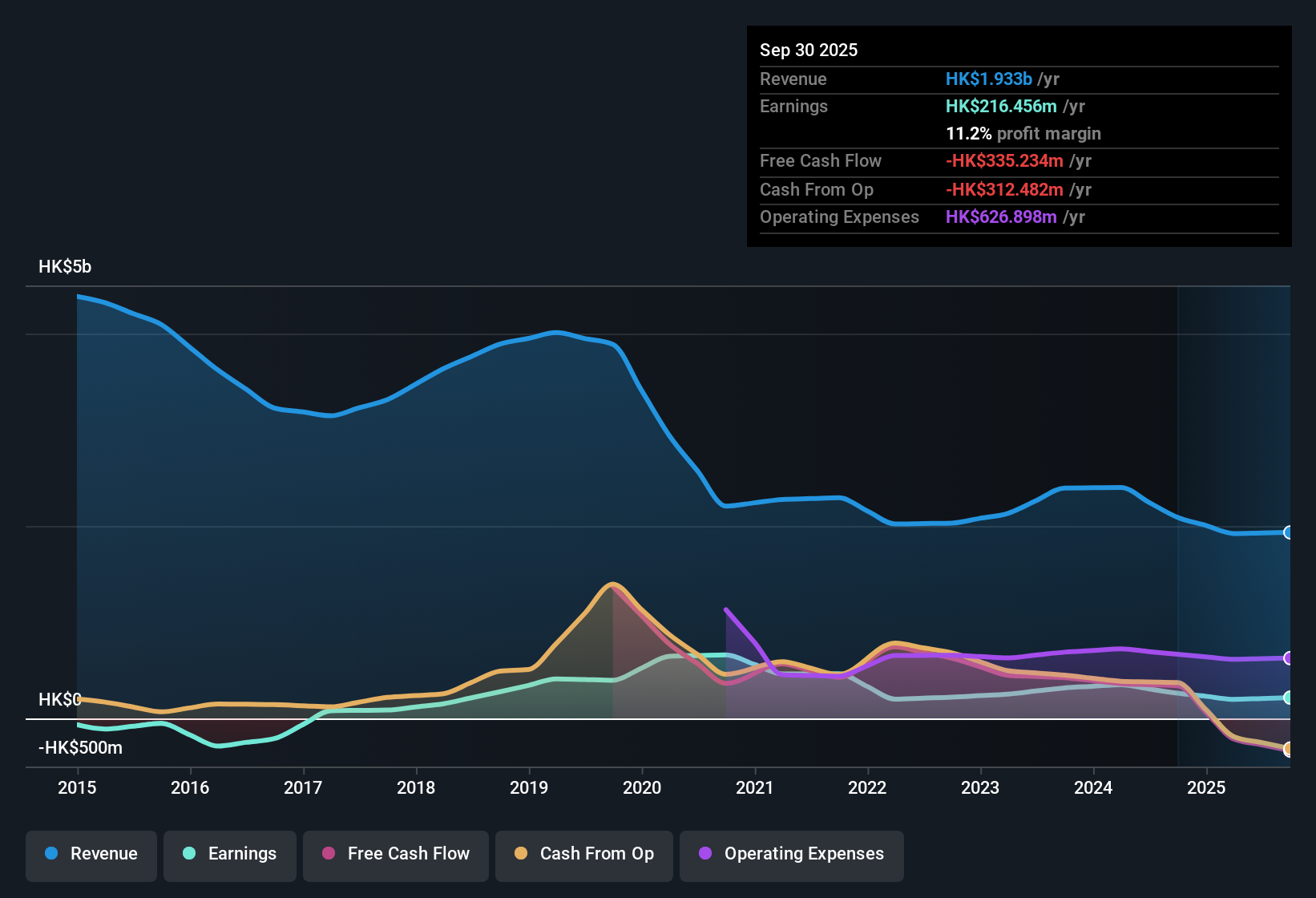
Examining Cashflow Against Dickson Concepts (International)'s Earnings
In high finance, the key ratio used to measure how well a company converts reported profits into free cash flow (FCF) is the accrual ratio (from cashflow). The accrual ratio subtracts the FCF from the profit for a given period, and divides the result by the average operating assets of the company over that time. This ratio tells us how much of a company's profit is not backed by free cashflow.
As a result, a negative accrual ratio is a positive for the company, and a positive accrual ratio is a negative. While having an accrual ratio above zero is of little concern, we do think it's worth noting when a company has a relatively high accrual ratio. To quote a 2014 paper by Lewellen and Resutek, "firms with higher accruals tend to be less profitable in the future".
For the year to September 2025, Dickson Concepts (International) had an accrual ratio of 3.08. As a general rule, that bodes poorly for future profitability. To wit, the company did not generate one whit of free cashflow in that time. Even though it reported a profit of HK$216.5m, a look at free cash flow indicates it actually burnt through HK$335m in the last year. It's worth noting that Dickson Concepts (International) generated positive FCF of HK$339m a year ago, so at least they've done it in the past. Having said that, there is more to the story. We can see that unusual items have impacted its statutory profit, and therefore the accrual ratio. The good news for shareholders is that Dickson Concepts (International)'s accrual ratio was much better last year, so this year's poor reading might simply be a case of a short term mismatch between profit and FCF. Shareholders should look for improved cashflow relative to profit in the current year, if that is indeed the case.
Check out our latest analysis for Dickson Concepts (International)
Note: we always recommend investors check balance sheet strength. Click here to be taken to our balance sheet analysis of Dickson Concepts (International).
The Impact Of Unusual Items On Profit
Unfortunately (in the short term) Dickson Concepts (International) saw its profit reduced by unusual items worth HK$28m. In the case where this was a non-cash charge it would have made it easier to have high cash conversion, so it's surprising that the accrual ratio tells a different story. While deductions due to unusual items are disappointing in the first instance, there is a silver lining. When we analysed the vast majority of listed companies worldwide, we found that significant unusual items are often not repeated. And, after all, that's exactly what the accounting terminology implies. If Dickson Concepts (International) doesn't see those unusual expenses repeat, then all else being equal we'd expect its profit to increase over the coming year.
Our Take On Dickson Concepts (International)'s Profit Performance
In conclusion, Dickson Concepts (International)'s accrual ratio suggests that its statutory earnings are not backed by cash flow, even though unusual items weighed on profit. Having considered these factors, we don't think Dickson Concepts (International)'s statutory profits give an overly harsh view of the business. If you want to do dive deeper into Dickson Concepts (International), you'd also look into what risks it is currently facing. To help with this, we've discovered 3 warning signs (2 make us uncomfortable!) that you ought to be aware of before buying any shares in Dickson Concepts (International).
Our examination of Dickson Concepts (International) has focussed on certain factors that can make its earnings look better than they are. But there is always more to discover if you are capable of focussing your mind on minutiae. Some people consider a high return on equity to be a good sign of a quality business. So you may wish to see this free collection of companies boasting high return on equity, or this list of stocks with high insider ownership.
Have feedback on this article? Concerned about the content? Get in touch with us directly. Alternatively, email editorial-team (at) simplywallst.com.
This article by Simply Wall St is general in nature. We provide commentary based on historical data and analyst forecasts only using an unbiased methodology and our articles are not intended to be financial advice. It does not constitute a recommendation to buy or sell any stock, and does not take account of your objectives, or your financial situation. We aim to bring you long-term focused analysis driven by fundamental data. Note that our analysis may not factor in the latest price-sensitive company announcements or qualitative material. Simply Wall St has no position in any stocks mentioned.