
AI campus battle escalates: OpenAI seizes one million users at “wholesale prices”, how can Microsoft (MSFT.US) and Google (GOOGL.US) break the game?
The Zhitong Finance App notes that according to the purchase order, OpenAI has sold more than 700,000 ChatGPT licenses to around 35 public universities for use by students and staff. In contrast, Microsoft (MSFT.US), which usually bundles Copilot Assistant with existing software, is slowly gaining popularity of its AI tools in these schools, and the proportion of faculty and staff often use it higher than that of students.
ChatGPT is rapidly gaining popularity on US campuses. According to data from 20 schools that have signed contracts with OpenAI, students and staff used it more than 14 million times in September. On average, each user calls ChatGPT 176 times per month for help with tasks such as writing, research, and data analysis.
Private schools aren't subject to public records laws, so their AI license purchases aren't easily known, which means the actual number of college contracts is likely much higher. An OpenAI spokesperson said that globally, the company has sold “well over a million” licenses to universities. A Microsoft spokesperson said that many universities are using the company's series of AI products.
The tech industry has long been selling cheap software and hardware to students, hoping to develop them into lifelong customers. Apple (AAPL.US) offers educational offers and back-to-school events every year to further attract buyers. Google's (GOOGL.US) Chromebook laptops and free apps have also helped it win over campus users.
Today, OpenAI is playing a similar pattern in the field of artificial intelligence. Microsoft's Copilot and Google's increasingly acclaimed Gemini are likely to catch up. But currently, OpenAI has taken the lead with ChatGPT's popularity and massive discounts, which are similar to the appeal it has built among office workers and consumer groups.
Schools willing to buy access to ChatGPT in bulk are paying a few dollars per user per month, according to the contracts reviewed. This is a huge savings compared to the $20 per month that OpenAI usually charges to a small number of educational users. For business users, ChatGPT can cost up to $60 per month.
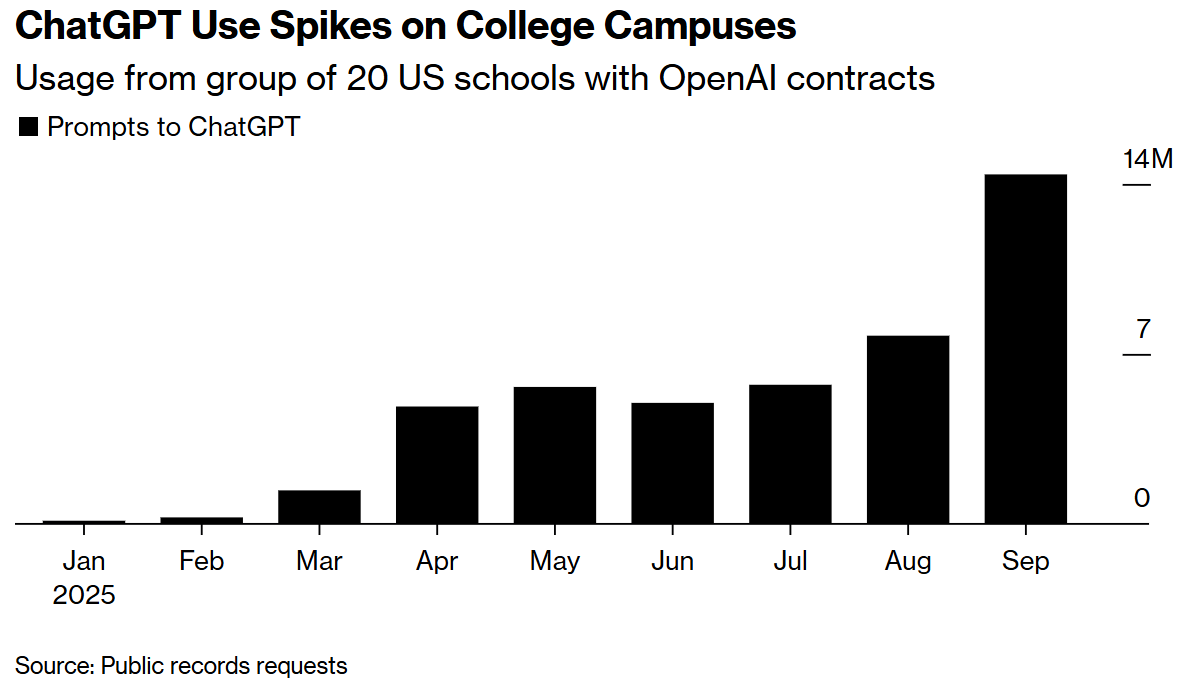
ChatGPT usage surges on college campuses
Arizona State University, one of the largest schools with students enrolled in the US, agreed to buy ChatGPT access for all students and staff in September. As of late November, the school had nearly 10,000 students and 6,400 employees using these new permits, according to a spokesperson.
Several other major universities have followed the same approach. In the fall of 2024, the California State University system decided to provide AI tools to all of its approximately 500,000 teachers and students to ensure that even those who can't afford to pay for themselves can use it. Chief Information Officer Ed Clark said management evaluated several tools and found that ChatGPT was the least expensive and students were most familiar with it. The system (which includes campuses like San Diego State University) agreed to pay OpenAI $15 million a year.
Clark revealed that initially management was very interested in Microsoft's Copilot because it works with apps such as Word that the school already uses. But Microsoft's offer was significantly higher than what they ended up paying OpenAI — Copilot is $30 per user per month, while ChatGPT is actually only $2.50. According to documents reviewed, many universities that use Copilot, such as the University of Georgia and the University of Washington, pay around $30 per user per month.
Campus Offensive
Less than two years ago, many university administrators were skeptical about artificial intelligence. Today, universities have become one of AI's biggest institutional customers. How did they learn to stop worrying and fall in love with ChatGPT?
Educators were among the first to respond to the impact of generative AI because the technology was clearly a great helper for college students. ChatGPT quickly became ubiquitous on campus, with students using it for basic research, writing — and, of course, cheating. Some schools banned or restricted ChatGPT due to concerns about widespread plagiarism, which caused students to secretly start using it.
But many school administrators have reached a cautious acceptance and are currently seeking to establish ground rules for how teachers and students use AI. “We don't think there's an option to 'opt out of use' in the future,” said Anne Jones, associate dean for undergraduate education at Arizona State University. “Employers expect and need a workforce that knows how to operate these tools.”
Meanwhile, the tech industry is making a concerted effort to convince schools of the benefits of AI. OpenAI has hired education-focused sales staff and removed a senior executive from Coursera, an online learning platform that often partners with universities. Leah Belsky, a former Coursera employee and current vice president of education at OpenAI, said, “College students in particular are one of our most important user groups.”
Ahead of the final exam in spring 2025, OpenAI made ChatGPT free for students and launched large-scale advertising campaigns. It also hired “student ambassadors” to promote the tool within the Cal State University system. “A growing education ecosystem realizes that AI will be around for a long time,” Belsky said. Her propaganda argument for universities is that formal adoption of AI allows it to be used in ways that help with learning, job preparation, and teaching; in contrast, if AI is only used as an “answer machine,” it may hinder learning.
Meanwhile, Microsoft is funding research on the current state of AI applications in education. Schools using the company's software can already use the basic version of its AI chat assistant for free, and the company recently announced a price cut for academic institutions — cutting the price of the premium version from around $30 to $18 per month. A Microsoft spokesperson said, “Microsoft has been partnering with universities for decades to support their evolving teaching, research, and operational needs through trusted technology and innovation.”
Federal and state government policymakers are also beginning to provide incentives to schools that officially adopt AI programs. Earlier this month, the Trump administration announced new federal higher education funding priorities, including a $50 million funding pool to support plans to expand access to AI and use the technology to “enhance teaching, learning, and student success.”
Even as they embrace AI, some schools remain wary and are stepping up research on its potential impact on education. In March of this year, Netflix Chairman Reed Hastings donated $50 million to Bowdon College to further study the impact of these tools on teaching and learning.
Eric Jon, a professor of digital and computational research at Bowden College, is in charge of the work, and he said the technology's ability to help students learn has not been proven. He said AI may reduce the complexity of administrative tasks such as managing schedules and developing syllabuses, but it seems less effective in terms of actual teaching. Jon is worried that the university is in a hurry to sign an OpenAI contract, not so much about figuring out how AI can improve education, but rather about being left behind.
Many schools are slowly rolling out these tools while testing their effectiveness. The University of Nebraska at Omaha surveyed hundreds of employees when it began purchasing ChatGPT licenses in spring 2025. The results showed that 92% of teachers, librarians, and students surveyed said they would recommend the tool to others at school, and most said it saved them 1 to 5 hours a week. Writing and brainstorming are the most common uses, but about a quarter of respondents use them for lesson plan writing and student coaching. As of September, the school had around 800 active users.
There is a huge difference in popularity. At the University of Illinois at Urbana-Champaign, around 200 faculty members are active on the school's ChatGPT license account. Among them, a few “superusers” contributed most of the usage. A policy researcher called the tool 742 times in September — about 34 times a day, assuming a standard work week. Meanwhile, most users call the tool less than 10 times throughout the month. (The school also pays for approximately 600 Microsoft Copilot licenses.)
Mered Martin, the school's chief information officer, said it was not uncommon for “early superusers” to appear. However, she also pointed out that the concerns of many faculty and staff are one of the reasons why the school is making careful progress. The school dropped the huge discounts brought about by large-scale licensing agreements in order to prove to employees that the school is taking legacy technology concerns, including plagiarism and data security, seriously.
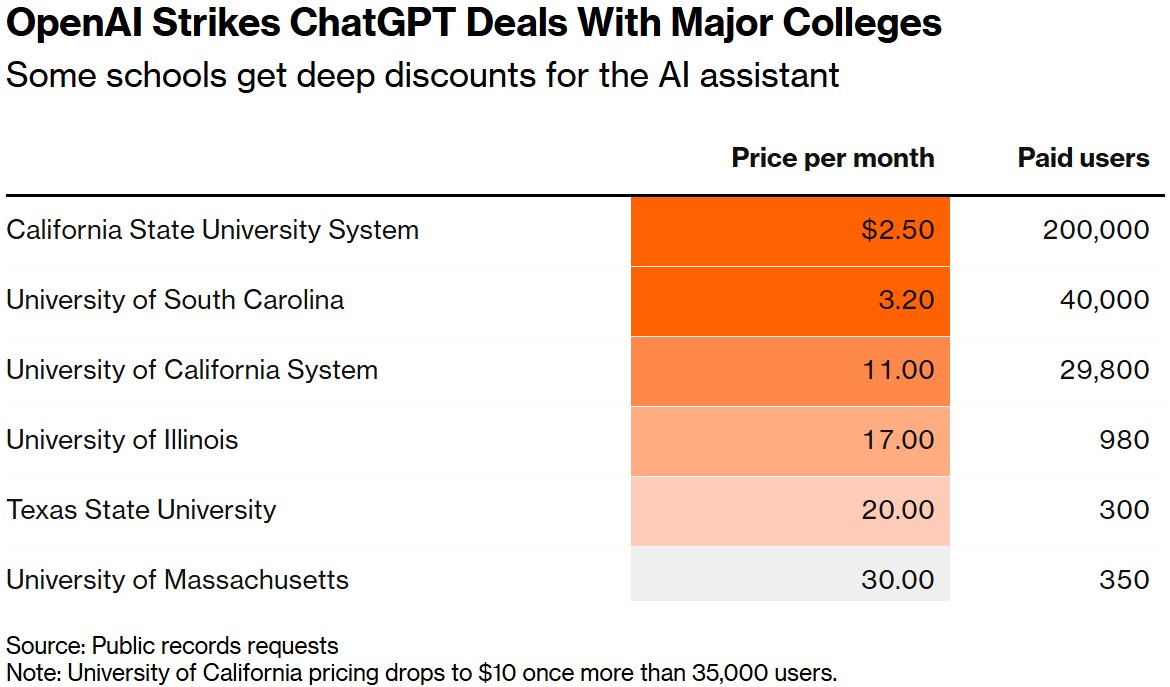
OpenAI reached ChatGPT cooperation agreements with many well-known universities
How long OpenAI can maintain its leading position in the campus sector depends in part on how responsive Google and Microsoft are. To preserve its share of the education market, Google is offering a one-year free trial of Gemini AI Assistant Pro to all college students. It also provides a completely free basic version of the AI assistant, and Miami-Dade County Public Schools (one of the nation's largest school districts) has rolled out this version to 100,000 students. (According to the documentation, the district also spent $150,000 to purchase 400 Google Pro AI licenses, mainly for faculty.) Google also touted the use of its AI technology at colleges and universities such as Boise State University.
Microsoft's software is very common in businesses, and the company has convinced many businesses to adopt Copilot and its other AI tools embedded in office applications such as Word, Excel, and Teams. However, in the field of education, due to Google's competition and other factors, Microsoft's advantage is weak. Many of the schools surveyed have purchased only a limited number of Copilot licenses (mostly for use by faculty and staff) and have yet to see widespread adoption among students.
Texas State University is a major Microsoft customer, paying around $1 million a year. All teachers and students at the school can already access the basic version of Microsoft Copilot through the bundled service. The popularity is good — one document shows that in a month around November, around 69,000 independent devices connected to Copilot under school Wi-Fi.
But documents show that even without a formal contract, ChatGPT's usage rate is still double that of Copilot. Google Gemini is also slightly more used than Copilot. Matt Hall, the school's chief information officer, said in an interview that the school is currently in talks with Google to buy more of its advanced AI tools.
OpenAI is confident that it has already won the favor of college students. OpenAI's Belsky said, “Many universities will adopt us even if they already have Gemini, Microsoft, and other AI tools. Because at the end of the day, the student's favorite technology is ChatGPT.”