
Following recent decline, Caregen Co., Ltd.'s (KOSDAQ:214370) top shareholder CEO Yong-Ji Jeong sees holdings value drop by 5.3%
Key Insights
- Significant insider control over Caregen implies vested interests in company growth
- 70% of the company is held by a single shareholder (Yong-Ji Jeong)
- Past performance of a company along with ownership data serve to give a strong idea about prospects for a business
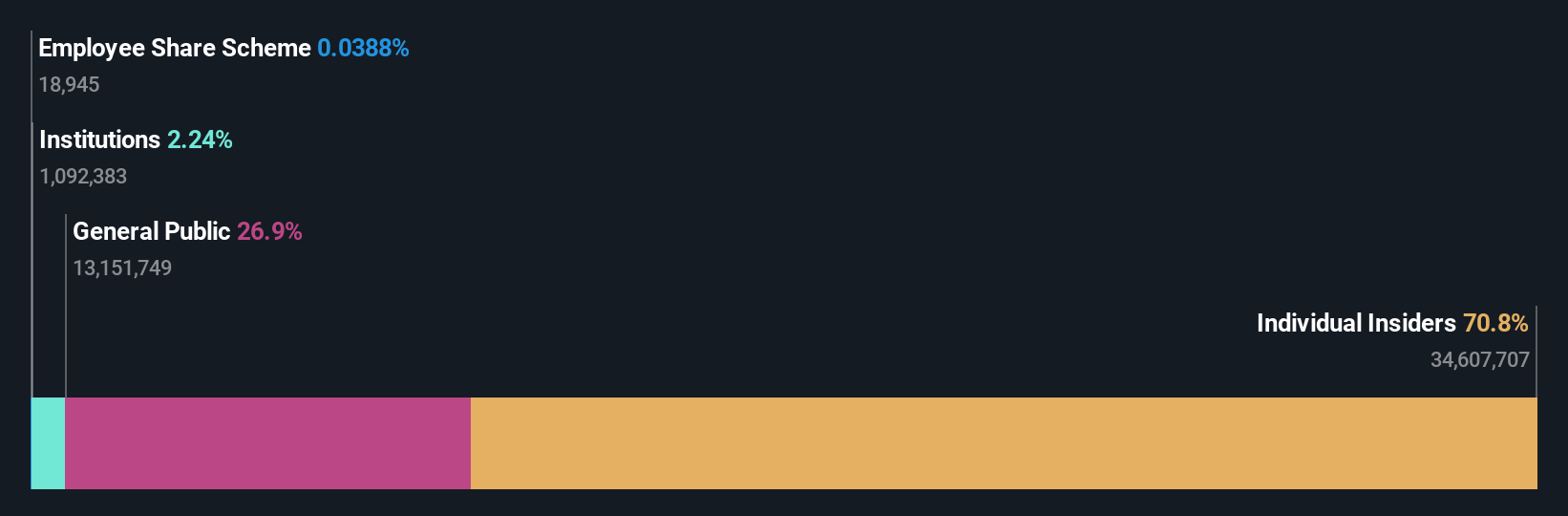
Every investor in Caregen Co., Ltd. (KOSDAQ:214370) should be aware of the most powerful shareholder groups. We can see that individual insiders own the lion's share in the company with 71% ownership. That is, the group stands to benefit the most if the stock rises (or lose the most if there is a downturn).
As a result, insiders as a group endured the highest losses after market cap fell by ₩186b.
Let's delve deeper into each type of owner of Caregen, beginning with the chart below.
See our latest analysis for Caregen
What Does The Institutional Ownership Tell Us About Caregen?
Many institutions measure their performance against an index that approximates the local market. So they usually pay more attention to companies that are included in major indices.
Less than 5% of Caregen is held by institutional investors. This suggests that some funds have the company in their sights, but many have not yet bought shares in it. If the business gets stronger from here, we could see a situation where more institutions are keen to buy. We sometimes see a rising share price when a few big institutions want to buy a certain stock at the same time. The history of earnings and revenue, which you can see below, could be helpful in considering if more institutional investors will want the stock. Of course, there are plenty of other factors to consider, too.

Hedge funds don't have many shares in Caregen. With a 70% stake, CEO Yong-Ji Jeong is the largest shareholder. With such a huge stake, we infer that they have significant control of the future of the company. It's usually considered a good sign when insiders own a significant number of shares in the company, and in this case, we're glad to see a company insider with such skin in the game. With 1.1% and 0.4% of the shares outstanding respectively, The Vanguard Group, Inc. and Eun-Mi Kim are the second and third largest shareholders. Interestingly, the third-largest shareholder, Eun-Mi Kim is also a Member of the Board of Directors, again, indicating strong insider ownership amongst the company's top shareholders.
While it makes sense to study institutional ownership data for a company, it also makes sense to study analyst sentiments to know which way the wind is blowing. We're not picking up on any analyst coverage of the stock at the moment, so the company is unlikely to be widely held.
Insider Ownership Of Caregen
The definition of company insiders can be subjective and does vary between jurisdictions. Our data reflects individual insiders, capturing board members at the very least. Management ultimately answers to the board. However, it is not uncommon for managers to be executive board members, especially if they are a founder or the CEO.
Most consider insider ownership a positive because it can indicate the board is well aligned with other shareholders. However, on some occasions too much power is concentrated within this group.
Our most recent data indicates that insiders own the majority of Caregen Co., Ltd.. This means they can collectively make decisions for the company. Insiders own ₩2.3t worth of shares in the ₩3.3t company. That's extraordinary! Most would argue this is a positive, showing strong alignment with shareholders. You can click here to see if they have been selling down their stake.
General Public Ownership
The general public, who are usually individual investors, hold a 27% stake in Caregen. While this size of ownership may not be enough to sway a policy decision in their favour, they can still make a collective impact on company policies.
Next Steps:
I find it very interesting to look at who exactly owns a company. But to truly gain insight, we need to consider other information, too. Case in point: We've spotted 1 warning sign for Caregen you should be aware of.
Of course this may not be the best stock to buy. Therefore, you may wish to see our free collection of interesting prospects boasting favorable financials.
NB: Figures in this article are calculated using data from the last twelve months, which refer to the 12-month period ending on the last date of the month the financial statement is dated. This may not be consistent with full year annual report figures.
Have feedback on this article? Concerned about the content? Get in touch with us directly. Alternatively, email editorial-team (at) simplywallst.com.
This article by Simply Wall St is general in nature. We provide commentary based on historical data and analyst forecasts only using an unbiased methodology and our articles are not intended to be financial advice. It does not constitute a recommendation to buy or sell any stock, and does not take account of your objectives, or your financial situation. We aim to bring you long-term focused analysis driven by fundamental data. Note that our analysis may not factor in the latest price-sensitive company announcements or qualitative material. Simply Wall St has no position in any stocks mentioned.