
Maruti Suzuki India Limited's (NSE:MARUTI) Price Is Out Of Tune With Earnings
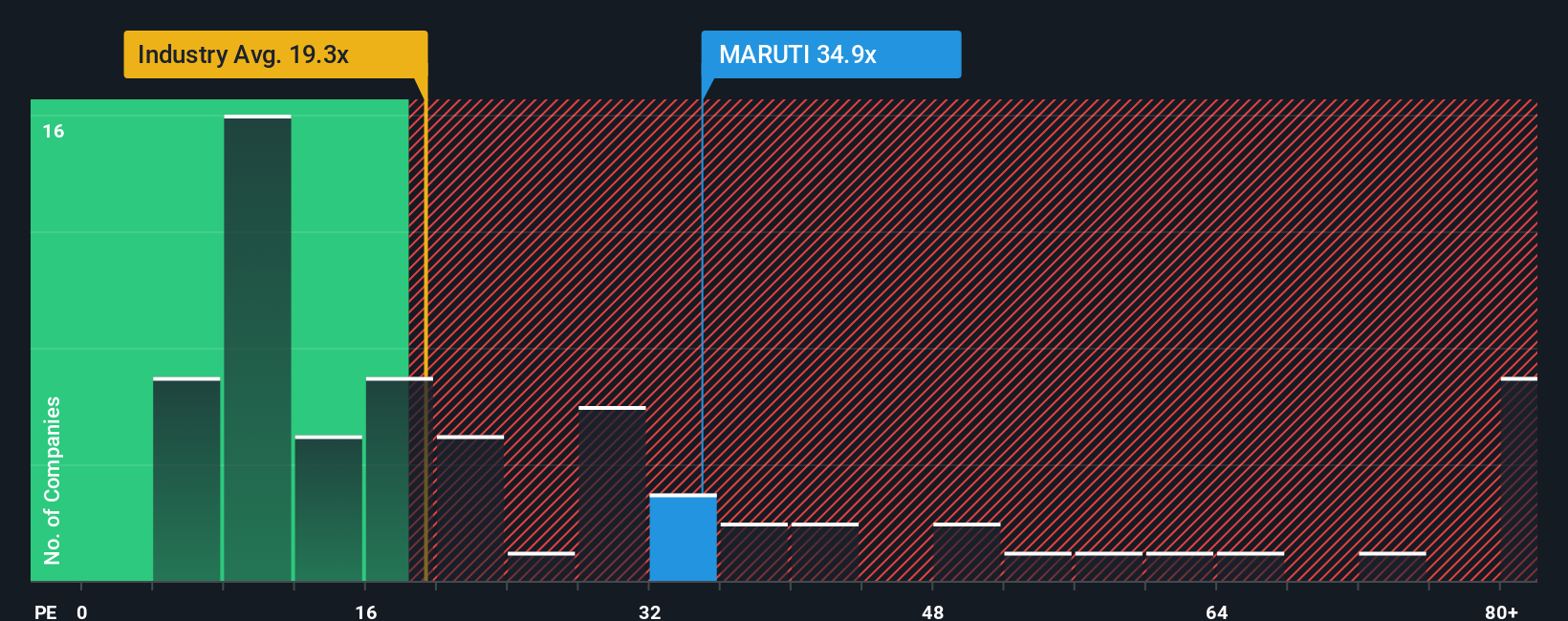
With a price-to-earnings (or "P/E") ratio of 34.9x Maruti Suzuki India Limited (NSE:MARUTI) may be sending bearish signals at the moment, given that almost half of all companies in India have P/E ratios under 25x and even P/E's lower than 14x are not unusual. Nonetheless, we'd need to dig a little deeper to determine if there is a rational basis for the elevated P/E.
Maruti Suzuki India could be doing better as it's been growing earnings less than most other companies lately. One possibility is that the P/E is high because investors think this lacklustre earnings performance will improve markedly. If not, then existing shareholders may be very nervous about the viability of the share price.
View our latest analysis for Maruti Suzuki India
What Are Growth Metrics Telling Us About The High P/E?
In order to justify its P/E ratio, Maruti Suzuki India would need to produce impressive growth in excess of the market.
Retrospectively, the last year delivered a decent 5.4% gain to the company's bottom line. The latest three year period has also seen an excellent 134% overall rise in EPS, aided somewhat by its short-term performance. Therefore, it's fair to say the earnings growth recently has been superb for the company.
Shifting to the future, estimates from the analysts covering the company suggest earnings should grow by 15% per year over the next three years. That's shaping up to be materially lower than the 20% per year growth forecast for the broader market.
In light of this, it's alarming that Maruti Suzuki India's P/E sits above the majority of other companies. It seems most investors are hoping for a turnaround in the company's business prospects, but the analyst cohort is not so confident this will happen. There's a good chance these shareholders are setting themselves up for future disappointment if the P/E falls to levels more in line with the growth outlook.
The Key Takeaway
While the price-to-earnings ratio shouldn't be the defining factor in whether you buy a stock or not, it's quite a capable barometer of earnings expectations.
We've established that Maruti Suzuki India currently trades on a much higher than expected P/E since its forecast growth is lower than the wider market. Right now we are increasingly uncomfortable with the high P/E as the predicted future earnings aren't likely to support such positive sentiment for long. This places shareholders' investments at significant risk and potential investors in danger of paying an excessive premium.
You always need to take note of risks, for example - Maruti Suzuki India has 2 warning signs we think you should be aware of.
It's important to make sure you look for a great company, not just the first idea you come across. So take a peek at this free list of interesting companies with strong recent earnings growth (and a low P/E).
Have feedback on this article? Concerned about the content? Get in touch with us directly. Alternatively, email editorial-team (at) simplywallst.com.
This article by Simply Wall St is general in nature. We provide commentary based on historical data and analyst forecasts only using an unbiased methodology and our articles are not intended to be financial advice. It does not constitute a recommendation to buy or sell any stock, and does not take account of your objectives, or your financial situation. We aim to bring you long-term focused analysis driven by fundamental data. Note that our analysis may not factor in the latest price-sensitive company announcements or qualitative material. Simply Wall St has no position in any stocks mentioned.