
Is CME Group’s Strong 2025 Run Still Justified Amid Elevated Volatility Tailwinds?
- If you are wondering whether CME Group is still worth buying after its long run, or if the market has already priced in the upside, you are not alone. That is exactly what we are going to unpack here.
- The stock has slipped around 1.6% over the last week and 1.5% over the past month, but it is still up 15.6% year to date and 17.8% over the last year, with multi year returns above 78% over three years and 82.2% over five years.
- Recent market attention has centered on CME as a key beneficiary of elevated volatility and trading volumes across futures and options. Investors increasingly view it as a core infrastructure play in global markets rather than a cyclical bet. Headlines have also highlighted how its role in risk management and hedging is becoming more important as rates, currencies, and commodities remain in focus for institutional investors.
- Despite that backdrop, CME Group only scores 1 out of 6 on our valuation checks. This means it screens as undervalued on just one metric. Next we will walk through the main valuation approaches behind that score and then finish with a more holistic way to judge the stock's true worth.
CME Group scores just 1/6 on our valuation checks. See what other red flags we found in the full valuation breakdown.
Approach 1: CME Group Excess Returns Analysis
The Excess Returns model looks at how much profit a company can generate above the minimum return that equity investors require, and then projects how long those extra profits can be sustained.
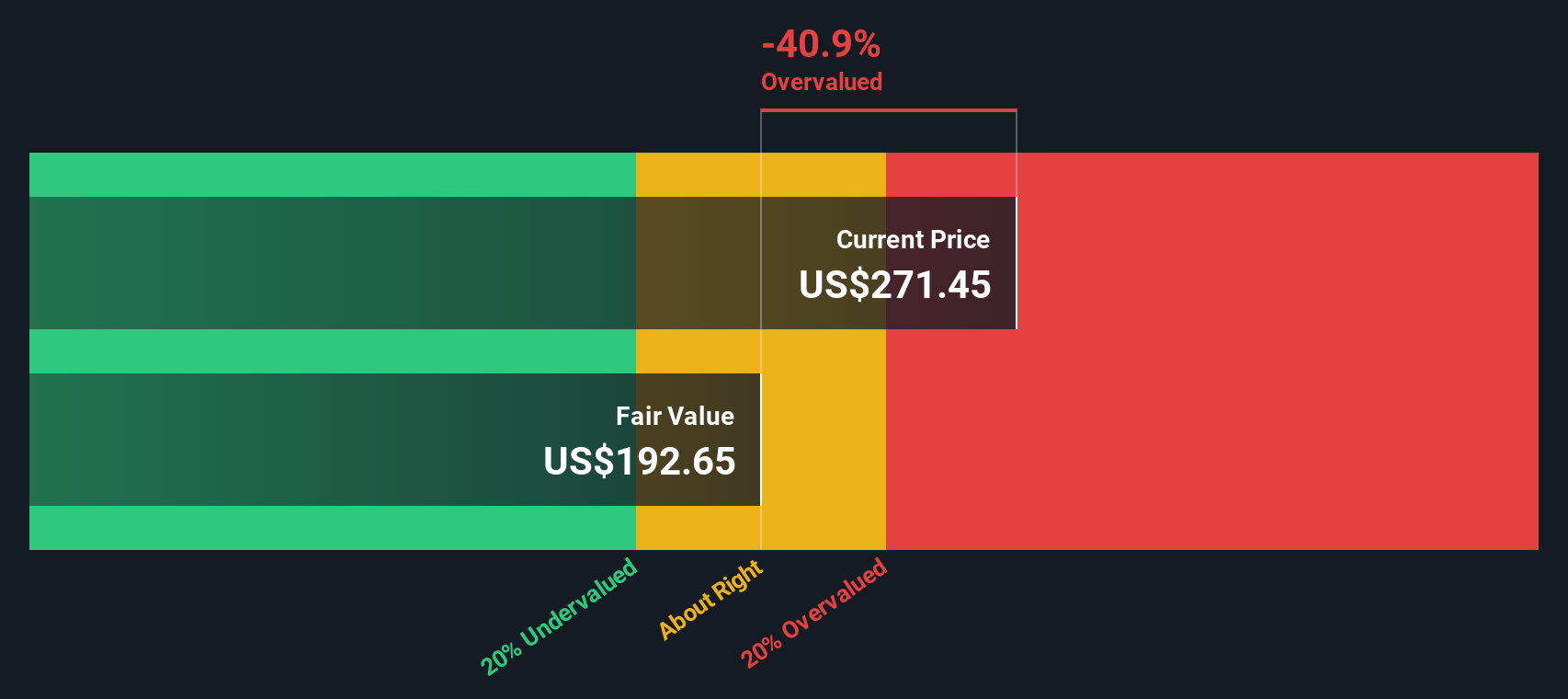
For CME Group, the analysis starts with a Book Value of $78.34 per share and a Stable EPS of $12.37 per share, based on weighted future Return on Equity estimates from 6 analysts. This implies an Average Return on Equity of 15.40%, comfortably above the Cost of Equity of $6.55 per share.
The difference between what CME earns on its equity and what investors require is captured in an Excess Return of $5.81 per share. Combined with a Stable Book Value of $80.31 per share, sourced from 4 analysts, the model translates these ongoing excess returns into an intrinsic value of roughly $199 per share.
Compared with the current market price, this implies the stock is about 35.2% overvalued on an Excess Returns basis. This suggests investors are paying a rich premium for CME’s quality and growth profile.
Result: OVERVALUED
Our Excess Returns analysis suggests CME Group may be overvalued by 35.2%. Discover 913 undervalued stocks or create your own screener to find better value opportunities.
Approach 2: CME Group Price vs Earnings
For a mature, consistently profitable business like CME Group, the price to earnings ratio is a practical way to judge valuation because it directly links what investors pay to the company’s current earnings power. In general, faster earnings growth and lower perceived risk justify a higher PE multiple. In contrast, slower growth or higher uncertainty call for a lower, more conservative PE.
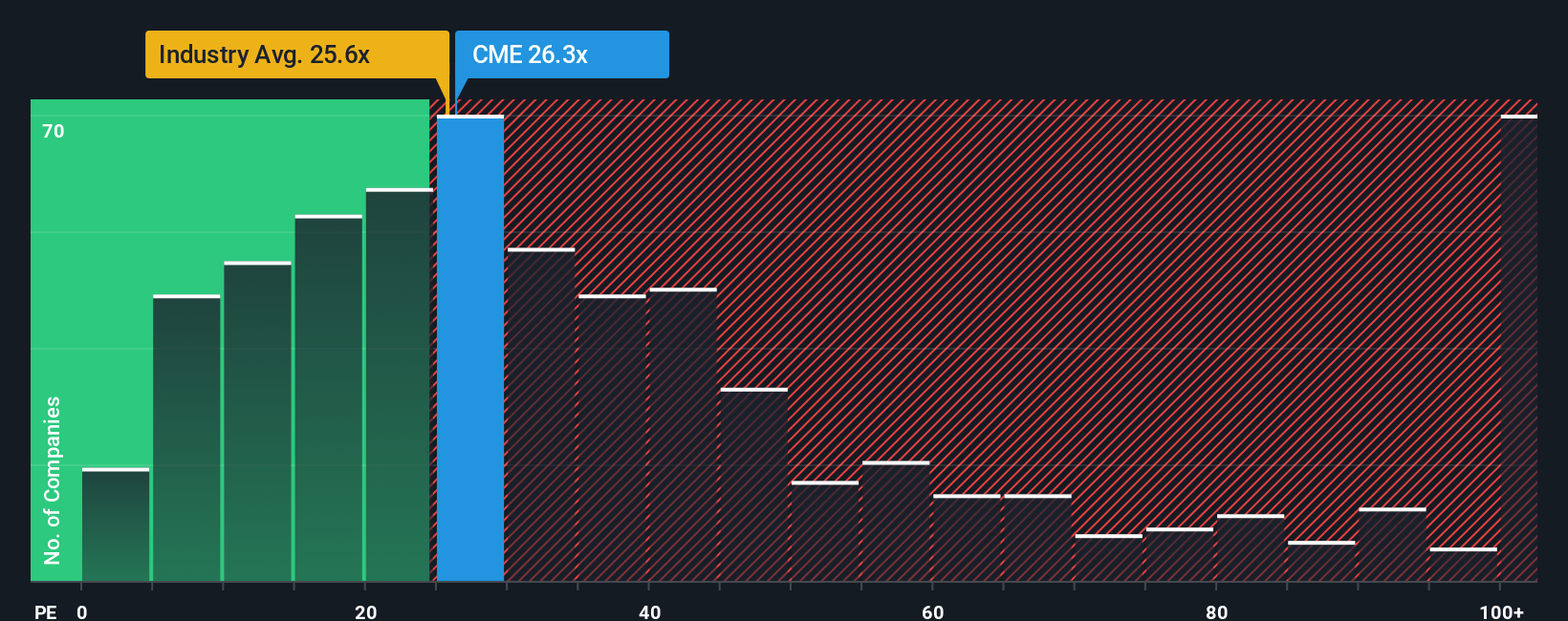
CME Group currently trades on a PE of 26.1x, which is slightly above the Capital Markets industry average of 25.1x but below the peer group average of 34.8x. To move beyond simple comparisons, Simply Wall St uses a “Fair Ratio” for the PE. This represents the multiple the stock might trade on given its specific earnings growth outlook, profitability, industry, size, and risk profile. For CME, that Fair Ratio is 15.1x, which indicates the current market price reflects a richer valuation than the company’s fundamentals alone would suggest.
Because CME’s actual PE of 26.1x is materially above the Fair Ratio of 15.1x, the stock screens as overvalued on a price to earnings basis.
Result: OVERVALUED
PE ratios tell one story, but what if the real opportunity lies elsewhere? Discover 1462 companies where insiders are betting big on explosive growth.
Upgrade Your Decision Making: Choose your CME Group Narrative
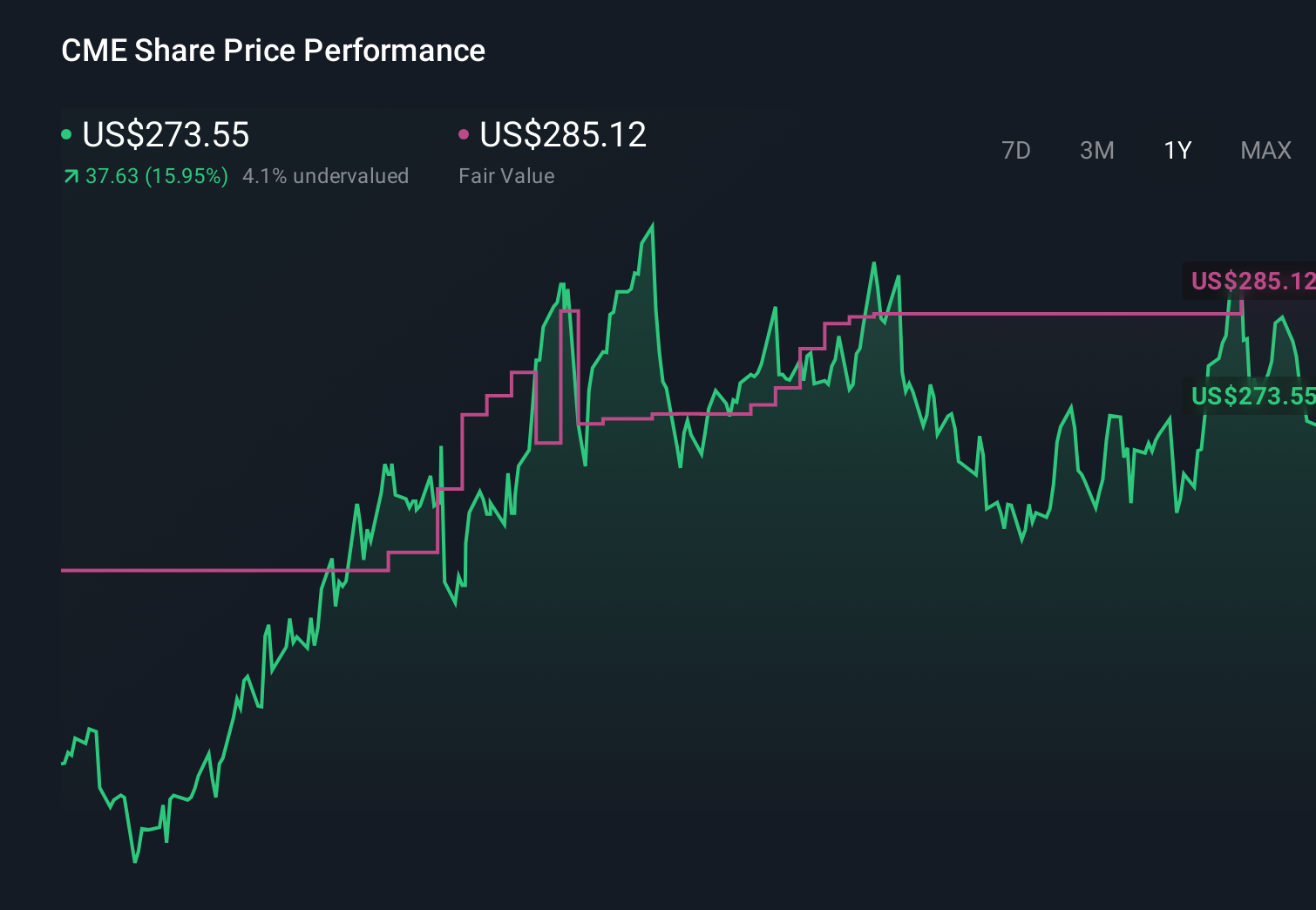
Earlier we mentioned that there is an even better way to understand valuation, so let us introduce you to Narratives. This is a simple framework on Simply Wall St’s Community page where you connect your view of CME Group’s story to a set of forecast assumptions and a Fair Value. You can then compare that Fair Value to today’s price to decide whether to buy, hold, or sell. The framework automatically keeps up with new information such as earnings or major news. For example, one investor might build a bullish CME Narrative around resilient fee income, expanding prediction markets, and mid 4% revenue growth that supports a Fair Value near the top of current targets around $313 per share. A more cautious investor could emphasize competition, lower volatility, and margin pressure, leading to a Fair Value closer to the low end near $212 per share. Both perspectives remain visible, dynamic, and easy to tweak as the facts change.
Do you think there's more to the story for CME Group? Head over to our Community to see what others are saying!
This article by Simply Wall St is general in nature. We provide commentary based on historical data and analyst forecasts only using an unbiased methodology and our articles are not intended to be financial advice. It does not constitute a recommendation to buy or sell any stock, and does not take account of your objectives, or your financial situation. We aim to bring you long-term focused analysis driven by fundamental data. Note that our analysis may not factor in the latest price-sensitive company announcements or qualitative material. Simply Wall St has no position in any stocks mentioned.
Have feedback on this article? Concerned about the content? Get in touch with us directly. Alternatively, email editorial-team@simplywallst.com