
Michael Burry Says China Has Structural Edge In AI As Nvidia's 'Power Hungry' Chips Outpace US Energy Grid
Michael Burry, the investor famous for predicting the 2008 financial crisis, has said that China's rapidly accelerating power-generation buildout gives it a structural edge in artificial intelligence if the industry continues relying on increasingly energy-intensive chips.
China's Power Advantage Is Growing Faster, Not Just Bigger
Burry sounded the alarm over the weekend in a series of posts on X, pointing to a chart showing China's installed electricity generation capacity has surged far beyond that of the U.S. and Europe since the early 2000s.
"It is not just the total power advantage," Burry wrote. "It is the slope."
Burry said the U.S. is on the wrong path if its AI strategy continues to rely on increasingly energy-intensive Nvidia Corp (NASDAQ:NVDA) chips. "Power hungry Nvidia chips are not the way forward," he wrote.
See Also: Nvidia Stock Dips After Oracle Snub: Larry Ellison Calls It ‘Chip Neutrality’
Nvidia's AI Roadmap Tied To Rising Energy Demand
In a follow-up post, Burry argued that Nvidia's dominant role in AI computing has locked the industry into a path of higher power consumption.
"Nvidia's development roadmap is essentially a power consumption roadmap," he stated, adding that innovation has increasingly become about "how to power and to cool bigger, hotter silicon."
He said efficiency improvements have failed to keep pace with the sheer growth in computing being deployed, pushing electricity needs ever higher.
US Grid Constraints Versus China's Build-At-Will Model
Burry contrasted China's infrastructure push with what he described as a decelerating U.S. transmission buildout.
"U.S. transmission grid development is actually decelerating due to permitting issues, while China is building transmission at will to match power output," he said.
That mismatch, he warned, leaves U.S. companies investing heavily in an AI arms race they are "structurally positioned to lose" if power-hungry scaling remains the dominant strategy.
A Call For A Shift Away From Brute-Force AI Scaling
Burry said the U.S. must pivot away from brute-force approaches centered on massive data centers and instead focus on more efficient designs.
"The U.S. needs to get away from bigger and bigger power-hungry chips and innovate with AI-tuned ASICs like nobody's business," he wrote.
Burry said Nvidia has a "death grip" on AI development in the U.S., citing its extensive investments and agreements with many major AI companies and startups.
Burry Raises Valuation Concerns As Nvidia's Market Cap Soars
Burry has been stirring debate by alleging that Nvidia may be employing accounting tactics to artificially boost its valuation. The company currently has a market cap of $4.40 trillion, making it the most valuable company in the world.
In October, the Jensen Huang-led company became the first to reach the $5 trillion market cap milestone. Year-to-date, Nvidia has gained 30.86% while in the past five years the stock has risen by 1,293.30%, according to Benzinga Pro.
Nvidia posted third-quarter revenue of $57.0 billion, representing a 62% increase from a year earlier and exceeding the Street consensus estimate of $54.88 billion.
The company also reported earnings per share of $1.30, topping analysts' expectations of $1.25. The results marked Nvidia's 12th consecutive quarter of beating Wall Street estimates on both revenue and earnings, with quarterly revenue reaching a new record.
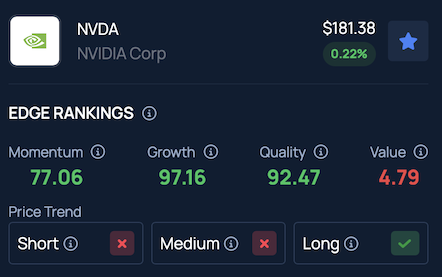
Benzinga Edge Rankings place Nvidia in the 97th percentile for growth, with further metrics available that compare its performance against peers like AMD and INTC.
Read Next:
Disclaimer: This content was partially produced with the help of AI tools and was reviewed and published by Benzinga editors.
Photo courtesy: Shutterstock