
Don't want to chase AI? These “low-profile” assets may be more stable in 2026
The Zhitong Finance App learned that Helen Jewell, International Chief Investment Officer of BlackRock's Fundamental Stock Team, said that as the powerful narrative of artificial intelligence (AI) continues to drive the valuation of tech giants, for stock investors who want a smooth layout in 2026, expanding their investment horizons beyond the AI boom may be a smart New Year's investment plan — and the opportunity may be hidden in the obvious.
Currently, the valuation of the US stock market is already too high. Schiller's price-earnings ratio of the S&P 500 index has exceeded 40 times, which is very close to the level of the Internet bubble in the 90s of the last century.
At the same time, market concentration has also reached an astonishing level. Goldman Sachs's analysis data shows that the total market capitalization of the five largest US tech giants — Nvidia (NVDA.US), Apple (AAPL.US), Google (GOOGL.US), Microsoft (MSFT.US), and Amazon (AMZN.US) — has surpassed the European Stoxx 50 Index, while also surpassing the combined market capitalization of the British, Indian, Japanese and Canadian stock markets.
In this context, market questions about this year's AI-driven upward trend began to surface, and the Chicago Board Options Exchange Volatility Index (VIX) has also surged sharply in the past few months.
But even so, in 2025, many markets and industry sectors outside the US tech sector still achieved steady returns — and, Jewell believes, many of these targets are expected to continue this positive trend next year.
Get out of the US market
From a geographical perspective, the US will not be the protagonist of the global stock market in 2025. The annual return in local currency is the statistical caliber. As of the beginning of December, the world's largest stock market had fallen to 20th place in the stock market rankings of various countries, while the South Korean and Spanish stock markets were at the top of the list.
Jewell said investors don't have to stick to the US market at all to get double-digit returns. Goldman Sachs data shows that in the past 12 months, 84% of the world's national stock markets have risen by more than 10%.
The international stock market is expected to continue its outstanding performance next year. Jewell believes that European stock markets may benefit from a recovery in economic activity. The current Eurozone loan growth rate has been steadily picking up, and the Composite Purchasing Managers' Index (PMI) is also well above the 50 boom and dry line, sending a clear signal of economic expansion. By 2026, Germany's fiscal stimulus policy and Europe's overall expansion of defense spending are expected to further inject strong impetus into this round of cyclical economic expansion.
These favorable factors will support European cyclical companies, such as truck and mining equipment manufacturers. And if the EUR/USD exchange rate stabilizes next year, the performance of such companies may rise to the next level.
In the Japanese market, the dual role of healthy inflation and corporate transformation — many companies are focusing on streamlining their business and focusing on core sectors — is expected to continue to improve corporate profitability in 2026, thereby increasing shareholder returns.
In addition, Japan's House of Representatives has just passed a supplementary budget of 117 billion US dollars to provide financial support for large-scale fiscal stimulus, which will provide a strong foundation for the overall economy.
It is worth mentioning that Japan may be the only major economy to raise interest rates in 2026. Although this move may limit economic growth, it is beneficial to the development of the banking sector, and is not expected to significantly drag down overall economic growth.
In the emerging market sector, as the US dollar weakens and global interest rates decline, and the rapid restructuring of the global supply chain to adapt to trade frictions and geopolitical conflicts, capital and investment continue to flow in, the profits of emerging market companies are expected to be firmly supported.
Finally, it is worth mentioning that since this year, the performance of the British stock market has surpassed the US stock market without the help of leading AI concept stocks. Jewell said that the current valuation of the British stock market is among the lowest in developed countries, and it is expected to provide a stable return on investment in the future. The challenge for investors is to identify British companies that can break through the negative emotions that surround the market and are truly of quality.
Break out of the tech sector
There is a similar logic at the industry level. Over the past five years, in local currency, the performance of the European banking industry has been 40 percentage points higher than that of the “Big Seven” in US stocks, and there has been no discussion in the market about a bubble in this sector. Currently, the valuation of the European banking industry is still below the historical long-term average. BlackRock's analysis shows that in the next three years, the European banking industry as a whole will return about 24% of the total market value to shareholders through dividends and stock repurchases.
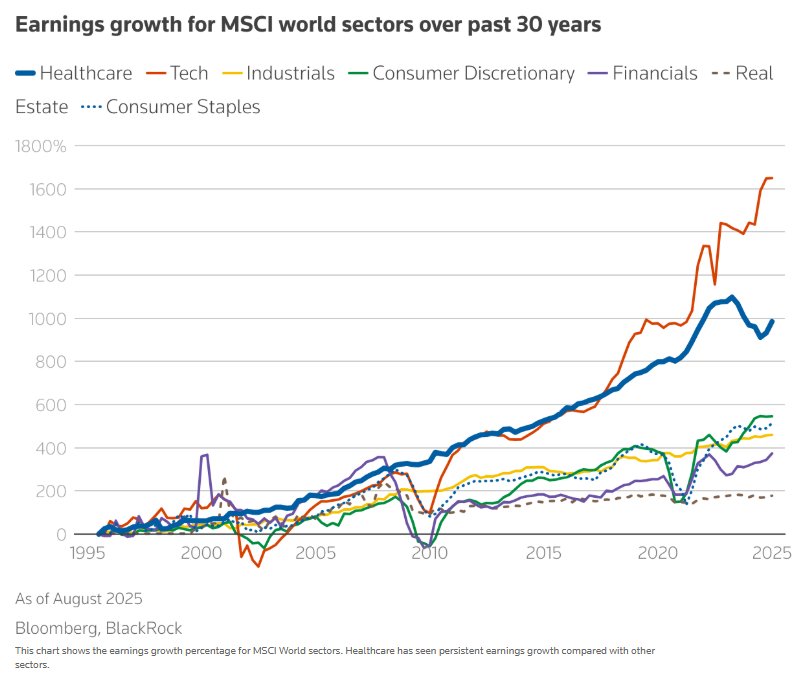
The health care sector has been slightly underperforming in recent years, and the trend has lagged behind the market in the past few years. However, as a typical defensive sector, healthcare demand is largely unaffected by economic cycle fluctuations, and historical data also prove that the sector can achieve strong and stable profit growth even during periods of market pressure.
According to BlackRock's analysis data, the current valuation of healthcare stocks is 28% off compared to the global stock market as a whole. This discount margin has only occurred twice in the past 30 years. And within 12 months after these two discounts, the sector achieved an increase of more than 20%.
Even in the popular arena of AI, investors can find investment paths without paying too high a premium. The surge in demand for electricity in the AI industry highlights the need to invest in clean energy and grid infrastructure, and utility companies that supply power to data centers have ushered in development opportunities as a result.
What is particularly critical is that the current valuations of clean energy stocks and listed infrastructure companies are lower than the overall level of the market. “It can be seen from this that it is not necessary to pay a high cost to lay out an AI track,” Jewell said.
“Admittedly, the AI boom may heat up even further in 2026 — especially when the efficiency improvements brought about by AI technology begin to translate into actual revenue returns,” Jewell added, “but even so, high valuations may keep the market tense. There are actually quite a few good alternatives for investors who want to reduce their exposure to related risks.”