
After technology stocks, who will take over and lead US stocks in 2026? Wall Street Answers: Cyclical Stocks
The Zhitong Finance App learned that as oil prices fall, the US economic growth is expected to accelerate, and the continued cooling of inflation has strengthened expectations that the Fed will cut interest rates. At the same time, stock selectors are setting their sights on fields other than artificial intelligence (AI) concept stocks, and the US consumer market is also maintaining strong consumption vitality.
Together, these factors form an almost perfect favorable environment for listed companies that are most sensitive to economic cycles. As a result, strategists and analysts expect banks such as JPMorgan Chase (JPM.US), equipment manufacturers such as Caterpillar (CAT.US), and retailers such as Gap (GAP.US) and Dollar Tree (DLTR.US) to perform well in 2026.
Michael Kantrowitz, chief investment strategist and head of portfolio strategy at Piper Sandler, said: “Investors have begun to smell the initial signs of bottoming out in the cyclical sector of the economy.”
This means that financial, industrial, and non-essential consumer goods suppliers are expected by Wall Street to become the leading force in the US stock market for another strong year. About 60 economists surveyed forecast an average growth target of 2% for the US economy next year — although this growth rate is not strong, it is enough to drive growth outside of the technology sector.
Kantrowitz added: “As cyclical data improves, value stocks may outperform the market for a long time in 2026. We should plan ahead of time those targets where profit expectations for next year are expected to improve marginally.”
In fact, the trend of changing market styles has quietly emerged. The annual trend of the cyclical stock basket compiled by Goldman Sachs is basically in sync with the S&P 500 index, but the cumulative increase in the past month reached 9.3%, double the 4.2% increase in the S&P 500 index.
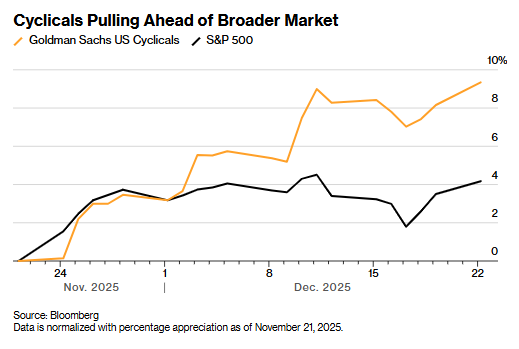
Furthermore, the performance of cyclical stocks has surpassed that of defensive stocks. Previously, defensive stocks were the biggest beneficiaries of the small-scale style change triggered by the October-November technology sector pullback. Goldman Sachs's other trading strategy — going long on non-commodity cyclical stocks and shorting defensive stocks — also reached 10% in the past month.
Sam Stovall, chief investment strategist at CFRA, stated in a report to clients: “The influx of capital into non-technology cyclical stocks highlights the market's optimistic expectations for economic expansion.” The agency predicts that the real gross domestic product (GDP) of the US will grow by 2.5% in 2026. “This increase will benefit from a 4.1% increase in retail sales and a fall in the core personal consumption expenditure (PCE) price index to 2.4%.”
Many Wall Street institutions believe that the strong performance of cyclical stocks is sustainable for a long time. Dennis DeBusschere, founder and chief market strategist at 22V Research LLC, said, “The window period for procyclical trading is not limited to just one or two quarters.”
His core investment strategy is to go long on banks and retail stocks, short essential consumer goods stocks, and at the same time be optimistic about transportation stocks outside of the aviation sector.
The trend of the Dow Jones Transportation Average also confirms that the investment logic of cyclical stocks is being strengthened. The index has risen 10% in the past month. After a long period of poor performance, it is currently only 0.4% short of breaking through the historic high set in November 2024.
Tom Hainlin, chief investment strategist at US Bank NA, advises clients to increase their exposure to cyclical stocks in their stock portfolios. “We hope to increase the allocation of cyclical stocks, but we will not achieve this goal by selling off technology stocks,” he said in a telephone interview. He expects the technology sector to continue to lead profit growth in 2026, followed by the raw materials and industrial sector.
A team of Citigroup strategists led by Adam Pickett pointed out in the December 15 report that cyclical stocks will perform better than defensive stocks, and investors are advised to overallocate the financial sector — this is the bank's preferred target in the cyclical sector, while also under-allocating the essential consumer goods sector. The report also mentioned: “The industrial sector also has the potential to raise ratings.”
However, Pickett also cautioned that the 2026 cyclical stock upward path is not unhindered. If the US economy overheats, it may cause delays in implementation of interest rate cuts expected by the market, or even a policy shift.
“Whether the Federal Reserve can continue to cut interest rates until the end of 2026 is far from certain,” he stressed.
According to the data, the current market expects the Federal Reserve to cut interest rates twice in 2026. The Federal Reserve's latest forecast also shows that the US GDP growth rate will reach 2.3% in 2026, up from the 1.8% forecast in September.
Michael Dickson, head of research and quantitative strategy at Horizon Investments LLC, said in a client report: “Accelerating US economic growth will significantly benefit cyclical companies and sectors, because the profit performance of such targets is highly correlated with the level of economic activity.”