
Surprise asset of the year? The 30-year US Treasury is resilient in 2025, and next year may face an even tougher test
The Zhitong Finance App notes that the annual financial assets for 2025 are none other than US 30-year treasury bonds. Admittedly, its gains are simply incomparable to those astonishing artificial intelligence-related stocks or gold.
In fact, its price has not increased at all this year. But given the challenges it has faced over the past 12 months, it should have been hit hard. But at the end of the year, the asset is nearing the end of the year at the same level as at the beginning of the year — that alone is amazing.
If someone says on January 1 that gold will soar by nearly 70% and break through $4,000 an ounce, Wall Street will experience the biggest technological boom in a quarter of a century, and the financial environment will be at its most relaxed state in three years, you might expect a sharp rise in long-term bond yields.
If anyone else says that US inflation will be higher than the target for the second year in a row, the US dollar will plummet 10%, the US “term premium” will rise to the highest point in ten years, and the once sacred concept of central bank independence will be destroyed by the Trump administration's continued attacks on the Federal Reserve. How will investors feel?
If that wasn't enough, President Donald Trump's “Big Beauty Act” is expected to increase the budget deficit by trillions of dollars over the next decade, thereby boosting the “depreciation of the dollar” deal.
Despite all this, the 30-year US Treasury yield is currently around 4.8%, almost back to the level at the beginning of the year.
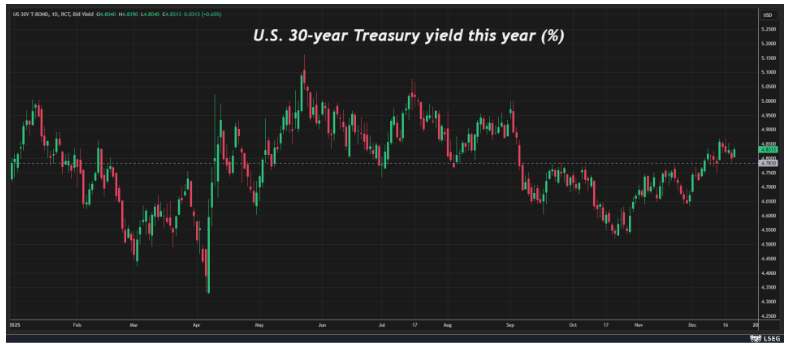
Investors prefer a 5% yield
Of course, the 30-year yield was not without fluctuation over the period. Admittedly, the Federal Reserve's 75 basis point cut this year was expected to depress long-term yields — the 10-year yield did drop by nearly 50 basis points. But similarly, cutting interest rates when inflation continues and is significantly above target will always easily limit the downside of ultra-long-term yields.
The yield curve has steeper — the 2-year/30-year curve has reached its steepest level in four years — but this is almost entirely driven by changes in short-term interest rates.
Compared to similar international assets, US long-term bonds performed well this year, although after currency adjustments, as the US dollar fell by 10%, this light was somewhat bleak.
The yield on German 30-year treasury bonds recently hit its highest point since 2011, with a cumulative increase of nearly 100 basis points this year; while Japan's 30-year treasury yield also hit a record high, rising more than 100 basis points this year.
How do you explain this relative strength? For a product that is regarded as one of the safest and most liquid long-term assets in the world despite constant macro noise, the 5% yield is clearly very attractive to many investors. Demand continues to be strong from “real money” buyers such as pension funds, mutual funds, and insurance companies, who need long-term assets to match their long-term liabilities.
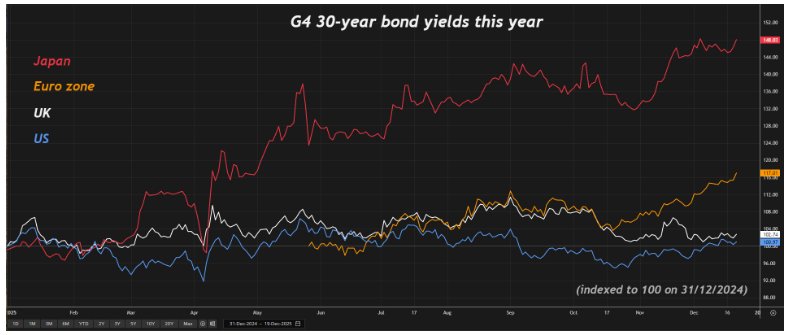
Prolonged worries
This demand has ensured that the 12 30-year bond auctions conducted by the US Treasury this year went largely smoothly.
The Treasury sold a total of $276 billion in debt, once a month. According to Exante Data, the average bid multiplier for these 12 auctions (a measure of demand) was 2.37, which is very close to the average of about 2.38 over the past 50 auctions since November 2021.
Domestic institutional investment funds subscribed to about 70-75% of the bonds for sale, and foreign investors increased their purchases in the second half of the year, accounting for more than 15% in November for the first time since the beginning of last year.
On the other hand, in these auctions, the Ministry of Finance only paid three times with a yield lower than the pre-sale market level of the day, and paid a higher yield six times. Investors usually ask for a premium in auctions.
Although US long-term bonds have shown great resilience this year, they will still face serious challenges next year. The long-term global context for fixed income remains difficult — risk premiums, inflationary risks, and debt supply are rising, doubts about AI productivity narratives continue to erode confidence, and concerns about the independence of the Federal Reserve are growing.
As a result, 30-year US bonds will face challenges similar to those in 2025, but this time they may be more intense. Its resilience may only be tested for real now.