
Three major tests for US stocks in 2026: profit growth, AI returns, and the Federal Reserve's policy
The Zhitong Finance App learned that US stocks are about to end three consecutive years of excellent results with double-digit percentage increases. Continuing previous gains in 2026 (that is, achieving the fourth consecutive year of growth) will face a challenging situation. This requires corporate profits to maintain strong growth, the Federal Reserve maintain a moderate policy orientation, and continue to increase investment in the field of artificial intelligence.
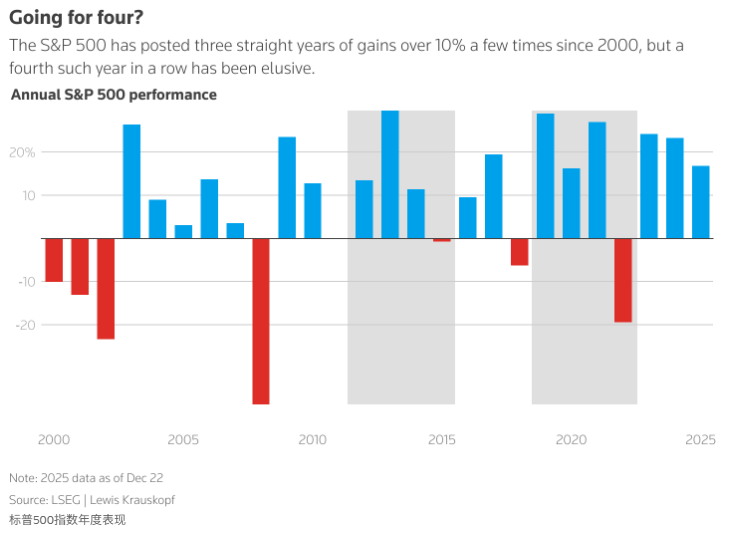
The bull market in US stocks, which began in October 2022, has benefited from the optimistic outlook of artificial intelligence, lower interest rates, and continued economic growth, even though the market has fluctuated due to concerns about the recession. In the middle of this year, the stock market experienced roller coaster fluctuations. After the Trump administration announced in April the imposition of tariffs that exceeded expectations, stock prices fell sharply. The S&P 500 is already up more than 17% with just a few trading days left in 2025, 23% in 2024, and 24% in 2023.
Sam Stovall, chief investment strategist at CFRA, said that to achieve strong double-digit returns next year, the market needs “everything ready.” Stovall pointed out, “The many negative factors make me think that although we may have an unexpectedly good year, I don't think it will be another great year.” He expects the target point of the S&P 500 index to be 7,400 points by the end of 2026, up about 7% from current levels.
Many market strategists expect strong market performance in 2026. Some forecast targets for the S&P 500 index are equivalent to an increase of more than 10%, including the 8,000 point target set by Deutsche Bank, which is about 16% higher than the current index level.
Can profitability and artificial intelligence provide a boost?
Stock market bulls indicated that the profit prospects of US companies are optimistic. Tarkinder Dillon, head of earnings research at the London Stock Exchange Group (LSEG), said that the profits of S&P 500 companies are expected to increase by more than 15% in 2026, based on a 13% increase in 2025.
Analysts expect that the driving force for profit growth will no longer be limited to a few giants in technology and technology-related fields, but will be driven by a wider range of companies. This is because fiscal stimulus policies and loose monetary policies provide strong support for the economy and consumer spending.
Dillon of the London Stock Exchange Group (LSEG) pointed out that seven companies with extremely high market capitalization, including Nvidia (NVDA.US), Apple (AAPL.US), and Amazon (AMZN.US), are known by the market as the “Big Seven”. In 2024, the profit growth rate of these seven companies reached 37%, while the profit growth rate of the rest of the companies in the S&P 500 index was only 7%.
By 2026, this gap is expected to close significantly: the profits of the top seven companies by market capitalization are expected to increase by 23%, while the earnings of the remaining companies in the index are expected to increase by 13%.
“Earnings growth on the other 493 stocks in the S&P 500 index could improve — we're already seeing some signs — this will definitely help the stock market achieve double-digit returns next year.” Christina Hooper, chief market strategist at Inshman Group, said.
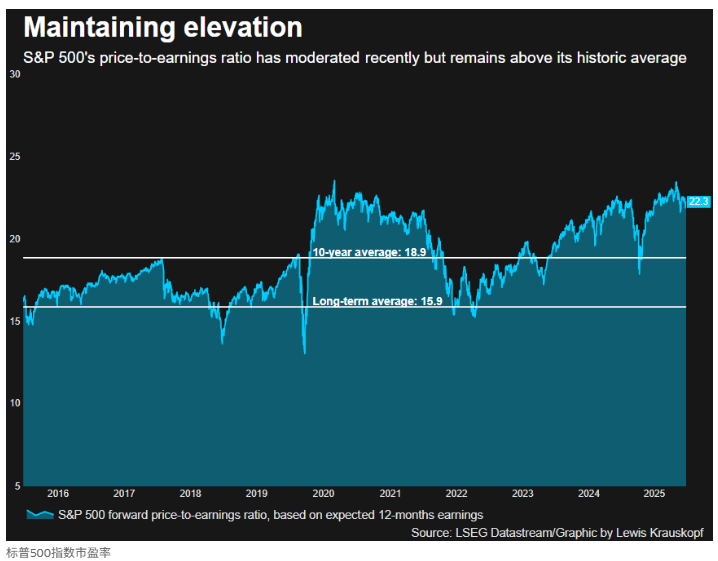
Investors pointed out that in the current context where stock valuations have climbed to historic highs and further upward space is limited, profit growth will be a core factor in determining market performance. One of the key drivers supporting valuation is the market's strong optimism about artificial intelligence technology — this is reflected not only in huge capital investment in AI infrastructure construction, but also in strong expectations for its commercial application. Recently, however, market doubts about the return on AI-related capital expenditure have heated up, putting pressure on the performance of technology stocks and the AI concept sector, and the focus of this controversy may continue to dominate the industry's valuation logic in 2026.
Jeff Buchbinder, chief stock strategist at LPL Finance, said, “If companies start cutting back on previously anticipated capital expenses, and the market loses confidence in the returns that AI investments can bring... then this year's results may remain flat or even decline slightly.”
The dovish Federal Reserve and mixed historical signals
Investors said that another key factor in the strong performance of the stock market is that the economy is moderately slowing down, thus paving the way for calming inflation and further interest rate cuts, but not falling into recession. Federal funds futures show that after cutting interest rates by a cumulative total of 175 basis points in 2024 and 2025, investors expect to cut interest rates at least twice more in 2026, 25 basis points each time.
Yang Yu Ma, chief investment strategist at PNC Financial Services Group, said, “The factor I am most looking forward to is probably that the Federal Reserve maintains a moderate stance.” Investors are watching US President Donald Trump's decision to select the Federal Reserve Chairman, which is expected in early 2026, as a sign that the Federal Reserve will be more dovish, but are also worried that its independence will be tested.
Historical data gave mixed conclusions about potential returns for 2026. On the positive side, according to LPL Research, in the seven rounds of the four-year bull market since 1950, the average increase in the fourth year was 12.8%, six of which achieved positive returns for the whole year. However, in the US midterm election year, stock market performance was often poor due to the uncertainty of the composition of the federal government caused by the election of the new Congress. According to CFRA's Stowall, the average annual increase in the S&P 500 index was only 3.8% in the midterm elections, while it increased by an average of 11% during the other three years of the presidential term.