
Tianshu Zhixin was the first to break through the “death canyon of mass production”. Passing the Hong Kong stock hearing is only the beginning
On December 19, Tianshu Zhixin passed a hearing on the Hong Kong Stock Exchange. If there are no surprises, it will be officially listed in January 2026.
Previously, Moore Thread and Mu Xi shares successively landed on the Science and Technology Innovation Board. After listing, the stock prices went wild, making the market enthusiastic about domestic GPUs at an all-time high. Now, Bizao Technology and Tianshu Zhixin have gone through a hearing on the Hong Kong Stock Exchange. So far, the four leading domestic companies known by the industry as the “Four Little GPUs” have all gathered on the capital market stage to prepare for a fierce competition over the future computing power landscape.
As we temporarily remove the myth of high premiums brought about by companies such as Moore Thread due to market popularity, the uniqueness of Tianshu Zhixin lies in its value logic of replacing conceptual narratives with mass production and delivery.
As a “domestic general-purpose GPU mass production breaker” recognized in the industry, it is not the first company to put forward an ambitious technical blueprint, but it is one of the few players that actually delivered 7nm high-performance general-purpose GPU chips into data centers and achieved large-scale commercial implementation. Its Tianyi series and Zhikai series products have been deployed in various key industries such as finance, energy, education, and medical care, forming a verifiable closed loop of revenue and customer repurchases.
Today, the capital market's attention to Tianshu Zhixin has long surpassed its Hong Kong stock issuance price or short-term stock price fluctuations, and is more focused on the value logic represented by Tianshu Zhixin. What is revealed behind it is actually a fundamental duel in the GPU industry over valuation logic: in the world of hard technology investment, does advanced technology narrative dominate pricing power, or does solid commercial implementation anchor value?
New Thoughts on Valuation Frameworks: Technology vs. Commercialization
Whether in terms of industry evolution or capital market perception, the dynamic growth logic shown by Tianshu Zhixin has broken the progressive development framework of traditional hardware companies and instead presents a kind of nonlinear transition driven by the ability to deliver on technology.
In 2023, the company's revenue increased by more than 60% year over year, and GPU shipments exceeded 50,000 units — not only is this figure far ahead of its peers, but it also makes it the only company in the industry that dares to publicly disclose detailed shipping data. More importantly, this scale marks Tianshu Zhixin's success in crossing the critical threshold of “mass production death valley” and becoming the first company in China to actually move general-purpose GPUs from laboratories to large-scale commercial implementation.
This is no longer a parameter race, but a response to the ultimate proposition of hard tech companies: Can technology be transformed into real productivity? While some peers still use “successful streaming” or “architecture release” as valuation anchors, Tianshu Zhixin chose to use double shipments, auditable customer lists, and industry orders that continue to be repurchased to build the first true sense of the word commercial moat.
According to Frost & Sullivan's data, among Chinese chip design companies, Tianshu Smart Chip is the first company to achieve mass production of general-purpose inference GPU chips, the first company to achieve mass production of training general-purpose GPU chips, and the first company to achieve such milestones using advanced 7nm process technology.
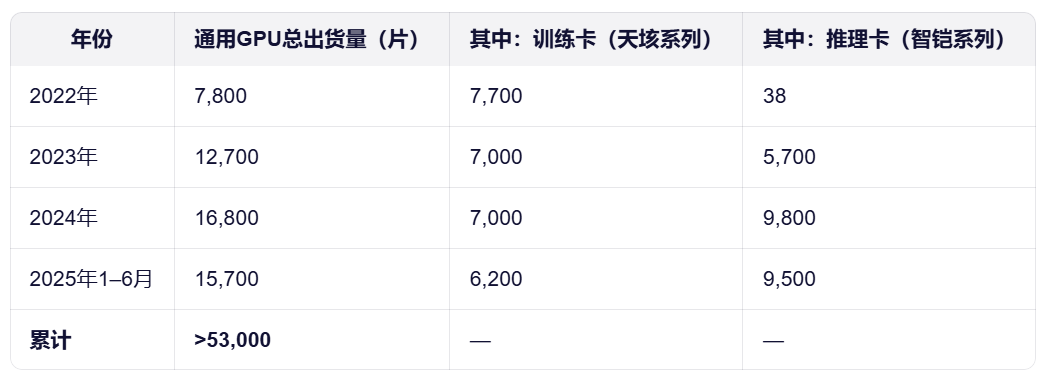
The data is the best proof:
Revenue jumped from 189 million yuan in 2022 to 540 million yuan in 2024, with a three-year compound annual growth rate of 68.8%; revenue for the first half of 2025 was 324 million yuan, a year-on-year increase of 64.2%, and growth continued to be strong;
The annual shipment volume of general-purpose GPUs increased from 7.8,000 in 2022 to 16.8,000 in 2024. In the first half of 2025, 15.7,000 units were delivered in a single quarter. Cumulative shipments have exceeded 52,000 pieces, leading the industry in large-scale delivery capacity.
Mass production is not the end; it is the starting point of value. The real barrier to Tianshu Zhixin is the ability to obtain multi-industry verification for the “versatility” of its products.
By the end of June 2025, the company had served more than 290 enterprise customers, covering many fields such as finance, healthcare, transportation, education and scientific research, consumer retail, etc., and had completed more than 900 actual scenario deployments. This ability to land across industries and multiple scenarios not only disperses market risks, but also demonstrates the “universal” properties of its chips, in stark contrast to some competitors that focus on a single track.
Supporting this expansion capability is its complete “training and promotion” product matrix: the Tianyi series focuses on training. Among them, Tianyi Gen1 is the first mass-produced general-purpose training GPU in China, and Gen3 was released in Q3 in 2024; the Zhikai series is specially designed for reasoning, and was quickly recognized by the market when mass-produced in 2023, covering all cloud-side scenarios.
The closed-loop coverage of training and reasoning enables Tianshu Zhixin to provide customers with full-stack computing power support from model development to application deployment, and has built a deep product moat and continuous growth momentum.
User mindset: Tianshu Zhixin's key password for crossing the mass production divide
Why was Tianshu Zhixin the first to achieve large-scale delivery?
The underlying logic stems from a scarce “user mentality”: focusing on “usable, easy to use, and willing to use.” This kind of pragmatic approach is particularly valuable in the current new stage of shifting from “whether there is” domestic replacement to “good or not easy to use, uneconomical”.
Tianshu Zhixin is centered on user needs and focuses on scenario applications to improve product yield, optimize the supply chain, strengthen scenario adaptation, and improve the tool chain in various ways, so that users can actually use domestic general-purpose GPUs and use them easily and actively. This shift in thinking centered on user needs has made its product the most popular domestic general-purpose GPU product among customers, and it is the key password for crossing the mass production gap.
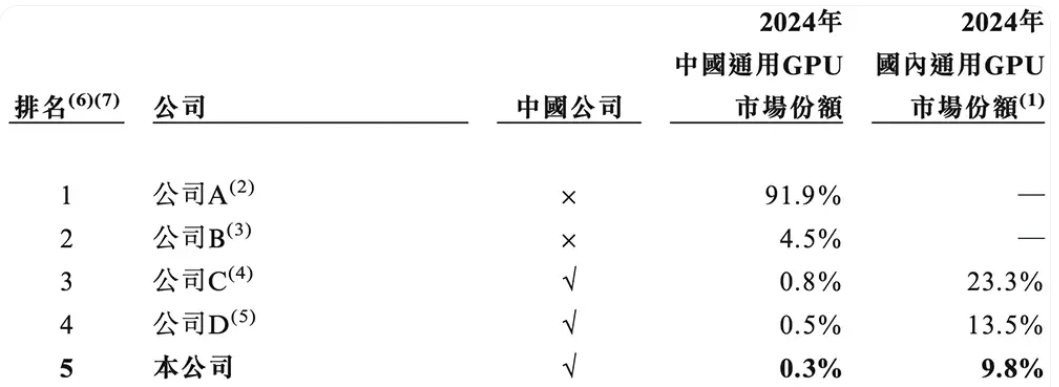
Therefore, the core story of Tianshu Zhixin's current IPO is not another disruptive technical prediction, but a definitive report on large-scale commercial implementation. The real breaking point was to elevate “doubling shipment volume” from a simple financial growth indicator to become the company's strongest strategic moat.
In the field of hard technology investment, traditional valuation logic often focuses on the depth of R&D investment, the depth of the patent pool, and the advanced nature of chip design parameters. The risk of this “heavy asset” model is that it may fall into the “technical and no sales volume” laboratory dilemma. High R&D costs cannot be diluted through large-scale sales, which ultimately causes valuations to be suspended.
Tianshu Zhixin chose a “re-delivery” path. The core focus of its valuation logic is the actual shipment volume, customer retention rate, and the compound growth rate of revenue. From 2022 to 2023, its revenue grew by leaps and bounds, with revenue from cloud-based training and inference solutions surging, which is a direct reflection of the strong rise in shipments. Every chip that is successfully delivered and runs stably is a strict customer verification. It proves that the product not only exists on PPT, but can also withstand the test of actual workloads, and has completed a critical leap from “sample” to “product.”
This growth curve, supported by shipment volume, has multiple strategic connotations.
First, it means that the product power has been endorsed by the market, forming real customer stickiness. Second, large-scale shipments have reversed the entire chain capability from design and flow sheet to package testing, and in particular, accelerated the process of localizing the supply chain — Tianshu Zhixin has achieved deep cooperation with leading domestic semiconductor foundries, which forms critical supply chain resilience in a complex international environment. Finally, continuous revenue inflows provide valuable “blood” for the development of the next generation of more advanced products, forming a virtuous cycle of “sales-development-iteration”.
As a result, the delivery figures of tens of thousands of pieces are more significant than a market ranking. It marks that an enterprise has crossed the “Darwin Sea” from technical success to commercial success and entered a new stage of continuous evolution driven by market feedback.
Three dimensions of revaluation
For investors, Tianshu Zhixin's case provides a critical perspective: when evaluating a hard technology company, should we chase a distant and grand ecological story, or should we focus more on its close and clear profit path and continuously expanding shipping capacity? The final choice of the market will profoundly influence the valuation paradigm for future hard technology investments.
In fact, traditional valuation models (such as PS/PE) are difficult to measure the long-term value of an eco-level enterprise. The valuation of Tianshu Zhixin needs to be repriced in three dimensions:
Short-term: Discounted cash flow value from certainty in mass production. The mass production scale of over 50,000 tablets and a compound growth rate of 68.8% make it the only domestic GPU company with “self-hematopoietic” capabilities;
Mid-term: The market share of general-purpose GPUs continues to increase. If Tianshou Zhixin can occupy 20% of the training+reasoning market, its gross margin can increase to 65% (currently 58%), exert a multiplier effect and show exponential growth;
Long-term: In addition to being compatible with the CUDA platform, the adaptation of Tianshu Zhixin to various ecological levels such as domestic operating systems, databases, large models, and application software will build a perfect domestic ecosystem and further expand market space.
Endorsements from top strategic investors further validate this logic. Tianshu Zhixin investors not only provide capital, but also collaborate deeply on scenarios and resources. This “industry+capital” two-wheel drive shifts Tianshu Zhixin's valuation logic from “technical expectations” to deterministic+ecological pricing for mass production.
Since Tiansu Zhixin's final issuance price has not been disclosed, it is currently impossible for the outside world to determine the market capitalization situation, but there are examples of Moore Thread and Mu Xi shares — the listed stock prices of the two have increased more than 6 times, and the current market capitalization is around 300 billion yuan. The market value of Tianshu Zhixin, which has better commercial implementation performance and is more trusted by domestic users, after listing, is even more anticipated.
Conclusions
As global competition for computing power enters the deep-water zone, the ultimate answer to domestic GPUs lies in the soil of commercialization.
With the attitude of being a “game breaker in mass production,” Tianshu Zhixin proved one thing with double shipments, steady revenue growth, and customer coverage across industries: in the world of hard technology, the real barrier is not only the advanced nature of technology, but also the ability to transform technology into products and continue to deliver.
Its commercialization practice provides a model for the domestic GPU industry to fully open up the “technology-product-market” process, and also pushes the industry as a whole to move from “chip design” to “commercial delivery and implementation.” As computing power is increasingly becoming the cornerstone of the country's core competitiveness, enterprises that can deliver reliable computing power on a large scale are becoming the backbone of domestic computing power breakthroughs.