
HBM will not dance alone, the “storage supercycle” will not end in 2027! Nomura: Supply-side “meaningful increments” will be in place as early as 2028
The Zhitong Finance App learned that a memory chip industry tracking research report recently released by Japan-based financial giant Nomura Securities (Nomura) shows that under the strong resonance and impetus of “the combined surge in demand for enterprise-grade high-performance server DRAM+HBM storage system+data center high-performance SSD brought about by the accelerated acceleration of the global AI data center construction process”, the upward slope of DRAM/NAND memory chip prices steeped. Among them, server DRAM will increase by as much as 60% month-on-month in the fourth quarter.
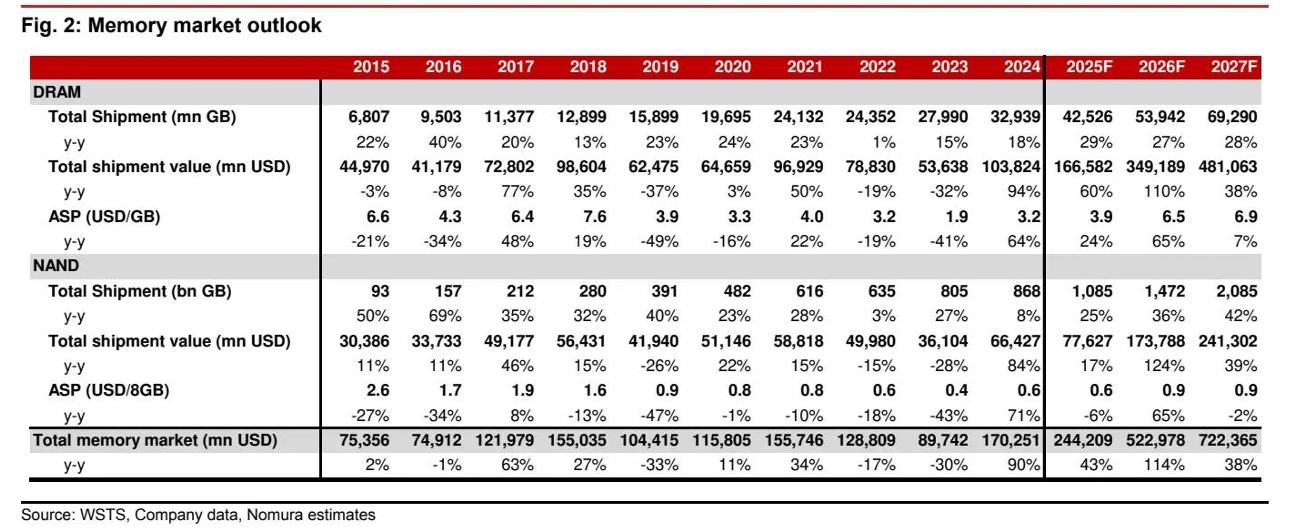
The Nomura Securities analyst team drastically revised the profit forecast for Samsung Electronics and SK Hynix from the fourth quarter of 2025, further raised the investment institution's target share prices for the two “Korean memory chip giants” within 12 months, and Nomura analysts determined that the “storage supercycle” that began in the second half of this year will continue until at least 2027, and that a truly meaningful new supply will not appear until early 2028 at the earliest.
In recent months, the world's top three memory chip giants — Samsung Electronics, SK Hynix and Micron, as well as Western Digital and Seagate — have recently announced extremely strong results, causing financial giants such as Nomura, J.P. Morgan, and Morgan Stanley to chant that the “storage supercycle” has arrived, highlighting the continued blowout expansion of the world's AI training/inference computing power demand and the consumer electronics demand recovery cycle driven by the AI boom on the end side have all driven the expansion of the DRAM/NAND series of storage products. The one that has the highest share in the storage business with Micron HBM storage and server-level high-performance DDR5 in the DRAM segment; in addition, demand for enterprise-grade SSDs in the NAND sector has also recently surged.
Analysts at Morgan Stanley said in a December research report that Micron's performance showed “the best revenue and profit growth trajectory in the history of the US semiconductor industry other than Nvidia.” The Morgan Stanley analyst team expects Micron's revenue to almost double in the fiscal year ending August. Since Micron announced its results last week, its stock price has risen by more than 25% during this period and has repeatedly reached record highs.
The three monopoly memory chip manufacturers SK Hynix, Samsung, and Micron have concentrated most of their production capacity on HBM storage systems — the advanced process production capacity and manufacturing and testing complexity required for such storage products are much more complex than DDR series and HDD/SSD series memory chips, so the three major memory chip leaders continue to migrate production capacity to HBM, which has largely caused these hard disk storage products to be in short supply.
Micron even announced in early December that it would stop selling storage products to individual consumers in the PC/DIY market in order to focus on providing storage production capacity for large-scale AI data centers being built on a large scale, and even announced in early December that it would stop selling storage products to individual consumers in the PC/DIY market, highlighting that as the global AI infrastructure boom is in full swing, demand for high-performance data center-level DRAM and NAND series products continues to surge.
Whether it's Google's huge TPU AI computing power cluster or Nvidia's massive AI GPU computing power cluster, it is inseparable from the HBM storage system that needs to be fully integrated with AI chips. Currently, tech giants must purchase server-level DDR5 storage and enterprise-grade high-performance SSD/HDD on a large scale to accelerate the construction or expansion of AI data centers.
Nomura reaffirms that the “supercycle” will continue until 2027
A team of analysts from Nomura said that investors should continue to be overequipped with storage leaders in 2026, using the “price-profit-valuation” three hits of memory chips as the main line of storage investment in 2026, rather than just using storage as a single subject for HBM. The agency expects the profits of the three major memory chip companies to reach record highs.
Nomura said that the profit drivers of the three major memory chip leaders will be upgraded from “HBM single person dance” to the “HBM+ commodity bull market style (commodity) DRAM+ enterprise-grade SSD/NAND” three hardcore narratives, grasping the “upgrade cycle” rather than just a “valuation story”, and that the three major memory chip product structures are more “switchable” means that the demand cycle is more durable: when commodity profits improve rapidly, manufacturers do not have to “passively take orders” on HBM storage systems, but can expand to HBM/Commodity according to marginal profit Resource allocation between DRAM/NAND; this is equivalent to improving supply-side discipline and bargaining power in the industrial chain.
According to Nomura's latest judgment, the agency reiterated that this round of the “memory chip supercycle” will continue until at least 2027, and Nomura clearly stated in the research report that “a meaningful increase in supply will be as early as 2028.” The report repeatedly emphasized that the expansion of production capacity for memory chips and HDD/SSD storage components is not “just expansion”; it involves the pace of greenland/brownfield/customized semiconductor equipment upgrade plans. Taking SK Hynix as an example, Nomura directly accurate production capacity constraints to levels such as long cycle/wafer production capacity in clean rooms, large delays in yield and cycle time due to advanced process upgrades, and restrictions on construction/upgrade of overseas chip factories, thus deriving that the increase in supply is slower and the gap lasts longer.
Firmly optimistic about SK Hynix and Samsung! Raise the target price for South Korea's “memory chip duo”
Nomura Securities maintained a “buy” rating for SK Hynix in the research report and gave a target share price of up to 880,000 won, which is higher than the previously anticipated target price of 840,000 won, which means that in Nomura's view, SK Hynix's stock price has a potential upside of up to 50% over the next 12 months.
The Nomura analyst team said, “As artificial intelligence (AI) investment and the deployment of server clusters by tech giants continue to increase, the pricing power for memory chips is being completely transferred to suppliers, and storage companies already have an upward cyclical market environment where they can adjust their product portfolios more flexibly.”
Nomura drastically raised profits for the fourth quarter and the full year of 2026, and emphasized that commodity DRAM profit margins will match or even surpass the HBM storage system that SK Hynix has relied most on in recent years, so that profit elasticity no longer depends only on HBM supply volume. Nomura's research report attributes SK Hynix's production capacity constraints to clean rooms, production expansion points (new production line/new park commissioning window), and pace delays caused by process upgrades, so it is more certain that the boom can continue until 2027.
Nomura also raised Samsung Electronics' target share price from 150,000 won to 160,000 won, which means a potential upside of up to 45% over the next 12 months, and pointed out that as memory chip prices continue to rise, there is still plenty of room for improvement in Samsung Electronics' performance until next year. “As general-purpose DRAM and NAND flash memory prices both rose sharply in the fourth quarter, the profitability of the storage industry is rapidly improving.” The Nomura analyst team said.
According to the Nomura research report, the price of general-purpose DRAM increased by 30% to 40% in the fourth quarter, and the price of high-performance DRAM for data center servers is expected to increase by 40% to 60% month-on-month. The report emphasizes that Samsung has a much lower P/B compared to its peers, and whether future target price expectations can be further raised depends on its capital expenditure discipline and shareholder returns, as well as improvements in the company's competitiveness in storage technology and chip foundry. Nomura mentioned that Samsung is more likely to focus on more critical nodes such as DDR5 capacity expansion and HBM4 production capacity climbing, rather than sticking to the pace of HBM3E's advancement for specific customers.