
Apple (AAPL.US) stock price reached a record high. Why is the market concerned about its “lack of momentum”?
Although its performance in the first half of 2025 was lower than that of its “Big 7 Tech” peers and market, Apple (AAPL.US) rebounded strongly by 35% in the second half of the year after experiencing an 18% decline as of June, achieving a net increase of more than 11% during the year, outperforming the S&P 500 index and many large technology stocks during the same period.
The Zhitong Finance App notes that this reversal is due to the steady acceleration of its core iPhone and Mac sales and the steady expansion of profit margins brought about by a favorable product portfolio, which to a certain extent offset the increase in operating expenses related to AI research and development.
However, the stock price reached a record high in the second half of the year, leaving very little room for fault tolerance for the new year. Although Apple still holds potential catalysts such as a more personalized Siri and the foldable iPhone 18, these are seen more as necessary to maintain competitiveness than as disruptive drivers that can significantly broaden growth prospects. Meanwhile, current valuation premiums have yet to fully reflect a range of impending challenges.
This paper mainly analyzes three direct risks that have not received sufficient attention.
Challenge 1: iPhone upgrade requirements that were overdrafted ahead of time
Apple set an iPhone sales record in the September quarter, mainly driven by strong demand for the iPhone 16/17 series, which even limited growth due to supply shortages. Management said that growth guidance for the December quarter included a large backlog of iPhone 17 orders, which suggests that growth will accelerate.
However, looking ahead to the 2026 fiscal year, the outlook for iPhone demand is worrying. Although management has downplayed the role of tariffs in releasing demand early, major US operators have generally observed that since the April tariff news was announced, equipment upgrade activities were earlier than the usual fall cycle. The redesigned iPhone 17 has also successfully piqued consumer interest. But these demand drivers are difficult to sustain.
The upcoming foldable iPhone 18 is not expected to be a strong growth engine. Its initial supply will be severely limited, and the folding screen form has yet to win the favor of the mainstream market. More importantly, stemming from the huge wave of switching in the iPhone 12 era, it was expected to be driven by AI functions, but demand was lackluster in early 2025 due to repeated delays in the release of Apple's AI features. Subsequently, tariff concerns instead spurred demand for iPhone 16 upgrades in the second half of 2025.
This means that demand released early by tariffs and iPhone 17 design innovation may cause Apple to face a difficult comparison base in the 2026 fiscal year. The effect of the increase in the superimposed average sales price due to changes in the product portfolio will weaken, and the risk of slowing growth will increase.
Challenge 2: Increasing cost pressure
In fiscal year 2025, thanks to a favorable product portfolio, Apple achieved faster profit growth than revenue growth. Management expects this trend to continue in the short term. However, there is limited room for future profit margin expansion, and it is difficult to fully offset the deterioration in the cost structure caused by multiple factors.
Tariff risk: Although tariff-related costs are currently manageable through active supply chain management and trade agreements, their long-term risks have not been mitigated. Apple's efforts to diversify its supply chain are still ongoing, but the uncertainty of the trade relationship between China and the US, as well as the tariff concessions it relies on for production in India linked to investment commitments, are making long-term costs variable.
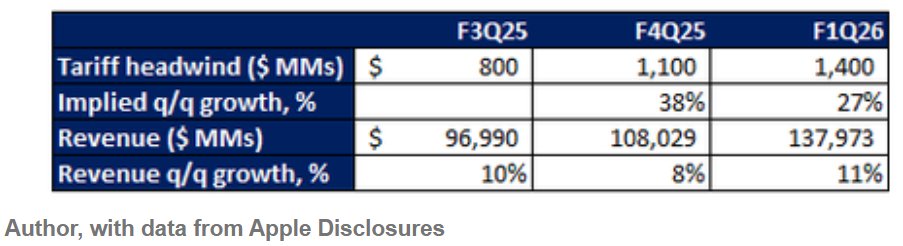
Rising material costs: In line with the “Made in America” trend, Apple increased production of key components (such as Corning Glass and TSMC's local chips) in the US, which is driving up costs. TSMC has warned that its US plant will drag down profit margins. At the same time, the entire industry is facing tremendous pressure from rising prices of raw materials (especially memory). The price of LPDDR5x memory for iPhone has more than doubled in the past year. Although Apple enjoys a certain advantage due to its scale, it is difficult to be completely immune to market price fluctuations.
Other pressures: Although the more profitable service sector continues to achieve higher profit margins, the normalization of its low to medium growth rate of about ten percent is unlikely to be enough to offset the product-side pressure discussed in the previous analysis. This is evidenced by the fact that Apple has only observed a modest expansion in consolidated profit margins in recent quarters, as service growth and its share in consolidated revenue stabilized. Since Apple is also unlikely to drastically raise the price of its products, the means to maintain future profit margins are limited.
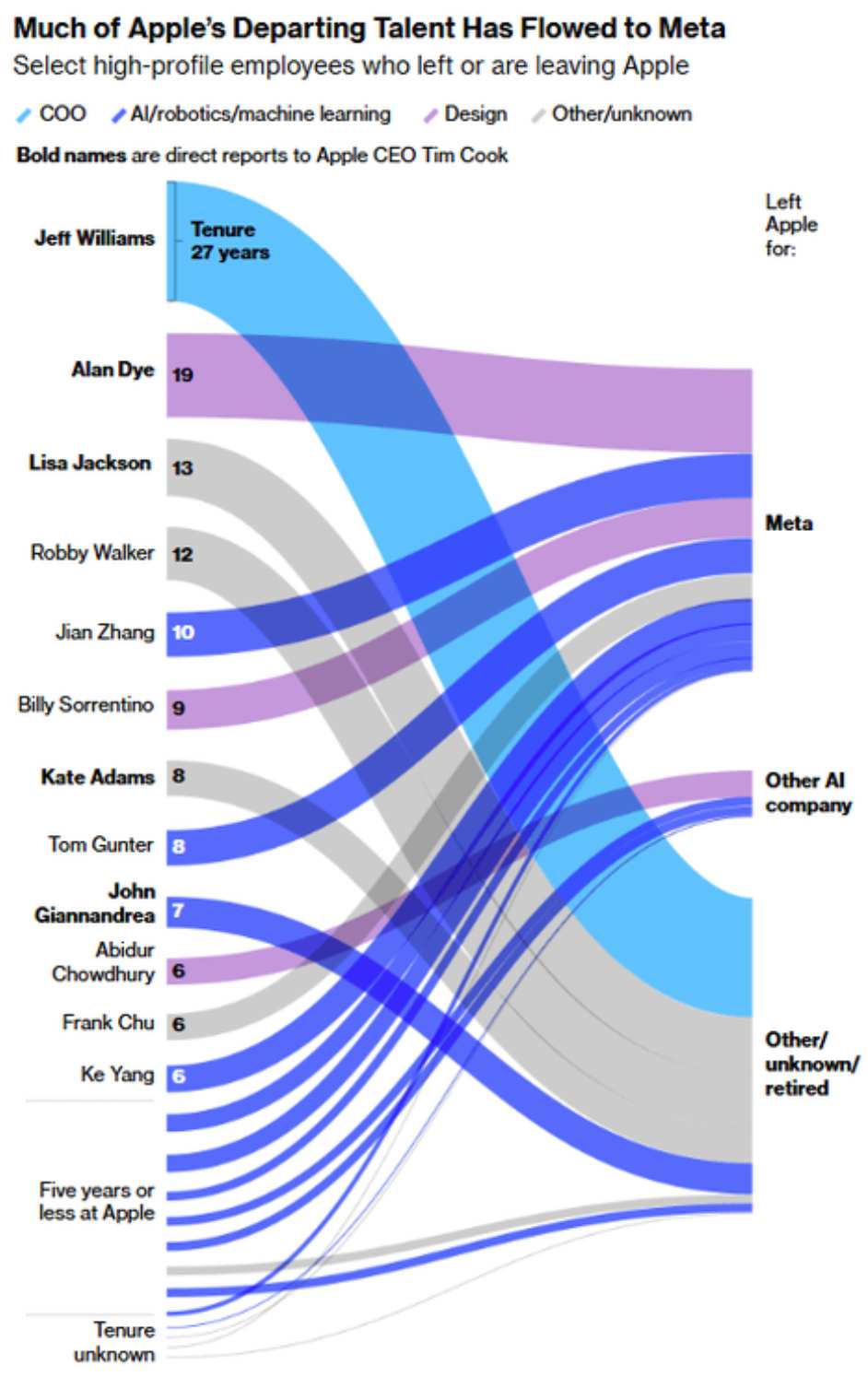
The recent spate of top talent drains has further exacerbated this problem. Recent notable departures include John Giannandrea, Apple's senior vice president responsible for machine learning and AI strategy, Alan Dye, head of user interface design, and Ruoming Pang, chief scientist of the AI model team. As the AI transformation continues, Apple is seeking to retain and acquire key talents, and these separations together increase the risk that it will face higher personnel costs. It is expected that this will further increase the pressure brought about by Apple's recent acceleration of AI R&D spending. This expenditure has led to an upward trend in operating expenses, limiting future improvements in operating leverage.
Challenge 3: Potential impact of “big rotation” in the market
In addition to fundamental headwinds, changes in market style also threaten the sustainability of Apple's high valuation. The recent rise in the market is mainly driven by non-technology sectors such as pharmaceuticals, utilities, industry, and energy, which have lagged behind in the past two years. The market expects that a continuous cycle of interest rate cuts to stimulate the economy will be a broad success for these sectors.
This “big rotation” may not only curb the upward space of the entire technology sector next year, but may also reduce the market's preference for traditional “cash cow” safe-haven assets such as Apple. As a result, large technology stocks generally face valuation premium adjustments, which may cause Apple to bear the risk of short-term valuation multiples being reduced.
Summary: There is limited room for valuation to reach new highs, and risks are accumulating
Apple's stock price reached a record high for nearly half a year, reflecting the market's confidence in its short-term execution and profit stability. This is due to a favorable product portfolio, iPhone's strong momentum, and cost control.
Looking ahead, however, there is limited room for a substantial increase in its valuation from current levels. Short-term benefits such as advanced iPhone demand and high average sales prices are expected to subside in the 2026 fiscal year. The company will also face an increasingly complex cost environment, including macroeconomic uncertainty across the industry, rising material costs, and rising personnel and AI R&D expenses unique to its own.
Combined with the new trend that market capital may rotate from overvalued technology stocks, the market is cautious about the persistence of Apple's stock price near the current historical high, because it has not fully absorbed the risk of multiple valuation compression that may occur in the coming year.