
Wall Street bankers launch a “battle for revenge,” and the golden age of alternative asset management giants comes to an end?
The head of a giant Wall Street bank had dinner with a buyer competitor when the investor casually referred to the bank as a “utility company.” The CEO believes that the most troubling point is that this is not an insult; the other party is just stating the facts.
The Zhitong Finance App noticed, but by the end of 2025, this arrogant attitude was changing. Bankers have clenched their teeth in the face of alternative asset managers invading their territory for the past decade, and now they are optimistic about the next few years—they say the regulatory and market environment is turning in their favor.
Shareholders are betting big on this: the six biggest players in the US banking industry — J.P. Morgan Chase (JPM.US), Bank of America (BAC .US), Citigroup (C.US), Wells Fargo (WFC .US), Goldman Sachs Group (GS .US), and Morgan Stanley (MS.US) — have increased their average share prices by more than 45% this year.
In contrast, the shares of the four major listed alternative asset management giants — Blackstone, Apollo Global Management, KKR, and Carlyle Group — declined overall, and only Carlyle achieved significant growth.
This is the strongest transcendence of traditional lenders in a generation.
“This is the bank's revenge,” said Mike Mayo, an analyst at Wells Fargo tracking other major lenders in the industry. “For the past 15 years, banks have been competing with non-banks, like playing basketball with one hand on their backs. Suddenly, banks can now use both hands against rivals. It's a sense of euphoria.”
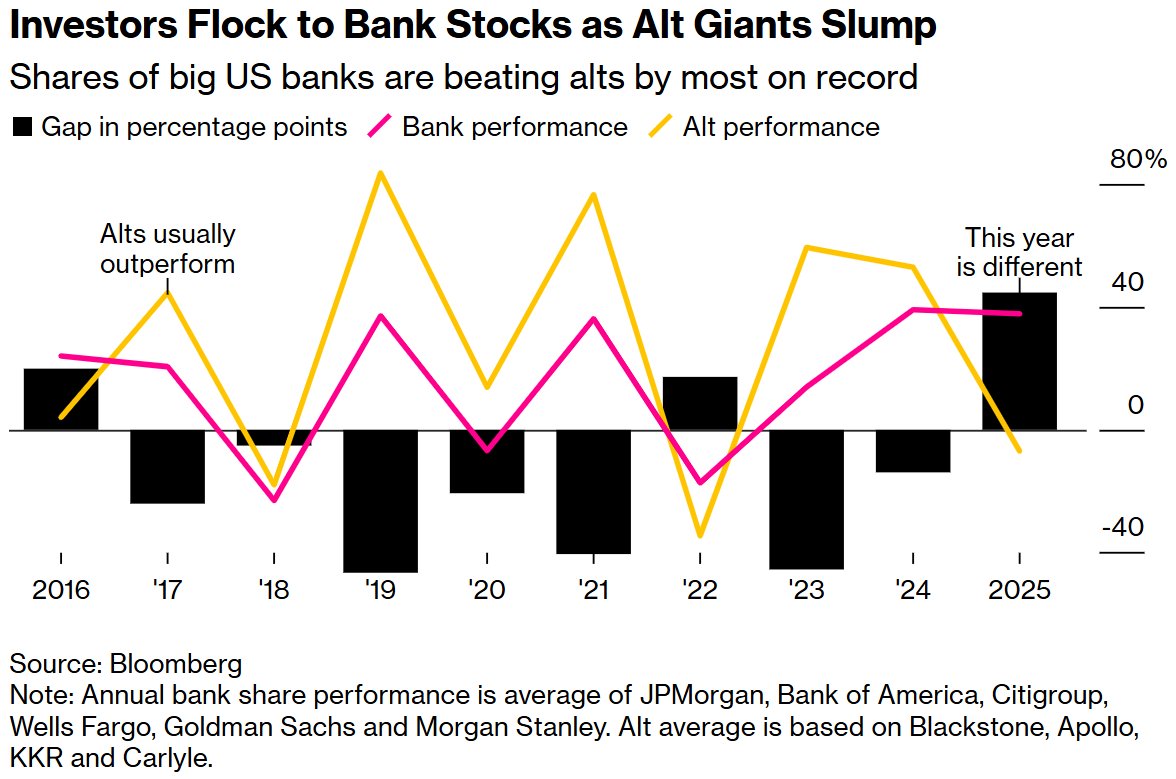
The performance of major US bank stocks reached record highs, far surpassing other stocks
This observation on competition between industries is based on conversations with executives from a number of major Wall Street institutions. Almost everyone asked not to be named in order to be able to speak honestly about government regulators and competitors.
Bank leaders are pleased that second-term Trump administration appointees at the Federal Reserve and other regulators are reducing post-financial crisis restrictions, including proposed capital rules and stress tests. The rules have long been mocked by the industry as misleading and costly — but many outsiders believe these restrictions are necessary after the 2008 taxpayer-funded bailout.
What is less contentious is that this strict regulation has cleared barriers for buyer companies to enter some of the most lucrative loan sectors.
When banks scrutinize borrowers and prefer safe loans with the least capital burden, asset managers raise tens of billions of dollars to be able to make faster financing decisions — often charging applicants higher interest rates on the grounds of convenience.
Blackstone and Apollo became giants in the private credit sector. As of September, the credit and insurance assets managed by Blackstone (a measure of its financing) exceeded US$432 billion, an increase of 67% over the end of 2021. At Apollo, credit asset management (AUM) jumped 83% during this period to reach $723 billion.
Bankers acknowledge that time cannot be turned back: large private equity firms have now become entrenched loan rivals and occasional bank partners. They are penetrating deeper into asset-based loans and other traditional banking territories. Moreover, the potential returns in the buyer's market are still more lucrative, which has attracted many of the bank's top traders and matchmakers.
But in recent quarters, after repulsing a series of rules, large banks have begun to re-demonstrate their lending prowess. They thwarted a more stringent capital requirement proposal from the Biden era called “Basel III Final.” They were also given a break from other regulatory pressures, which had forced them to hold more capital, including the Federal Reserve's stress tests and special caps on balance sheet leverage.
There have also been individual breakthroughs, giving the industry more leeway to issue leveraged loans and process cryptocurrencies. Even one regulator — the Consumer Financial Protection Authority (CFPB) — has been drastically cut.
As regulations were relaxed, leading banks expanded their loan portfolios at the fastest rate since the financial crisis.
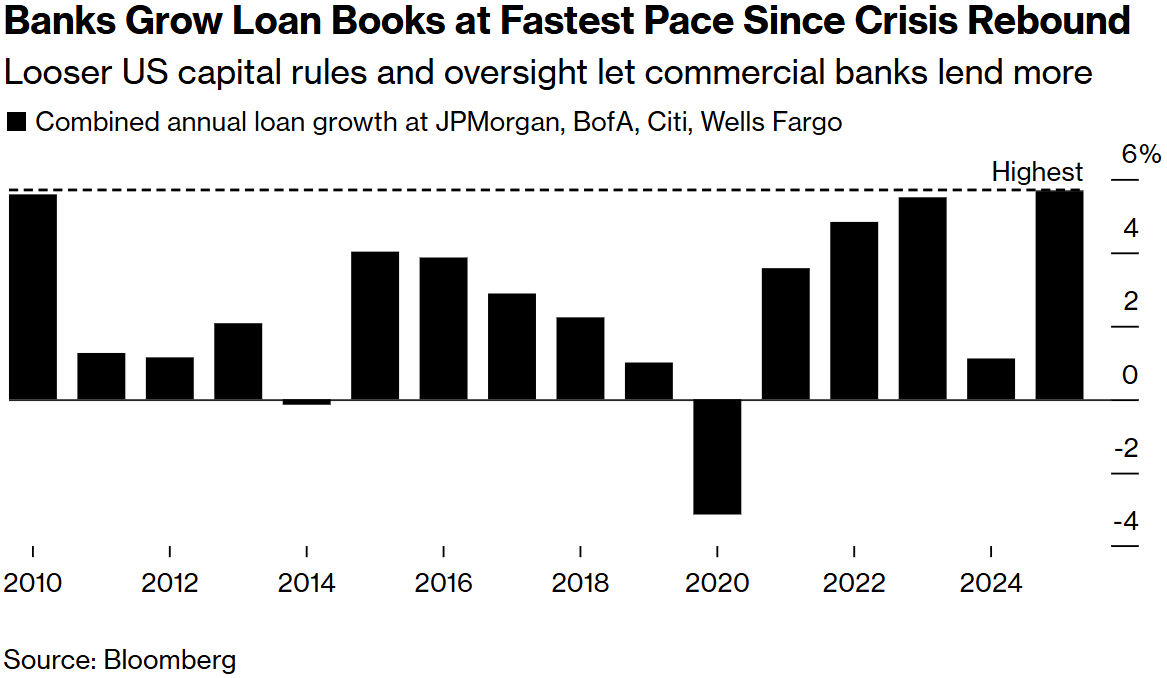
The growth rate of bank loans reached a new high since the crisis rebounded
J.P. Morgan Chase, which has just moved into a new multi-billion dollar headquarters, is spending heavily. In May, it led a $8 billion funding round to support 3G Capital's acquisition of Skechers. A month later, the bank agreed to provide $1.75 billion to help Warner Bros. explore the split. In October, it provided $20 billion for the acquisition of EA, the biggest commitment a single bank offered for a leveraged buyout at the time.
Earlier this month, Wells Fargo promised a $29.5 billion bridge loan when Netflix began raising capital for its bid for Warner Bros.
Overall, the result is that top commercial banks have increased their group loan amounts in recent quarters, narrowing the gap with private credit rivals.
In mid-2024, few people could have anticipated such a reversal. At the time, Apollo CEO Mark Rowan insisted that the bank's loan account was an opportunity for private credit, which annoyed the bank.
But for alternative asset managers, some of Trump's signature policies ultimately hindered rather than helped their core business.
His tariff policy impacted some private equity portfolio companies and reignited concerns about inflation, causing the Federal Reserve to be unwilling to cut interest rates quickly. This keeps financing costs high for a longer period of time, making it more difficult to divest old assets and raise new investment funds.
Meanwhile, the growing influence of the alternative investment giant's credit sector is beginning to be scrutinized more by the authorities. Last month, a key Justice Department official raised concerns that asset managers might misvalue their private equity and credit assets. In the UK, officials have even begun testing how the industry responds when facing financial stress.
Earlier, the collapse of subprime car lender Tricolor Holdings and auto parts company First Brands Group had raised concerns in the market that corporate borrowers were abusing competition between lenders and suspected fraud.
J.P. Morgan CEO Jamie Dimon caused a stir by predicting the possibility of more credit “cockroaches.” Although banks are at the center of these setbacks, investors are selling off shares of alternative asset management companies with extensive exposure in the private debt sector.
By the fall, when Rowan complained about exaggerated concerns about private credit at an investor pitch, bank leaders were privately commenting, and lending finally felt “fun” again.
J.P. Morgan is one step away from achieving the highest annual profit in US banking history. The Federal Reserve lifted the asset cap imposed on Wells Fargo seven years ago because it abused consumers. Even Citigroup, which was lagging behind after the 2008 crisis, once again returned to book value.
The fate of banks and private equity firms has changed to such an extent that bankers have begun to crack down on one of the things they hate most: digging the foot of a wall. Over the years, private equity firms have continued to recruit junior bankers in advance, so much so that this summer, new J.P. Morgan Chase employees even skipped training courses at their current job in order to answer calls hoping to get the next job.
J.P. Morgan warned incoming analysts that they would be fired if they were offered future positions at other companies before or within the first 18 months of joining the job. Soon, other banks followed suit — even large private equity firms began to compromise.