
The military investment frenzy is sweeping the world! Citi chants “rearms” and the general trend is betting on Thor (RTX.US) to reap the dividends of the international military industry
The Zhitong Finance App learned that Wall Street financial giant Citi recently released a research report saying that the “international rearming” trend (International Rearming) is about to become the main structural and multi-year global military defense demand, and it is predicted that the military sector of the international stock market will continue to rank as a popular investment sector in the global stock market for the next 2-3 years, which is expected to become a core contributor to the rise in the stock market, and military giant Raytheon Technology (RTX.US) from the United States because of its significantly higher international business revenue/orders compared to its peers such as Rome Exposure is bound to become one of the core beneficiaries of the sector that Citi emphasizes.
In a year full of trade frictions, geopolitical turbulence and conflict, and vague concerns about the “bursting of the artificial intelligence bubble,” trading prices in the defense and military sector and precious metals, including gold, silver, and platinum, can be described as having jumped across the board in 2025, while “traditional safe-haven assets” other than gold have collectively failed. This is an extreme pricing situation unprecedented in the century-old history of the capital market.
If you are concerned about the intensification of global geopolitical conflicts, investing your money in traditional defensive stock market sectors (such as utilities and essential consumer goods, the most typical “traditional safe haven”) is not the best choice. Instead, the real benefit is the defense and military sector, which has the title of “alternative safe haven” itself, which is closely related to geopolitics. According to the latest statistics, the frenzy of defense and military investment can be described as sweeping the stock market. For example, American aerospace and defense stocks have recorded a 36% increase so far in 2025, while the same military stock sector in the European stock market has risen sharply by 55% so far this year, even significantly outperforming the semiconductor sector, which is the core driving sector of the US stock market, with a 45% increase, mainly because Germany and the entire European continent wanted to rearm Europe after Trump announced that they would fully concentrate on defense construction in the US.
Generally speaking, the defense and military sector is not a “traditional safe haven” that traders have focused on for a long time, but rather an “alternative safe-haven asset”, mainly because it may show relative strength as a “safe-haven” during the conflict escalation and rearmed cycle, but it is still essentially a stock risk asset, which is affected by valuation, interest rates, market beta, policy and order cycles, so the military logic is more “financial budget and military spending-driven profit improvement”; it is not entirely equivalent to “traditional safe-haven assets” such as gold/US bonds, which are also quite different Avoid the traditional “stock market” where demand is more stable during periods of economic downturn or fluctuation “Insurance sector” (such as utilities, essential consumption, medical care).
However, in years of rising conflict and uncertainty, it is not the “traditional defense sector” such as utility/essential consumption that actually outperforms the “alternative safe-haven asset” defense and military sector (defense industry chain) itself. This corresponds to “guns” as a direct carrier of power and budget inclination: when continued global geopolitical turmoil triggers safe-haven demand and national security becomes the main investment line in macrofinancial markets, global capital will directly perfectly price the “military spending - order - profit” chain.
Citi chants that the military stock investment boom has taken the world by storm. Thor must not be missed
Citi emphasized in the research report that compared to its peers, Thor (RTX) is more prominent in its international military and defense business exposure and order structure, and directly links this advantage to trends such as NATO (NATO)'s drastic increase in military spending targets, the EU's potential increase, and the acceleration of defense export sales (FMS) and joint production (co-production).
Citi summarizes current military and defense needs as an “international rearming supertrend”: major defense contractors have experienced a record backlog of international backlogs (international backlogs), and allied budgets are “structurally moving upward”, driven by a strong increase in NATO's military spending target in GDP and potential large-scale additional military spending by the European Union. The research report highlights two mesoscopic signals: the pace of FMS orders and co-production is accelerating — meaning demand is moving from “intent/procurement negotiations” to more visible execution and delivery (friendly to order growth and more friendly to revenue confirmation for military giants); Defense Military Corporation management is investing more in production capacity, partners, and local industrialization (Europe/Asia), with the intention of taking on the increase in military demand in 2026 and beyond.
Globally, in the “rearming” cycle of mainland Europe and the US, Citi favors leaders that can transform international military defense needs into sustainable delivery and profits — especially companies with a high share of international orders and generally higher gross profit/bargaining power in international business, such as the US military giant Thor. Citi stressed that Thor's huge backlog order structure suggests that the share of high-profit international business may continue to rise.
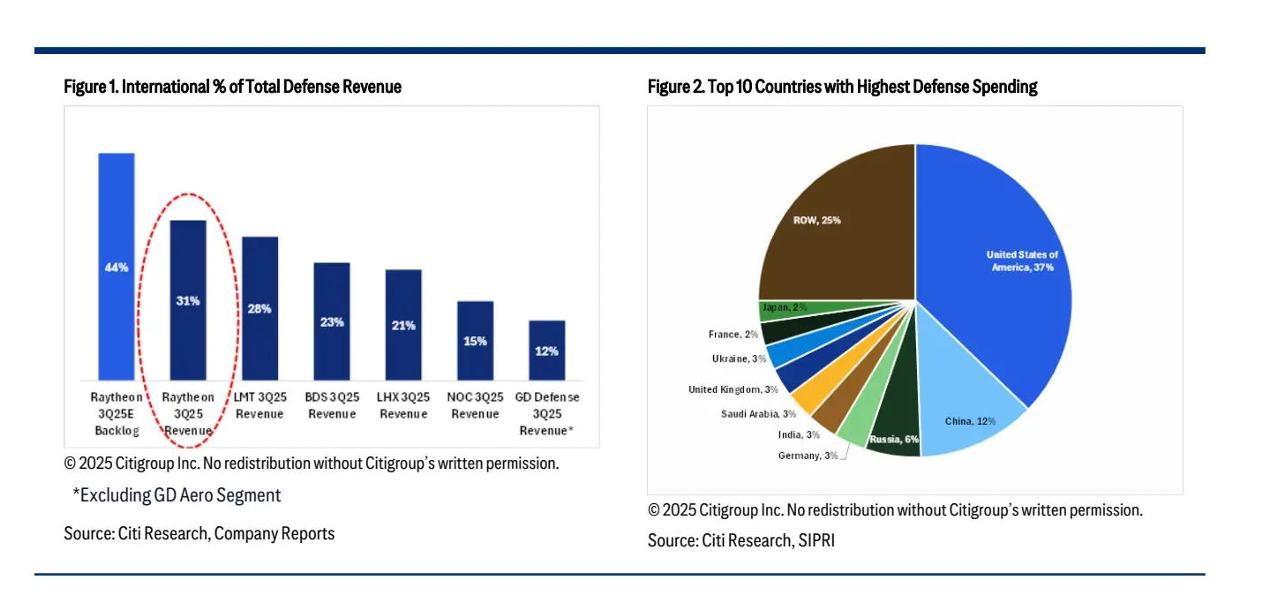
Citi said that the 3Q25 (RTX) international business accounts for about 31% of revenue; more importantly, the 3Q25 international backlog accounts for about 44%, which means that the “international component” of future delivery and revenue recognition is higher and more visible. The comparison over the same period highlights the strength of Thor's international military defense business: LMT (Lockheed Martin) is about 28%, BDS is about 23%, LHX is about 21%, NOC is about 15%, and GD Defense is about 12% (all account for international revenue; GD caliber indicates that aviation business is not included).
In Europe, a financing/fiscal package proposed by the European Commission shows that one of the key goals is to “leverage/mobilize” defense related investment and spending space of about 800 billion euros over the next four years (commonly described as 2025-2028). The vast majority of this comes from member countries' own finances. The EU level is more a combination of “loan instruments+relaxation of rules”; the German government is even shouting the slogan “at any cost” to promote Germany's military construction and infrastructure renewal and construction.
According to the 2026 Defense Budget + Bundeswehr (Bundeswehr) Special Fund Economic Plan approved by the German Parliament Budget Committee, the total scale of the plan exceeds 108 billion euros. Germany's finance minister said earlier that defense spending will be gradually raised from about 2.4% of GDP in the near future, and is expected to reach 3.5% of GDP by 2029.
In the rearming cycle, air defense and anti-missile drugs, sensors/radars, command control, and interception systems are often the first to increase the budget; while Thor (RTX)'s core military defense business portfolio (missiles and air defense systems, radar and sensors, integrated avionics and integrated military mission systems, etc.) is highly compatible with the procurement direction of “allies to replenish stockpiles+enhance system countermeasures.” This also explains why Citi uses “share of international orders/international backlog” as RTX's core winner and loser indicator.
The Patriot “Patriot” air defense and anti-missile system, which Thor is proud of, can be described as one of the backbone systems of multiple defense air defense. RTX revealed “used by 19 countries”; NASAMS National Advanced Surface and Air Missile System (in cooperation with Kongsberg, Norway; the core ammunition type is Raytheon AMRAAM), RTX revealed that it is used by 13 countries; the FIM-92 “Stinger” portable anti-aircraft missile (Stinger). RTX also revealed that it is “the preferred surface-to-air missile of 24 countries.”
Citi emphasized that in the context of international rearming and the upward budget structure of America's allies (especially Europe), priority was given to allocating leaders with a higher share of international business and visibility of international orders; among them, RTX was named by Citi as the absolute leader in defense and military investment themes due to “high share of international revenue + higher international backlog.” As a result, Citi initiated stock coverage for Thor (RTX), with a “buy” rating and a target price of $211 within 12 months. As of the closing of US stocks last Friday, Thor's stock price closed at 185 US dollars, with a market value of about 2.5 billion US dollars.