
Faith in the bull market is full of faith! Wall Street is unanimous in betting that the AI boom, monetary easing, and economic resilience will be the greatest help for the fourth year in a row in US stocks
The Zhitong Finance App learned that among large banks and boutique investment institutions, an optimistic consensus has been formed: the US stock market will rise for the fourth consecutive year in 2026, which will be the longest continuous rise record in nearly 20 years.
Of course, the market is not without anxiety about the round that has driven the S&P 500 index to cumulatively rise by about 90% since its low in October 2022. The reasons include: the artificial intelligence (AI) boom may turn from boom to decline, the economic situation and the Federal Reserve's interest rate decisions may fall short of expectations, and the second year of US President Trump's administration may have more unexpected shocks than the first year.
However, the strong rise in US stocks over the past three years has made any bearish predictions untenable. Against this backdrop, sell-side strategists have almost uniformly turned optimistic. Analysts surveyed by the media showed that the S&P 500 index's mid-target for 2026 has room to rise by about 9% next year. Of the 21 analysts interviewed, none expected the S&P 500 index to fall next year.
Ed Yardney, a senior market strategist and longtime US stock bully, said, “Pessimists have been wrong for too long; people are a little tired of that.” He expects the S&P 500 to close at 7,700 points next year — up 11% from last Friday's closing price. However, even he found this undisputed optimism a bit worrisome. He added, “This is where my rebellious instinct comes in: things have been going as I expected for so long that it seems like everyone is becoming optimistic, which is a bit worrying. Pessimism no longer tastes good now.”
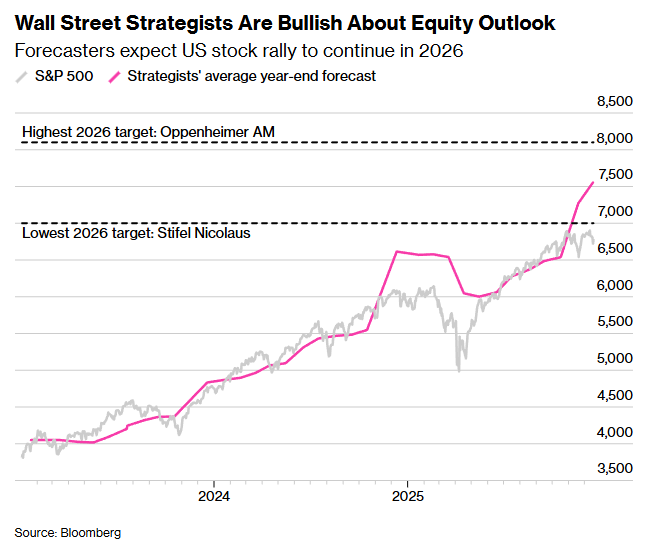
Institutions are all singing about 2026 US stocks
Wall Street's optimism has also been strengthened by sharp swings in the stock market this year. At the beginning of 2025, the “low cost AI shock wave” brought by DeepSeek put pressure on the valuations of large technology stocks and the sell-off triggered by Trump's trade policy once threatened the optimistic goals of strategists. As the S&P 500 index fell nearly 20% cumulatively from mid-February to early April, approaching a bearish range, strategists lowered their predictions for the S&P 500 index at the fastest pace since the pandemic. But then it had to rise again, as the stock market experienced one of the strongest reversals since the 1950s.
This further continues a period of headache for market “prophets” since the pandemic. Although Trump's tariff policy has impacted the global system that has supported the global economy for decades, the US economy has shown remarkable resilience. Meanwhile, huge investments in artificial intelligence—large amounts of capital are flocking to data center construction and high-performance chips—continued to drive up the stock prices of the top five tech giants, which contributed almost half of this year's rise in the S&P 500 index.
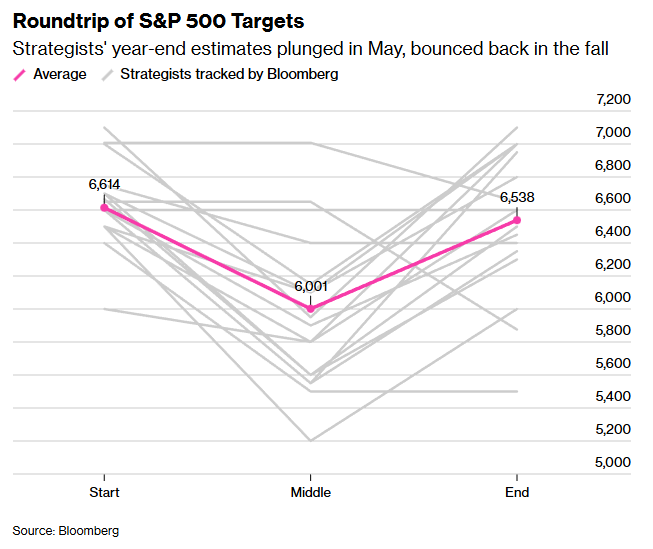
Strategists' year-end expectations for the S&P 500 index fell sharply in May, then quickly rebounded in the fall
Michael Kantrowitz, chief investment strategist at Piper Sandler, said, “This is very difficult because I think the past five years, and this year in particular, have been very uncertain.” He has abandoned the practice of publishing S&P's year-end target points because “in a highly uncertain environment, investors will become very short-sighted and respond quickly to various data points, and there aren't many triggers needed to change opinions and market consensus.”
If Wall Street forecasters are correct about 2026, then US stocks will usher in the longest continuous cycle of annual growth since the eve of the global financial crisis. If the highest goal is achieved, it will also mark the first time since the internet bubble in the 90s that the S&P 500 index has achieved four consecutive double-digit gains.
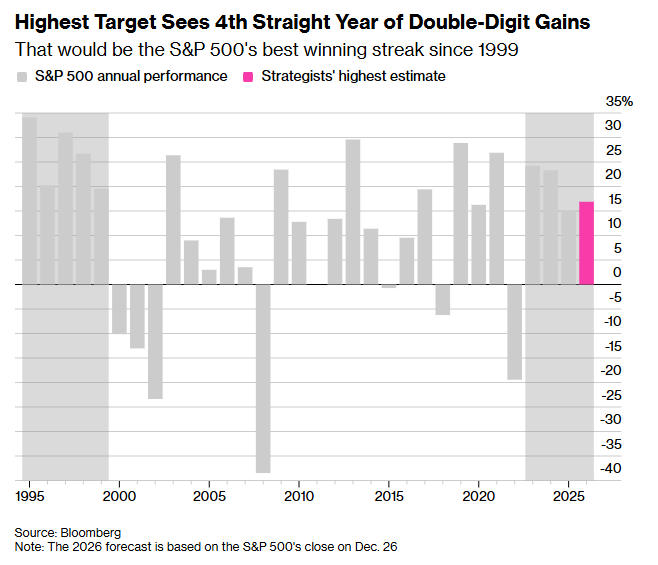
Wall Street's highest target indicates that the S&P 500 index will achieve a fourth consecutive year of double-digit gains
Christopher Harvey, a senior strategist who switched from Wells Fargo Securities to the capital market of Imperial Bank of Canada this year, is one of the few analysts who insisted on his original judgment despite sharp fluctuations throughout the year. He previously expected the S&P 500 to close at 7,007 points at the end of the year, while the index closed at around 6,930 points on Friday, just 1% lower than his forecast.
Christopher Harvey currently predicts that the S&P 500 will reach 7,450 points by the end of 2026, which means an increase of about 8%. But at the same time, he warned that “many macro risks are being overlooked by the market,” including: the Federal Reserve may keep interest rates unchanged for longer than traders currently expect; the US may raise tariffs on Canada or Mexico; and, after a period of strong performance, corporate executives may try to lower profit expectations. “All of these factors may start to disrupt the situation,” he said.
Like almost everyone else, J.P. Morgan analysts were surprised by the turmoil that swept through the stock market at the beginning of this year. In April, when Trump's trade war hit the market, they abandoned their optimistic outlook for 2025 at the beginning of the year and became the most pessimistic among strategists, predicting that the S&P 500 index would fall 12% in 2025. By June, the bank had abandoned its pessimistic stance and instead predicted a slight increase. But even so, this judgment seems too conservative, as the S&P 500 index ended up rising almost 18% this year.
As for 2026, J.P. Morgan Chase has completely left its cautious stance. It is expected that the S&P 500 index will rise to 7,500 points, driven by steady corporate profits and lower interest rates. Mislav Matejka, head of global and European equity strategy at J.P. Morgan Chase, said that this optimism is also based on the resilience of economic growth, the cooling of inflation, and the sharp rise in market bets on AI stocks, reflecting a potential economic transformation rather than a bubble that is about to burst. He said, “If the economy is weaker than we predicted, the stock market will not necessarily react negatively to it. The market will look to the Federal Reserve to assume the main supporting role.”
Despite not having any “doomsday” predictions for US stocks next year, Bank of America's Savita Subramanian is one of the few strategists calling for a degree of prudence. She expects the S&P 500 to rise to 7,100 points in 2026, but high valuations will limit gains. However, the bullbear scenario range she gave was very wide, reflecting the degree of uncertainty. She believes that if there is a recession, the stock market may fall 20%; but on the other hand, if corporate profits significantly exceed expectations, the stock market may also rise by as much as 25%.
Importantly, Wall Street strategists now seem to be taking a lesson they've paid a high price to learn in the past few years—don't underestimate the resilience of US stocks. Fundamentals are underpinning this view. The US economy achieved its fastest growth in two years in the third quarter, thanks to resilient consumer and corporate spending, and smoother trade policies. Meanwhile, American companies as a whole are expected to achieve another double-digit profit growth.
Manish Kabra, head of US equity strategy at Société Générale, said: “You can't change your opinion just because the year has changed. Profit prospects are strong, and they are spreading from the technology sector to a wider range of fields.” At the same time, he also mentioned the economic stimulus brought about by the Federal Reserve's interest rate cuts and Trump's tax cuts. “The overall macro environment is indeed quite stable.”