
The commodity inventory at the end of the year: weak energy, “crazy cow” of precious metals! Will the “gold rush” market shift to color in 2026?
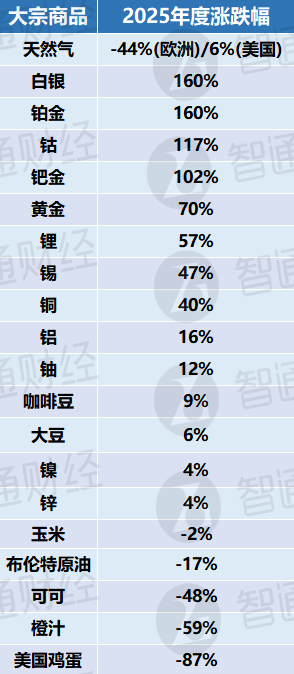
The price trend in the global commodity market in 2025 showed a clear divergence. The main characteristic is that the prices of energy and agricultural products fell, while the prices of precious metals (such as gold and silver) and industrial metals (such as copper) continued to rise and repeatedly reached new highs. This situation is mainly affected by a combination of factors such as changes on the global demand side, geopolitical tension, monetary policy adjustments, and the development of the new energy industry. This differentiation is expected to continue until 2026, and energy prices are expected to fall further due to an oversupply of oil, while precious metals prices will continue to rise.
energy
crude oil
2025 review: In 2025, the global crude oil market showed a sharp fluctuation trend of “rising first, then falling, then shifting the focus downward”, and the Brent crude oil price center eventually fell back to the $60-70 per barrel range. In the first half of the year, geopolitical frictions and policy changes were the core factors driving oil price fluctuations. At the beginning of the year, due to the escalation of US sanctions against the Russian energy sector, risk aversion drove Brent oil prices to a high of 83 US dollars; since then, the market repeatedly played a game between the Trump administration's policy expectations of “increasing drilling” and tough sanctions against Venezuela and Iran. In the second quarter, as the “comprehensive trade tariff” policy raised concerns about shrinking global demand, and the escalation of the situation in the Strait of Hormuz posed a threat to energy channels, oil prices experienced a sharp rebound from a sharp decline to a high level. At this stage, repeated changes in geographical premiums formed the main tone of the market.
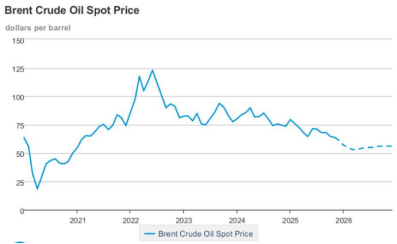
Entering the second half of the year, the crude oil market logic changed from “geographically driven” to “strong supply and weak demand”, and oil prices opened a continuous downward channel. On the supply side, the OPEC+ adjustment strategy moved from reducing production and price insurance to increasing production in stages to recover market share. Combined with US crude oil production, the US crude oil production reached a record high, leading to rapid accumulation of global inventories. On the demand side, due to factors such as the slowdown in global economic growth, the accelerated spread of electric vehicles, and the transformation of the transportation energy structure, oil demand growth was significantly sluggish, shrinking to less than 800,000 barrels per day. With the advent of peace in the Ukraine situation at the end of the year, the geopolitical premium subsided further. Under strong expectations of oversupply, Brent and WTI oil prices were generally under pressure.
2026 outlook: In 2026, the crude oil market will face more severe excess pressure, and the oil price center is expected to decline further. 2025 will be a turning point for the crude oil market, and 2026 will be a year of deep adjustment. The market has entered the “seller-led” stage. As long as the core conflict over oversupply is not resolved, oil prices will continue to be under pressure. Investors should pay attention to OPEC+ policy adjustments in the second quarter of 2026 and potential geopolitical premiums in the Middle East and other regions.
On the supply side, OPEC+ faces a dilemma. Although the alliance announced the suspension of production increases in the first quarter of 2026 at the end of 2025 and plans to extend the production reduction agreement until the end of the year, the pressure to release idle production capacity accumulated in previous years is still huge. Meanwhile, non-OPEC+ countries, led by the US, Brazil, and Guyana, are increasing production unabated, and the IEA predicts that total global supply will increase by about 2.4 million b/d in 2026.
On the demand side, weak demand is difficult to reverse due to weak global economic growth and the acceleration of energy transformation. The IEA expects demand growth of only about 860,000 b/d in 2026. As a result, the market will face a huge surplus of about 2 million to 3.8 million b/d. The EIA also warned that overflow of commercial inventories may force oil prices to hit a phased bottom.
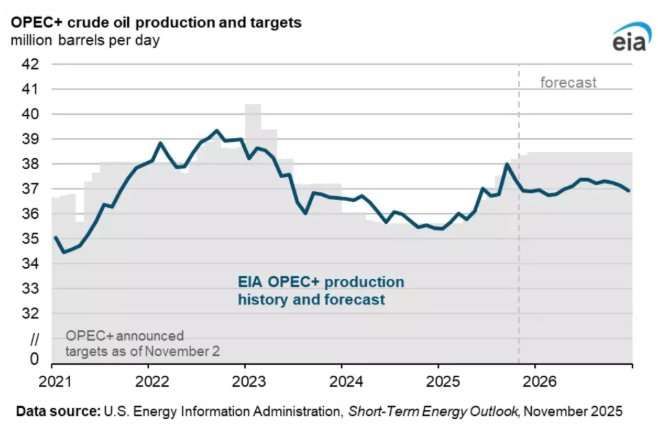
Based on this, authorities are generally bearish on 2026 oil prices. Goldman Sachs and J.P. Morgan predict that the average price of Brent crude oil will fall to the 56-60 US dollars/barrel range, and the EIA is more pessimistic that it may drop to 51 US dollars in the first quarter. Overall, 2026 will be a year dominated by “production competition.” The Trump administration's tendency to increase energy production and OPEC+'s battle to defend market share will jointly suppress international oil prices and cause them to fluctuate at a low level.
natural gas
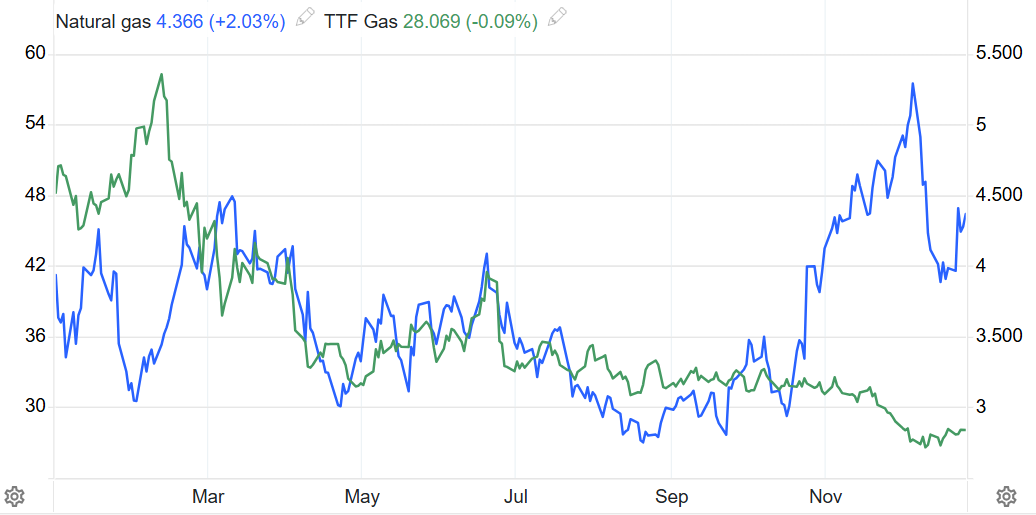
2025 review: In 2025, the global natural gas market showed the characteristics of “high in front and back, divided between Europe and the US”. After experiencing a weak 2024, in the first half of this year, prices in Europe, America, and Asia generally soared due to low temperatures exceeding expectations at the beginning of the year and the expiration of the Ukrainian transit agreement, prices in Europe, America, and Asia generally soared. At one point, the average price of Port Henry hit 4.5 US dollars. However, with the release of new production capacity such as Plaquemines in the US, demand growth in Asia has slowed due to energy restructuring, and global supply bottlenecks have been significantly alleviated. The market focus quickly changed from tight supply to “seasonal surplus”, driving rapid inventory accumulation, and global gas prices then entered a downward channel.
In the fourth quarter, the market evolved into a dramatic split. The US was affected by the La Niña phenomenon and the Arctic cold current. The surge in heating demand caused natural gas prices to soar to a three-year high of 5 US dollars in early December, showing extremely strong performance. At the same time, TTF prices in the European market showed a “steady decline” trend due to diversification of supply channels, continued weakness in industrial demand, and the easing of the geographical situation.
2026 outlook: The global gas market will usher in a critical transition from “tight balance” to “phased easing” in 2026. Affected by the concentrated release of new production capacity in the US, Qatar and Canada, global LNG production capacity is expected to surge 7%, the biggest increase since 2019. Despite sufficient supply, global aggregate demand will rise steadily by 2% due to rigid electricity consumption brought about by AI data center construction and a rebound in demand from emerging Asian markets due to falling gas prices. This supply-demand game has set a high bottom support for gas prices, while also making geopolitics and extreme weather the key variables disrupting the market.
The US market is driven by the centralized commissioning of LNG export terminals and electricity demand for AI data centers. Price expectations are optimistic. Goldman Sachs and Morgan Stanley predict that the average price will rise to 4.5-5 US dollars/mmBTU. However, the global LNG market is facing the biggest risk of overcapacity in many years due to the “peak” supply wave in the US and Qatar. The agency warned that as the supply growth rate (10%) far exceeds the demand growth rate (2%), forcing the market to reduce prices to stimulate consumption in price-sensitive regions such as South Asia, the Eurasian Benchmark Price (TTF/JKM) may drop sharply.
uranium
2025 review: The uranium market has experienced a transformation from “bubble removal” to “structural support”, and the price trend showed a significant “U-shaped” recovery. The first half of the year was suppressed by the withdrawal of speculative capital and the macroeconomic environment. Spot prices hit an annual low of about $63/lb in mid-March, completing a deep digestion of the overheated increase that once hit $100 in 2024. However, with the resumption of Sprott physical fund procurement in the second half of the year, the restart of nuclear power tenders, and the substantial drive of the AI data center's demand for nuclear energy, the price rebounded steadily and broke through $83/lb in September, and was eventually in the $81-83 range at the end of the year.
It is worth noting that in terms of supply and demand structure, this year has further highlighted the contradiction between “weak supply and surging demand.” On the supply side, production disturbances in Kazakhstan and bottlenecks continue to exist in Western mines; on the demand side, technology giants are deeply involved in the nuclear energy sector through power purchase agreements, and the restructuring of the global “de-Russification” supply chain has made nuclear power owners extremely willing to lock in long-term contracts. Despite sharp fluctuations in spot prices, long-term contract prices have remained strong above $80, reflecting the market's deep concerns about the supply gap over the next ten years. 2025 is not only a consolidation period for uranium prices, but also a critical year for nuclear energy to be repriced globally as a core asset for energy security.
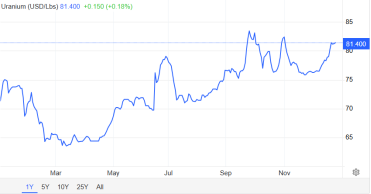
2026 outlook: As a result, as of 2026, the Wall Street Investment Bank and the authorities agree that uranium prices are expected to shift from “bottom fluctuation” to “accelerated upward trend.” Goldman Sachs predicts that, driven by the acceleration of global nuclear power construction and extended reactor life, the spot price will rise to 91 US dollars/pound by the end of 2026, with a premium potential of 20%; Bank of America gives a more aggressive outlook, and the peak is expected to reach 135 US dollars/pound. Industry authorities such as Sprott and the World Nuclear Association (WNA) pointed out that with the end of inventory removal in 2025, 2026 will usher in a peak period for utility companies to replenish stocks and sign long-term trade contracts, while supply contraction in major production regions such as Kazakhstan will exacerbate shortages. According to mainstream opinion, $80 has become a solid price bottom line, and under the dual impetus of the huge demand and supply challenges faced by AI data centers, the 2026 uranium price is highly motivated to challenge the “three-digit” mark, and is even expected to repeat the explosive growth in history and become the “new gold” in the energy transition.
metals
precious metals
2025 review: Judging from the annual performance, precious metals can be called an “epic market” this year. Gold has accumulated a cumulative increase of about 70% during the year, and silver has risen by more than 160%. Both are expected to record their best annual performance since 1979, continuing their strong performance in 2024. Factors driving the rise include continued purchases by central banks, inflows of traded funds (ETFs), and the Federal Reserve cut interest rates three times in a row during the year. The lower interest rate environment has weakened the opportunity cost of interest-free assets, and the market is also betting that interest rates may be cut further in 2026. In addition to gold and silver, platinum and palladium also showed crazy gains this year, reaching 160% and 100% respectively.
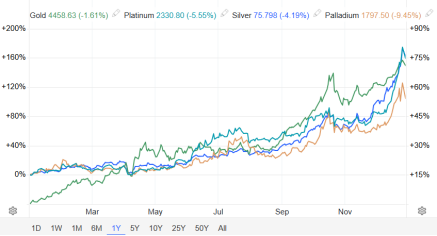
Furthermore, Trump's tough stance on reshaping the global trade pattern earlier this year, as well as remarks about the independence of the Federal Reserve, once “added fuel” to the rise in precious metals. As the size of government debt grew and the attractiveness of sovereign bonds and the currency they issued declined, investors turned to so-called “currency depreciation transactions,” further supporting demand for precious metals.
Furthermore, the return of pricing power for silver, platinum, and palladium is also driven by industrial attributes, and “green energy transformation” and “supply chain fragility” have become the strongest price drivers other than financial attributes. Against the backdrop of five consecutive years of supply gaps and inventory falling to historic lows, Baiyin experienced a “physical crowding” market this year with the iteration of photovoltaic N-type battery technology and the immediate demand for electronic paste from AI servers, leading the increase of precious metals. Platinum, on the other hand, benefits from the energy transition and the “two-wheel drive” of traditional industries. The hydrogen energy industry entered the first year of commercialization, and demand for platinum in electrolyzers changed from expectations to physical orders; at the same time, the postponement of the ban on fuel vehicles and the “platinum instead of palladium” process exacerbated the conflict between supply and demand in the context of production cuts at the South African mine side. Although palladium has been suppressed by electrification for a long time, the explosion of hybrid vehicles this year has maintained the bottom line of demand. After experiencing a slump at the beginning of the year, palladium bottomed out and rebounded at the end of the year, driven by supply disruptions caused by geopolitics and large-scale short recovery.
2026 outlook: Wall Street investment banks and authorities generally believe that the precious metals bull market will enter a new stage of “shifting from one-sided general rise to high consolidation and value mining.” First-tier investment banks such as Goldman Sachs, J.P. Morgan Chase, and Bank of America are all optimistic that gold will continue to rise. They believe that the increase in global central bank strategies, the Fed's interest rate cut cycle, and dollar credit anxiety are the core driving forces. It is generally predicted that the average price of gold will be between 4,500 and 4,800 US dollars in 2026, and is even expected to hit the 5,000 US dollar mark. The World Bank also pointed out that even if the growth rate slows down due to a higher base, physical demand and safe-haven premiums will build a solid bottom for gold prices.
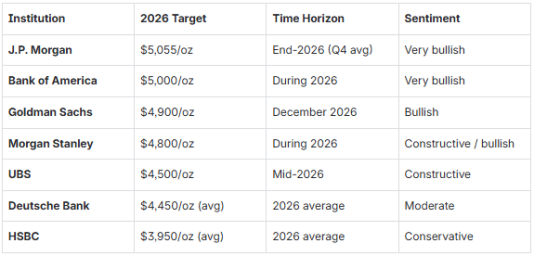
Silver and platinum group metals are seen as the more explosive “dark horses” in 2026. The institutional consensus is that due to the structural gap between supply and demand in the photovoltaic and AI sectors, the huge increase in silver of $80 has overtaken some expectations, and the high silver price may curb demand in the downstream jewelry and electronics industry. Next year, silver prices will continue to fluctuate at a high level above $50 — the average forecast is between 56 and 65 US dollars per ounce, which is a relatively conservative forecast; some aggressive opinions are even as high as $80-100. Due to years of continuous supply deficits and physical orders from the hydrogen energy industry, platinum is expected to usher in a “once-in-a-decade” rise. The target price is 2,400 US dollars. In contrast, expectations for palladium are quite divided. Deutsche Bank and other institutions warned of the need to be wary of the long-term suppression of demand by the electrification process, believing that the trend will rely more on geographical premiums and supply-side disturbances.
non-ferrous metals
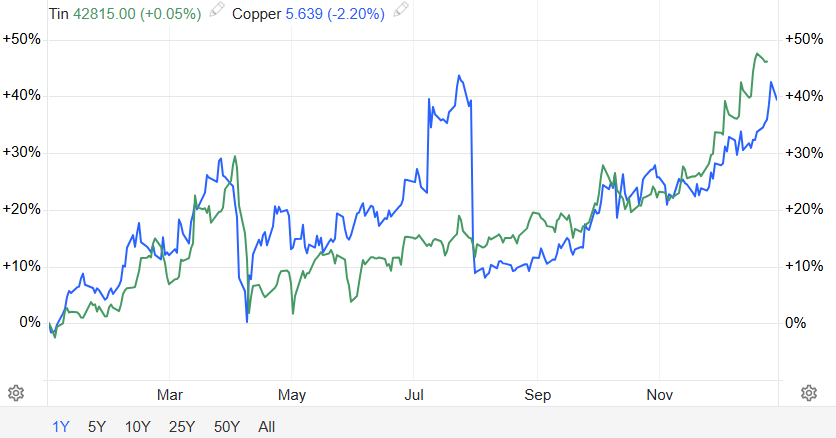
2025 review: The global industrial metals market is showing a pattern of extreme differentiation in the intertwining of “new and used kinetic energy conversion” and “regionalization of supply”. Varieties represented by copper and tin have taken the lead in starting the “computing power and electricity cycle”. Copper prices frequently hit record highs in 2025. At one point, a single ton surpassed 12,700 US dollars. Its core logic has moved from the traditional construction industry to structural demand brought about by AI data center expansion and global power grid upgrades. Combined with frequent force majeure at mining sites such as Chile and Peru, and cross-regional inventory crowding caused by trade tariffs, copper has become the most dominant metal of the year. Tin followed the strong recovery of the semiconductor industry. Driven by supply uncertainty in Myanmar and Indonesia, the price center moved sharply upward, showing strong upward elasticity.
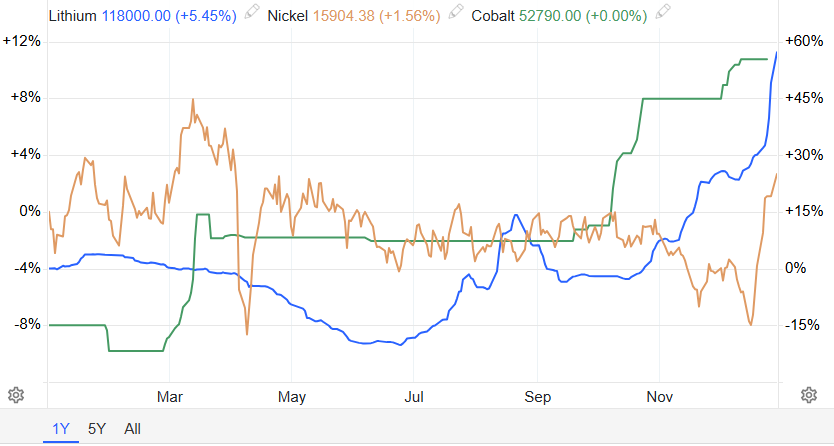
In stark contrast to this is the “deep-water bottoming” of new energy battery metals — lithium, cobalt, and nickel — and production capacity clearance. Lithium prices experienced a brutal cost line defense war in 2025. In the first half of the year, lithium carbonate once fell below some mine costs, forcing Australia and Africa to shut down high-cost production capacity. As demand for downstream energy storage rebounds and the industry's “anti-internal volume” self-regulatory production cuts, lithium carbonate bottomed out in stages around 60,000 yuan/ton in the middle of the year. Nickel prices, on the other hand, were affected by the continued expansion of Indonesia's high-pressure acid leaching (HPAL) production capacity. The surplus pattern was maintained throughout the year. The surge in LME inventories suppressed the high level of its rebound. Only the news that Indonesia plans to cut production at the end of the year caused it to rise. Although cobalt prices have come out of the shadow of a unilateral decline, the supply situation turned tight due to quota restrictions on exports of Congolese gold, and cobalt prices rose sharply at the end of the year.
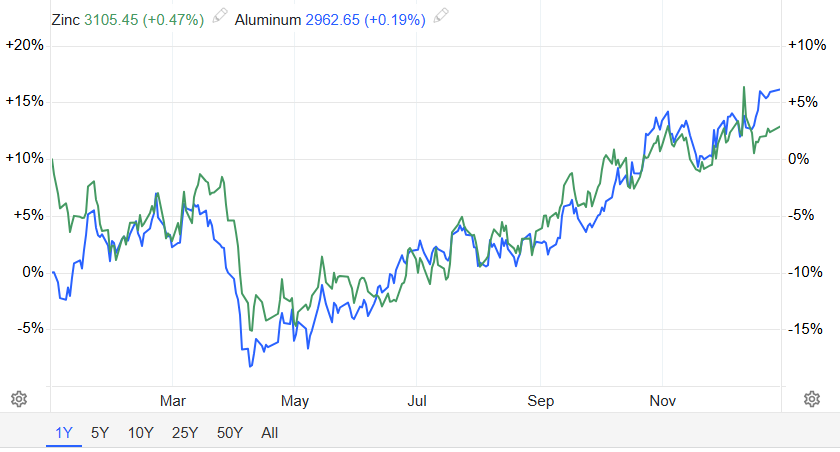
In addition, metals such as aluminum and zinc will show more toughness in 2025. In 2025, under the intertwining of “cost support” and “demand resilience,” industrial metals such as aluminum and zinc showed an overall high and wide fluctuation trend. The price performance of aluminum was particularly strong. Due to strong demand from AI data centers, high prices of alumina raw materials, and red line restrictions on global electrolytic aluminum production capacity, the price focus remained at 2,500-2,700 US dollars/ton; at the same time, the premium for green low-carbon aluminum increased significantly in 2025. Zinc prices showed a volatile recovery trend of “holding back first, then rising”: in the first half of the year, dragged down by tariff pressure and oversupply expectations, the second half of the year fell to a low level during the year, while in the second half of the year, reduced smelting production due to falling processing fees at the mine end. Combined with support from new energy and infrastructure demand, inventory removal drove prices to bottom and rebound, breaking through 3,200 US dollars at one point.
2026 outlook: Entering 2026, Wall Street investment banks and authorities forecast industrial metals in a complex situation of “outstanding copper and tin, lithium and nickel restoration, and differentiation of aluminum and zinc”. Copper and tin are still “darlings” in the eyes of the agency. Wall Street Investment Bank predicts that copper prices are expected to hit a record high of 15,000 US dollars/ton in the first half of 2026, driven by AI data centers, power grid upgrades, and US tariffs, and then enter a period of fluctuation above the 10,000 point mark due to high profit markets. Tin prices, on the other hand, benefit from the expansion of the semiconductor cycle and continued shortages on the supply side (Myanmar and Indonesia), and are expected to reach 44,000 US dollars/ton.
New energy metals and base metals face revaluation after being removed from storage. Bernstein and Deutsche Bank believe that after experiencing a liquidation in 2025, lithium will usher in a reversal in supply and demand in 2026, and the average price of lithium carbonate is expected to rise to 14,000-18,000 US dollars/ton; driven by the tightening of production policies, there is some room for nickel and cobalt to rise. In terms of aluminum and zinc, Morgan Stanley is optimistic that aluminum prices will hit a high level of 3,250 US dollars in the second quarter of 2026. The main logic is that the increase in consumption brought about by the energy transition has offset potential tariff shocks; while zinc prices have rebounded, most institutions maintain cautious fluctuation expectations around 2,900 to 3,000 US dollars. Overall, 2026 is a year where the pricing logic of industrial metals is deeply anchored in “scarcity of resources” and “immediate need for electrification.”
agricultural products
Cocoa and coffee beans
2025 review: After hitting a historic peak of $12,000 per ton at the end of 2024, prices retraced sharply in 2025, but overall remained structurally high. At the beginning of the year, New York cocoa futures were trading around $9,000, but as the International Cocoa Organization (ICCO) warned that the supply-demand gap had narrowed and production recovery expectations in West Africa (Côte d'Ivoire and Ghana) increased, prices declined all the way down, falling back to about $6,000 per ton by the end of the year.
As one of the two most popular crops in 2024, unlike Cocoa's volatile pullback, coffee beans showed a high-fluctuating M-shaped trend this year. In the first half of the year, prices stabilized for a short time as production in Vietnam and Indonesia recovered. However, after entering the second half of the year, the global benchmark price for coffee (Arabica beans in particular) exploded again, reaching a record high in February. Although there was a decline in the second half of the year due to improved climate after Brazil's heating season, the overall closing price still recorded positive annual growth, higher than the 2024 level.
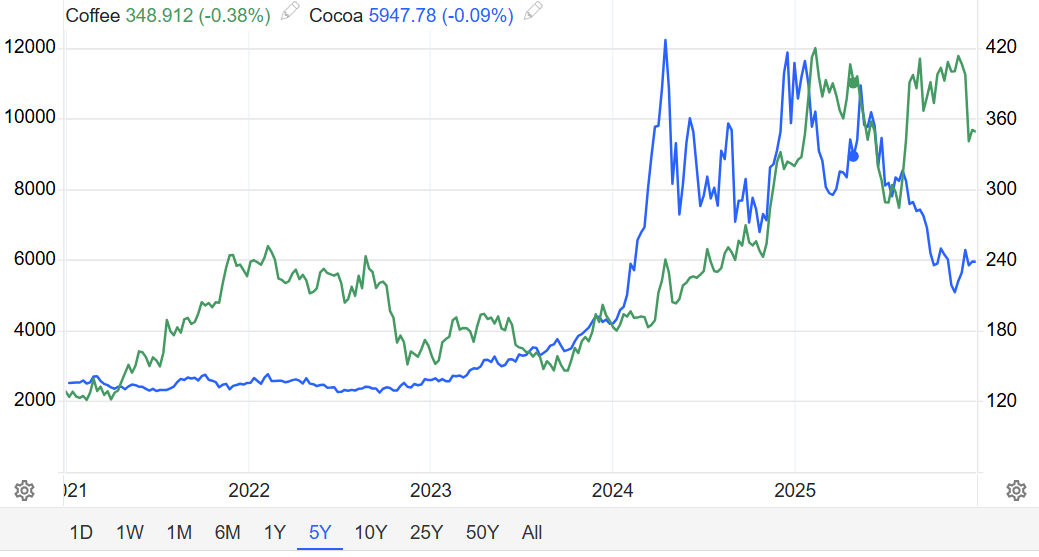
2026 outlook: According to the latest forecasts of authorities such as the Wall Street Investment Bank and the World Bank, in 2026, the global cocoa and coffee market will bid farewell to extreme fluctuations and enter a new cycle of “supply recovery and price decline.” On the cocoa side, driven by improved weather in West Africa and the release of new production capacity in Latin America, the International Cocoa Organization predicts that the market will shift from a severe shortage to a surplus of about 150,000 tons, driving prices back to a structural balance of around 6,000 US dollars per ton. Although high production costs and shrinking industrial demand limited the decline, institutions such as J.P. Morgan Chase believe 2026 will be a turning point for the chocolate industry to say goodbye to the cost crisis.
The coffee bean market is also showing a trend of changing from strength to weakness. The World Bank and Rabobank indicated that with a significant rebound in Arabica production in Brazil and Colombia, the global coffee surplus is expected to reach 10 million bags in 2026/27. Although Robusta beans are strong, supported by climate risks, the price of Arabica beans is expected to fall by about one-third from the 2025 high to the 2.5-$3/lb range. Overall, in 2026, the two major soft products will return to balance from the “seller's market”.
Soybeans, corn
2025 review: The overall price of soybeans is fluctuating and strengthening, and the average price for the whole year is expected to rise compared to 2024. Price fluctuations are mainly driven by factors such as supply and demand patterns, weather conditions in major producing countries (such as Brazil and the United States), and geopolitical trade dynamics. Despite sufficient global supply and expectations for a good harvest in Brazil, the US Department of Agriculture (USDA) report shows that its cultivation area has declined and is supported by China's continued procurement demand, causing soybean prices to shift their center of gravity in the midst of fluctuations.
In contrast, the overall price of corn showed a weak trend of low volatility. This is mainly due to the overall good global food production situation, steady growth in production of major grains, and a relatively relaxed market supply and demand situation. Although demand in the US is expected to increase steadily, leading to a rigid increase in feed consumption, the year-on-year decline in global inventory balances was limited, and facing strong competition for corn from South America, putting overall pressure on prices.
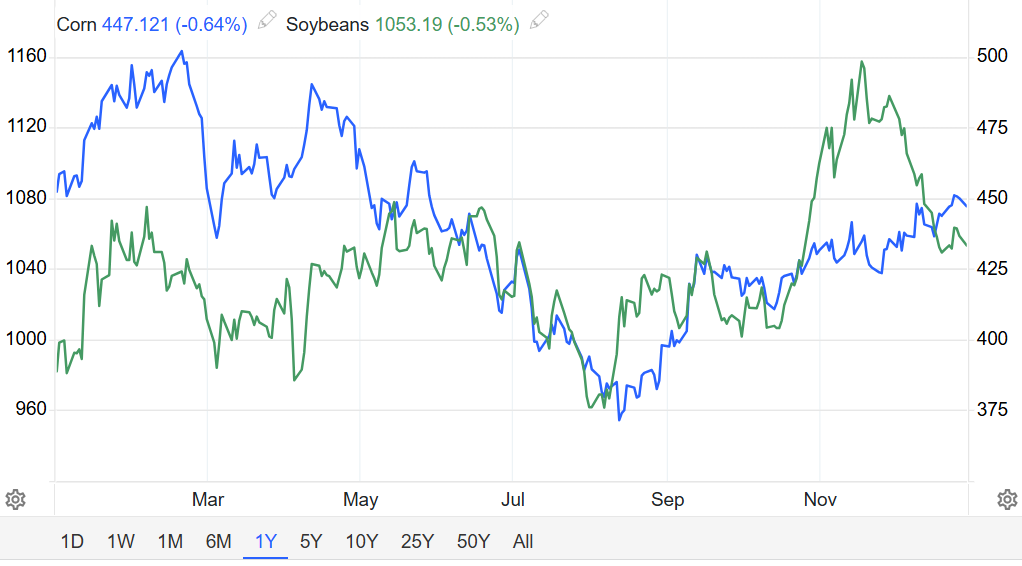
2026 outlook: The soybean and corn market will enter a “area-adjusted and policy-driven” game period. The US Department of Agriculture predicts that due to the implementation of the US-China trade agreement and biofuel demand, the soybean cultivation area is expected to rebound to 85 million acres, but the global oversupply pattern puts pressure on prices, and the average price is predicted to drop slightly to 10.30 US dollars/bushels. However, investment banks such as Goldman Sachs believe that if trade purchases are carried out beyond expectations, soybeans will usher in a significant valuation repair.
In terms of corn, the market will shift from “mass supply” in 2025 to “active storage removal”. Due to the estimated 3.7% reduction in planting area, combined with the strong resilience of feed and export demand, corn showed greater resistance to falling than soybeans. Institutions are generally optimistic that corn will achieve an upward shift in focus in 2026, and the price center is expected to rise to around $4.5. Overall, the trend of agricultural commodities in 2026 will depend on the balance between the “ceiling” of South American production and global trade relationships.
Orange juice, American eggs
2025 review: After experiencing a historic surge in 2024, this commodity also underwent a deep correction this year. Egg prices in the US fell sharply, reaching a record high at the beginning of the year. Then, as seasonal demand declined and new cases of avian influenza decreased, new fences were built faster than expected, and wholesale prices were the first to drop sharply. The price of eggs in the US fell below $0.99 per dozen, the lowest level since May 2023. Orange juice also reversed last year's rise, and there was a sharp correction at the beginning of the year; since then, Brazil's orange production expectations continued to improve, and the price trend continued to decline; towards the end of the year, prices rebounded.
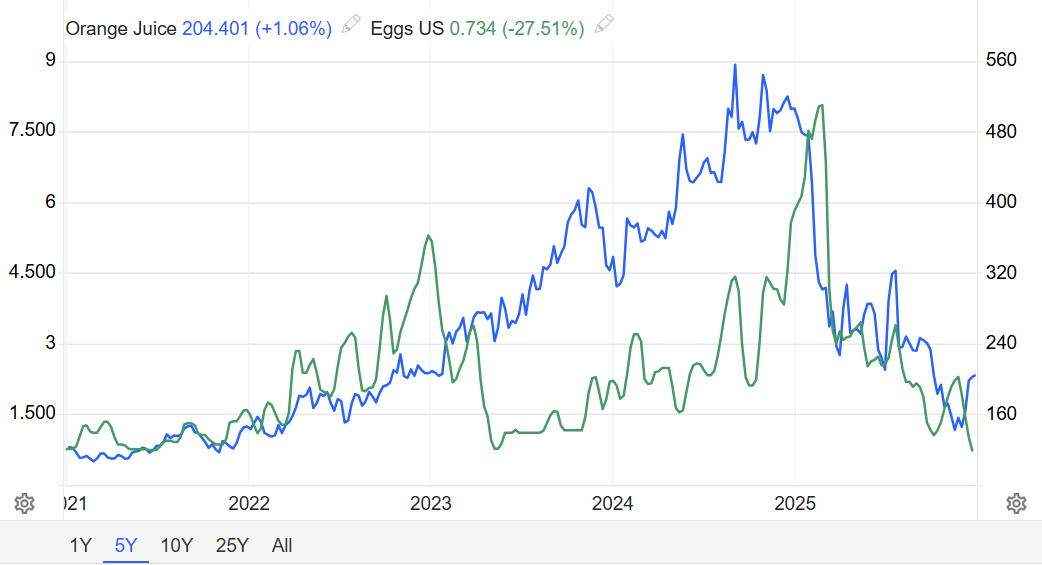
2026 outlook: According to Wall Street Investment Bank and USDA forecasts, egg prices are expected to fall sharply, while orange juice prices may gradually decline after fluctuating at a high level. The egg market has benefited from the relief of the bird flu epidemic and the recovery of the laying hen herd. The US Department of Agriculture expects the average price to drop to about $2.16 per pound from 2025. However, orange juice is under pressure from weak demand and expected increase in Brazilian production. The futures price is expected to be revised to about 1.8-2.04 US dollars/lb. However, due to structural problems such as shrinking production in Florida and the continued spread of Huanglong disease, the price will still be higher than the historical average, and there is still a risk of supply disruptions.