
Here's Why Colruyt Group (EBR:COLR) Can Manage Its Debt Responsibly
Howard Marks put it nicely when he said that, rather than worrying about share price volatility, 'The possibility of permanent loss is the risk I worry about... and every practical investor I know worries about.' When we think about how risky a company is, we always like to look at its use of debt, since debt overload can lead to ruin. We note that Colruyt Group N.V. (EBR:COLR) does have debt on its balance sheet. But the more important question is: how much risk is that debt creating?
When Is Debt Dangerous?
Debt assists a business until the business has trouble paying it off, either with new capital or with free cash flow. If things get really bad, the lenders can take control of the business. However, a more common (but still painful) scenario is that it has to raise new equity capital at a low price, thus permanently diluting shareholders. Of course, the upside of debt is that it often represents cheap capital, especially when it replaces dilution in a company with the ability to reinvest at high rates of return. When we think about a company's use of debt, we first look at cash and debt together.
How Much Debt Does Colruyt Group Carry?
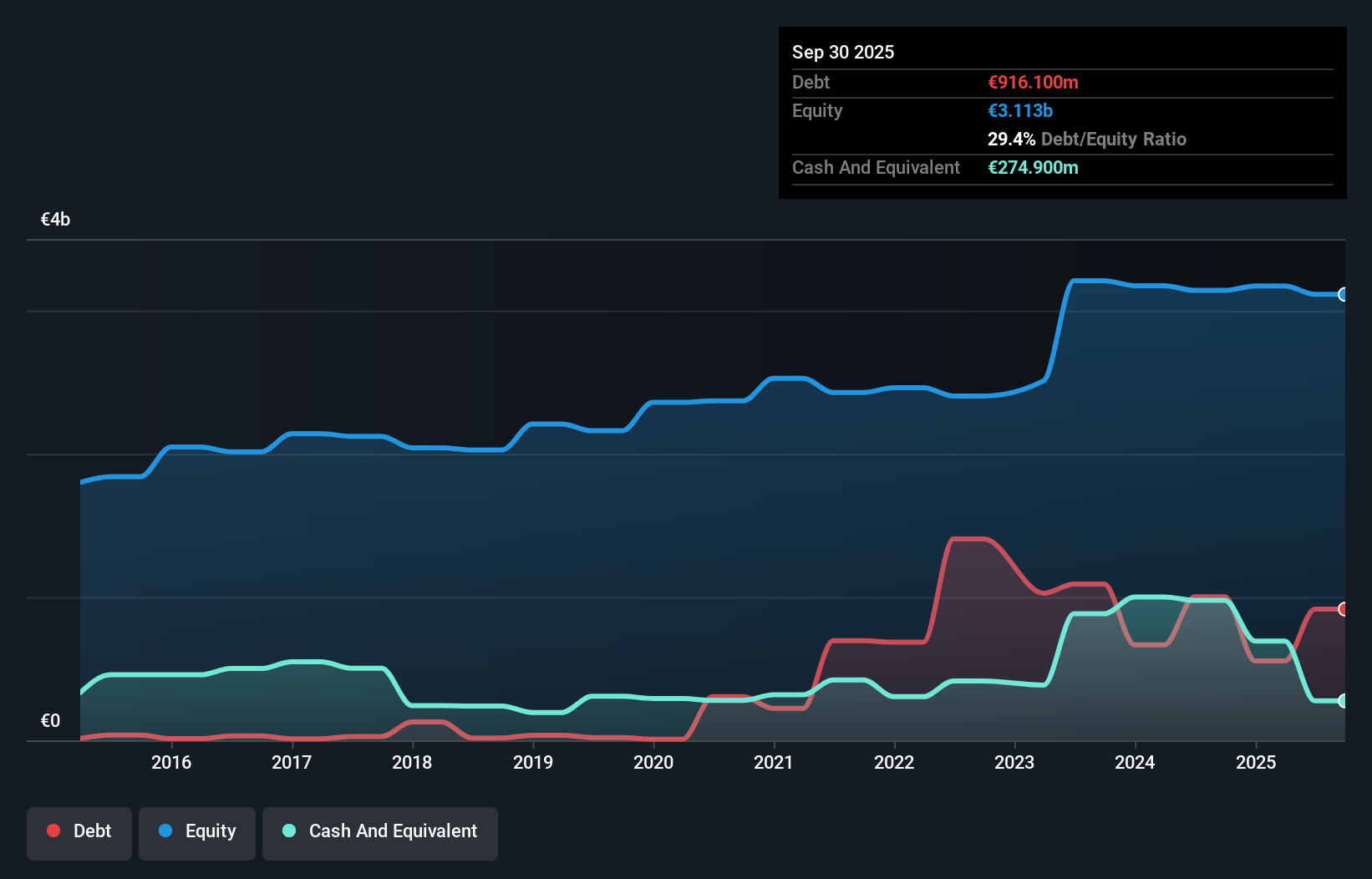
As you can see below, Colruyt Group had €916.1m of debt at September 2025, down from €1.00b a year prior. However, it does have €274.9m in cash offsetting this, leading to net debt of about €641.2m.
How Strong Is Colruyt Group's Balance Sheet?
We can see from the most recent balance sheet that Colruyt Group had liabilities of €2.33b falling due within a year, and liabilities of €888.5m due beyond that. Offsetting this, it had €274.9m in cash and €666.0m in receivables that were due within 12 months. So its liabilities outweigh the sum of its cash and (near-term) receivables by €2.28b.
This is a mountain of leverage relative to its market capitalization of €3.80b. Should its lenders demand that it shore up the balance sheet, shareholders would likely face severe dilution.
View our latest analysis for Colruyt Group
We measure a company's debt load relative to its earnings power by looking at its net debt divided by its earnings before interest, tax, depreciation, and amortization (EBITDA) and by calculating how easily its earnings before interest and tax (EBIT) cover its interest expense (interest cover). Thus we consider debt relative to earnings both with and without depreciation and amortization expenses.
Colruyt Group's net debt is only 0.89 times its EBITDA. And its EBIT easily covers its interest expense, being 181 times the size. So you could argue it is no more threatened by its debt than an elephant is by a mouse. On the other hand, Colruyt Group's EBIT dived 20%, over the last year. We think hat kind of performance, if repeated frequently, could well lead to difficulties for the stock. When analysing debt levels, the balance sheet is the obvious place to start. But it is future earnings, more than anything, that will determine Colruyt Group's ability to maintain a healthy balance sheet going forward. So if you want to see what the professionals think, you might find this free report on analyst profit forecasts to be interesting.
But our final consideration is also important, because a company cannot pay debt with paper profits; it needs cold hard cash. So we always check how much of that EBIT is translated into free cash flow. Over the last three years, Colruyt Group actually produced more free cash flow than EBIT. That sort of strong cash generation warms our hearts like a puppy in a bumblebee suit.
Our View
Colruyt Group's interest cover was a real positive on this analysis, as was its conversion of EBIT to free cash flow. In contrast, our confidence was undermined by its apparent struggle to grow its EBIT. Looking at all this data makes us feel a little cautious about Colruyt Group's debt levels. While debt does have its upside in higher potential returns, we think shareholders should definitely consider how debt levels might make the stock more risky. The balance sheet is clearly the area to focus on when you are analysing debt. But ultimately, every company can contain risks that exist outside of the balance sheet. To that end, you should be aware of the 1 warning sign we've spotted with Colruyt Group .
When all is said and done, sometimes its easier to focus on companies that don't even need debt. Readers can access a list of growth stocks with zero net debt 100% free, right now.
Have feedback on this article? Concerned about the content? Get in touch with us directly. Alternatively, email editorial-team (at) simplywallst.com.
This article by Simply Wall St is general in nature. We provide commentary based on historical data and analyst forecasts only using an unbiased methodology and our articles are not intended to be financial advice. It does not constitute a recommendation to buy or sell any stock, and does not take account of your objectives, or your financial situation. We aim to bring you long-term focused analysis driven by fundamental data. Note that our analysis may not factor in the latest price-sensitive company announcements or qualitative material. Simply Wall St has no position in any stocks mentioned.