
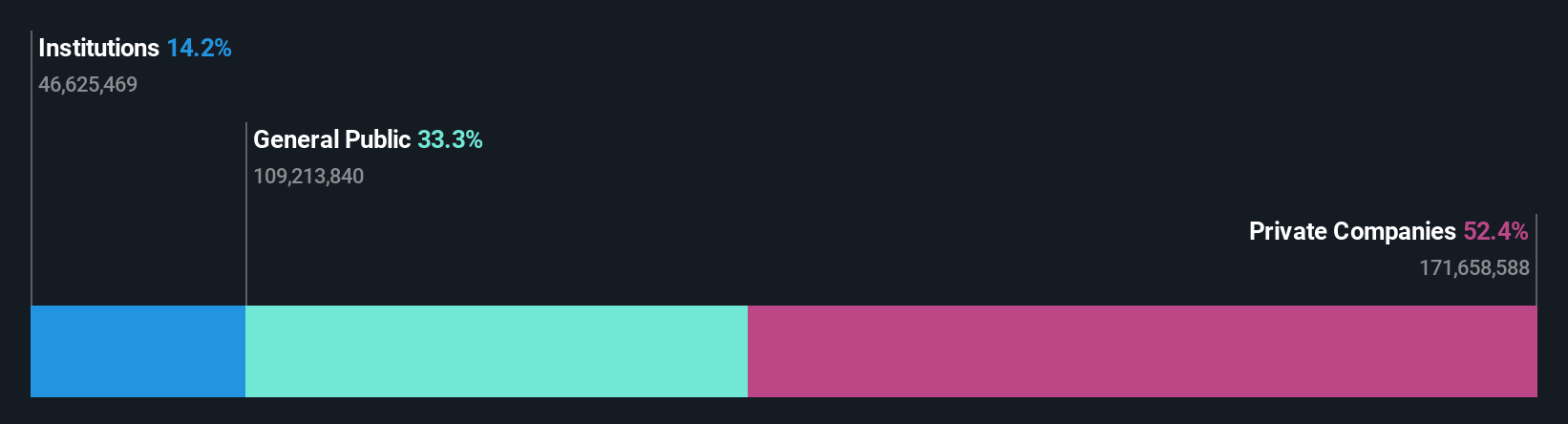
GCC, S.A.B. de C.V.'s (BMV:GCC) largest shareholders are private companies with 52% ownership, individual investors own 33%
Key Insights
- Significant control over GCC. de by private companies implies that the general public has more power to influence management and governance-related decisions
- The largest shareholder of the company is Control Administrativo Mexicano, S.A. de C.V. with a 52% stake
- 14% of GCC. de is held by Institutions
A look at the shareholders of GCC, S.A.B. de C.V. (BMV:GCC) can tell us which group is most powerful. And the group that holds the biggest piece of the pie are private companies with 52% ownership. In other words, the group stands to gain the most (or lose the most) from their investment into the company.
And individual investors on the other hand have a 33% ownership in the company.
In the chart below, we zoom in on the different ownership groups of GCC. de.
See our latest analysis for GCC. de
What Does The Institutional Ownership Tell Us About GCC. de?
Institutional investors commonly compare their own returns to the returns of a commonly followed index. So they generally do consider buying larger companies that are included in the relevant benchmark index.
GCC. de already has institutions on the share registry. Indeed, they own a respectable stake in the company. This implies the analysts working for those institutions have looked at the stock and they like it. But just like anyone else, they could be wrong. It is not uncommon to see a big share price drop if two large institutional investors try to sell out of a stock at the same time. So it is worth checking the past earnings trajectory of GCC. de, (below). Of course, keep in mind that there are other factors to consider, too.

We note that hedge funds don't have a meaningful investment in GCC. de. Control Administrativo Mexicano, S.A. de C.V. is currently the largest shareholder, with 52% of shares outstanding. This essentially means that they have extensive influence, if not outright control, over the future of the corporation. With 3.1% and 3.0% of the shares outstanding respectively, Norges Bank Investment Management and BlackRock, Inc. are the second and third largest shareholders.
While it makes sense to study institutional ownership data for a company, it also makes sense to study analyst sentiments to know which way the wind is blowing. There are plenty of analysts covering the stock, so it might be worth seeing what they are forecasting, too.
Insider Ownership Of GCC. de
While the precise definition of an insider can be subjective, almost everyone considers board members to be insiders. Management ultimately answers to the board. However, it is not uncommon for managers to be executive board members, especially if they are a founder or the CEO.
Insider ownership is positive when it signals leadership are thinking like the true owners of the company. However, high insider ownership can also give immense power to a small group within the company. This can be negative in some circumstances.
Our data cannot confirm that board members are holding shares personally. It is unusual not to have at least some personal holdings by board members, so our data might be flawed. A good next step would be to check how much the CEO is paid.
General Public Ownership
The general public, who are usually individual investors, hold a 33% stake in GCC. de. This size of ownership, while considerable, may not be enough to change company policy if the decision is not in sync with other large shareholders.
Private Company Ownership
We can see that Private Companies own 52%, of the shares on issue. It's hard to draw any conclusions from this fact alone, so its worth looking into who owns those private companies. Sometimes insiders or other related parties have an interest in shares in a public company through a separate private company.
Next Steps:
While it is well worth considering the different groups that own a company, there are other factors that are even more important.
Many find it useful to take an in depth look at how a company has performed in the past. You can access this detailed graph of past earnings, revenue and cash flow.
If you are like me, you may want to think about whether this company will grow or shrink. Luckily, you can check this free report showing analyst forecasts for its future.
NB: Figures in this article are calculated using data from the last twelve months, which refer to the 12-month period ending on the last date of the month the financial statement is dated. This may not be consistent with full year annual report figures.
Have feedback on this article? Concerned about the content? Get in touch with us directly. Alternatively, email editorial-team (at) simplywallst.com.
This article by Simply Wall St is general in nature. We provide commentary based on historical data and analyst forecasts only using an unbiased methodology and our articles are not intended to be financial advice. It does not constitute a recommendation to buy or sell any stock, and does not take account of your objectives, or your financial situation. We aim to bring you long-term focused analysis driven by fundamental data. Note that our analysis may not factor in the latest price-sensitive company announcements or qualitative material. Simply Wall St has no position in any stocks mentioned.