
Outsourcing no more the in-thing
FOR long, the global business process outsourcing (BPO) industry has prospered.
Companies outsourced non-core functions like customer support, payroll processing, billing, collections, information technology (IT) helpdesk and back-office operations.
The work which was repetitive and high-volume went to lower-cost markets like India and the Philippines because they were cheaper to execute there.
Not any more. Artificial intelligence (AI) is striking at the heart of that model. Chatbots and voice AI are replacing tier-one support. Robotic process automation is eliminating data entry roles.
Generative AI can draft emails, summarise complaints and even assist in sales conversations.
Globally, multinational clients are no longer asking outsourcers how many people they can deploy.
Instead, the question has shifted to how much work can be automated, how fast productivity can improve, and how headcount can be reduced over time without hurting service quality.
Analysts warn that labour-heavy BPO centres face the greatest disruption, no thanks to AI, particularly in markets where millions are employed in outsourcing.
Nowhere is this tension more acute than in India and the Philippines, the world’s two largest BPO hubs.
Both countries employ millions of workers in call centres, shared services and IT-enabled services.
At this scale, even modest efficiency gains can translate into significant job displacement.
Industry executives note that when AI reduces manpower needs by just 10%, the absolute impact is massive.
A single large delivery centre with 20,000 employees could see 2,000 roles made redundant.
Multiply that across hundreds of centres, and the social implications become huge.
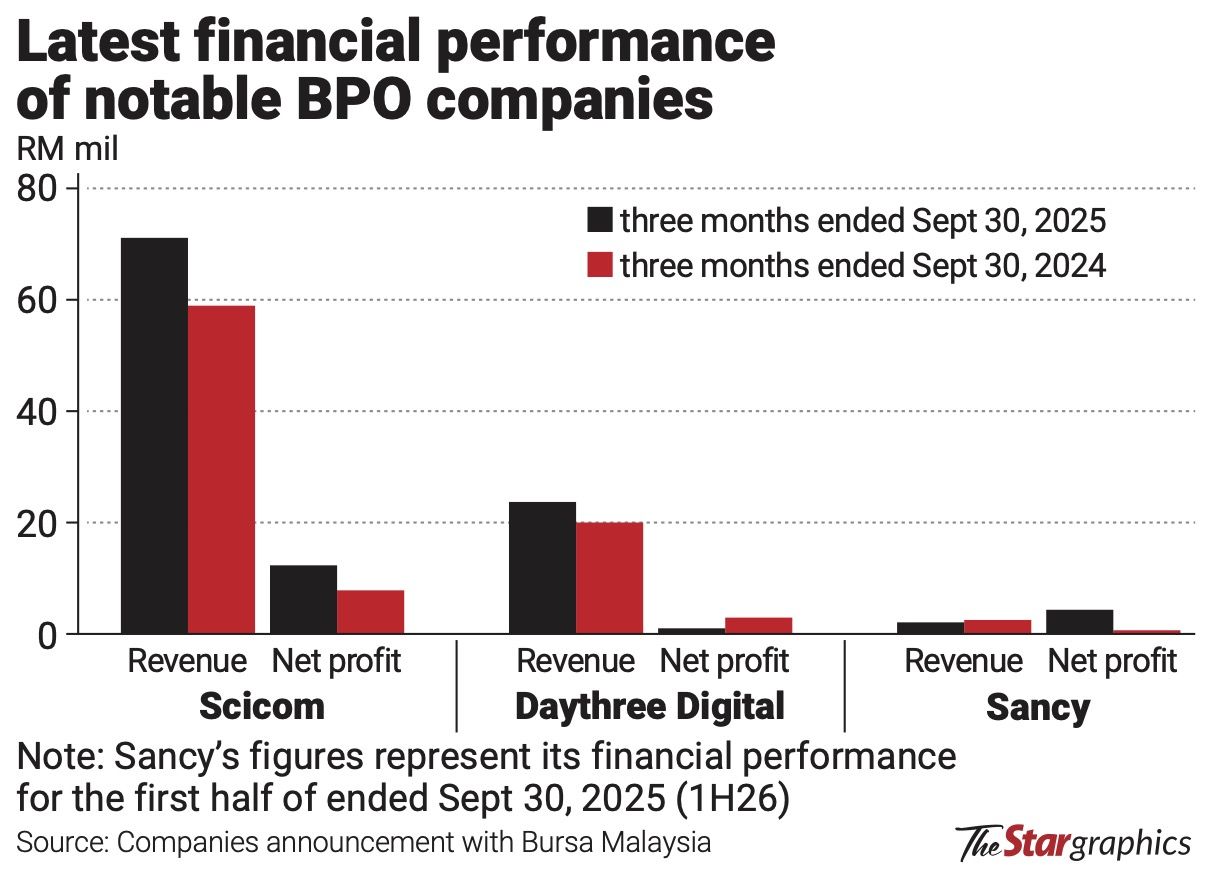
Malaysia’s BPO industry is far smaller, with an estimated 200,000 to 250,000 workers – a fraction of India’s US$280bil outsourcing sector and the Philippines’ US$30bil industry, which hire millions.
Among notable Bursa Malaysia-listed names are Main Market-listed Scicom (MSC) Bhd, ACE Market-listed Daythree Digital Bhd and LEAP Market-listed Sancy Bhd.
Scicom has been repositioning itself as a technology, and AI-driven services provider, moving beyond labour-heavy BPO work.
Its chief executive officer Leo Ariyanayagam says the company has “morphed completely from a BPO business into a technology business”.
“We are now providing AI digital infrastructure. If we are going to be thrown out of business because of the advent of AI, why don’t we be the people that enable AI?” he says.
The transformation, he says, was existential.
“It was very strategic for us. We knew we would be a waste of time as a non-AI technology company,” Leo says. He adds that while some providers rely on “wrapping” large AI engines, Scicom is building proprietary agentic AI solutions instead.
“Wrapping” refers to building a service around existing large language models, such as those from OpenAI or Google’s Gemini.
Wrap models, Leo says, are costly in labour-arbitrage markets like Malaysia.
“If you try to do a wrap in Malaysia or India where the cost of a full-time equivalent (FTE) is already low, your AI proposition could cost as much as the FTE,” he says, thus making it commercially unviable.
Instead, Scicom’s approach centres on owning the technology stack, allowing it to price its solutions more competitively while protecting margins.
“Our margins will improve. Competitiveness will also improve because we can price it at a rate that nobody else, doing a wrap, can match,” he says.
That positioning may explain why Scicom’s share price has nearly doubled over the past 12 months, as investors increasingly view it as an AI adopter rather than an AI casualty.
For AI to work effectively, however, Leo stresses that clients must first reach a certain level of data and application maturity.
“You need to get the data sorted. You need to have the applications and layers sorted. The AI must be integrated directly into their APIs and applications to get timely and accurate responses.”
This requirement, Leo notes, limits how quickly smaller firms can adopt AI. Many small and medium-sized enterprises still lack basic digital infrastructure, including enterprise resource planning systems, and will take time to reach the maturity needed to deploy AI meaningfully, he says.
Equally important are governance and guardrails, Leo adds.
“Otherwise, you ask something and it produces irrelevant responses. That will reduce your customer service proposition, hurt customer satisfaction scores and you will start losing customers,” he says.
At Daythree, group CEO Raymond Devadass strikes a similar tone, though acknowledging short-term margin pressures from tech investments.
“The conversation today is no longer about manpower. It is about transformation,” he says.
Instead of measuring BPO firms by headcount, Raymond argues the more meaningful metric now is revenue per employee.
Contracts are also evolving. “In the past, clients paid for seats. Now it is a mix – fewer seats plus the technology,” he says.
He notes that while India and the Philippines could see sharper employment impact due to scale, Malaysia’s smaller base means the disruption may be more manageable – with displaced workers potentially redeployed into higher-value roles.
In the near term, however, margins could face pressure as firms invest in AI infrastructure.
“The true effect of digitalisation and AI will improve your margins,” he says. “For a smaller headcount or for the same number, you are generating more revenue.”
Yet, the shift is not without consequence.
As Leo bluntly put it, “traditional BPO is a sunset business.”
“You won’t get rid of everybody, but a lot of roles will go.”
What survives is a new model: technology-led service providers that combine AI solutions with operational expertise.
In Malaysia’s case, the smaller scale of the industry and its ability to redeploy talent into higher-value roles may soften the social impact – even as the global BPO industry undergoes one of the most profound transformations in its history.