
2 Reasons Not to Give Up on Cruise Line Stocks
Key Points
Despite economic and political worries, the cruise industry has no shortage of fuel or customers.
Most cruise line stocks already traded at low valuations.
Amid the war in Iran and the virtual closing of the Strait of Hormuz, the focus has shifted back to oil prices and their effects on the economy. Oil prices have some impact on virtually all industries, but it is especially acute in the cruise line industry, as cruise ships depend on petroleum to operate.
Nonetheless, if these consumer discretionary stocks fall, now is probably a buying opportunity, and here's why.
Will AI create the world's first trillionaire? Our team just released a report on the one little-known company, called an "Indispensable Monopoly" providing the critical technology Nvidia and Intel both need. Continue »

Image source: Getty Images.
1. Worries about high prices are likely overdone
Cruise line stock investors are probably going to watch the oil market more carefully. The Strait of Hormuz, the waterway where tankers transport 20% of the world's crude oil, is virtually shut down amid the war. That caused oil prices to spike above $115 per barrel before pulling back a few hours later to the $88 per-barrel range as of the time of this writing.
The volatility in the price indicates that worries, rather than actual shortages, fueled the volatility. While the cruise industry's bottom lines could be significantly impacted if the high prices persist, for now, panicking is likely premature.
However, the run-up in oil prices may be overdone as the market continues to be well supplied.
Additionally, the economic worries in recent months have not dampened demand for cruise vacations if the financials of cruise lines like Royal Caribbean (NYSE: RCL) or Viking Holdings (NYSE: VIK) are any indication.
Amid record booking levels, demand has exceeded supply, meaning these companies have not had to discount much to fill ships. Amid such conditions, demand is less likely to fall if they have to pass on some of that cost to consumers.
2. Valuations
Furthermore, despite high occupancy levels, most cruise line stocks are not expensive, with all but Viking trading at price-to-earnings (P/E) ratios below the S&P 500 average of 29.
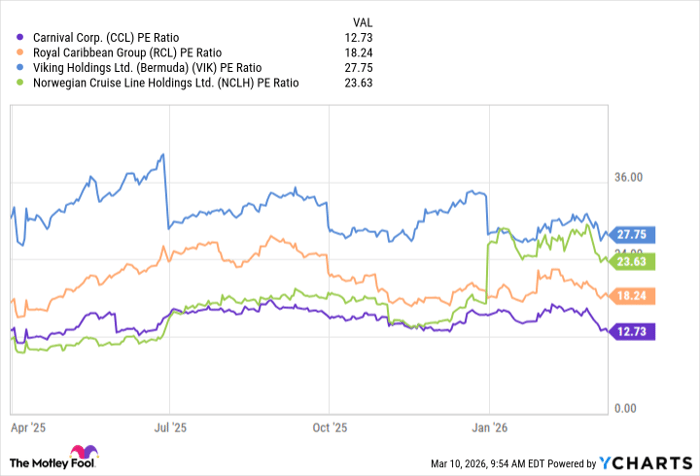
CCL PE Ratio data by YCharts.
This is particularly true of Royal Caribbean and market leader Carnival Corp (NYSE: CCL), whose P/E ratios are now in the teens, leaving little further downside for these stocks.
The low valuations have little to do with oil prices and are likely impacted by debt levels. Most of these companies ran up massive debts during the pandemic when governments barred them from sailing.
However, they have also reduced those debts significantly and steadily refinanced existing debt at lower rates. The only reason they are not falling faster is that the cruise lines continue to build ships to meet the high demand for cruises.
Cruise line stocks should continue to keep sailing
Given the state of the industry, high oil prices should not derail cruise line stocks.
Admittedly, the blockage of a major shipping lane for the oil industry is concerning and certainly, rising prices and geopolitical tensions have pressured travel-related stocks. If prices stayed high for months or years, that could negatively impact these stocks.
Nonetheless, supplies have so far not been impacted, and the fact that cruise demand continues to exceed supply should make it easier for cruise lines to pass on costs. Moreover, since most of these stocks already traded at low valuations, the oil price scare likely amounts to a more lucrative buying opportunity rather than a reason to avoid these stocks.
Will Healy has no position in any of the stocks mentioned. The Motley Fool recommends Carnival Corp. and Viking. The Motley Fool has a disclosure policy.