
SpaceX Puts the Wheels in Motion for Its IPO: 5 Reasons Why I Plan to Completely Avoid It
Key Points
Last week, Elon Musk's SpaceX confidentially filed for a U.S. IPO, with the company reportedly seeking a $1.75 trillion valuation.
Although the space industry and artificial intelligence (AI) are two of Wall Street's most lucrative addressable markets, SpaceX is rife with red flags.
In addition to an unjustified valuation, SpaceX's CEO, Elon Musk, is a red flag in more ways than one.
More than six years ago, oil titan Saudi Aramco debuted in overseas markets and raised a record $29.4 billion from its initial public offering (IPO). In the coming months, space and technology company SpaceX has an opportunity to dethrone Saudi Aramco.
According to reports from Bloomberg News and Reuters on April 1, billionaire Elon Musk's SpaceX has confidentially filed for a U.S. IPO. Musk's mega-company is reportedly seeking a valuation of approximately $1.75 trillion (not an April Fool's Day joke) and aims to raise between $50 billion and $75 billion, based on various reports and speculation. If accurate, SpaceX would debut as the sixth-largest public company in the U.S. -- ahead of Tesla (NASDAQ: TSLA) -- and potentially raise more than twice as much as Saudi Aramco did during its IPO.
Will AI create the world's first trillionaire? Our team just released a report on the one little-known company, called an "Indispensable Monopoly" providing the critical technology Nvidia and Intel both need. Continue »
Image source: Getty Images.
An IPO of this magnitude is bound to get Wall Street and investors excited. It would give them access to the lucrative space industry (including Starlink), along with xAI, the artificial intelligence (AI) company behind large language model Grok, which merged with SpaceX in February of this year. Further, it provides exposure to social media platform X, which xAI acquired in March 2025. There's a laundry list of puzzle pieces that make up what could very well be the largest IPO in Wall Street's history.
But I can tell you one investor who isn't beaming with excitement ahead of the SpaceX IPO... me.
Although space and AI represent two of the most lucrative addressable markets right now, there are five specific reasons I plan to completely avoid the SpaceX IPO.
1. The valuation is ludicrous
One of the primary reasons I have no interest in owning shares of SpaceX when it IPOs is the company's valuation. Although SpaceX has yet to file a prospectus that opens its books to investors, it's a virtual lock that this IPO is going to be pricey.
According to Reuters, SpaceX generated $15 billion to $16 billion in sales last year, leading to approximately $8 billion in profit. But when examining the sum of the parts, $1 trillion or more of SpaceX's proposed $1.75 trillion valuation derives from SpaceX itself. This implies SpaceX is trading at a triple-digit price-to-earnings (P/E) ratio and well over 60 times trailing 12-month sales.
SPACEX HAS OFFICIALLY FILED FOR AN IPO.
-- amit (@amitisinvesting) April 1, 2026
SpaceX Revenue -- $15B, targeting a $1.75T valuation$META Revenue -- $200B, currently at a $1.45T valuation
Are you buying the SpaceX IPO?
Amid the backdrop of a historically expensive stock market, I'm looking for bargains. SpaceX appears to mirror the same price dislocations observed in Musk's other public company, electric vehicle (EV) maker Tesla. Whereas automakers typically trade at high single-digit or low double-digit P/E ratios, Tesla has consistently been valued at a triple-digit P/E ratio. Neither Tesla's nor SpaceX's valuations are appealing.
2. Elon Musk tends to overpromise and underdeliver
Secondly, and to be rather blunt, I'm not a fan of Elon Musk's style of leadership.
Using Tesla as an example, Musk has repeatedly touted upcoming technological advancements and product launches to support the premium valuation of his company's stock. While virtually every CEO is their company's biggest cheerleader, the difference is that many of Musk's promises have failed to come to fruition.
While this is far from a complete list, Musk has been touting that Level 5 full self-driving (FSD) is "one year away" for the last 12 years. Meanwhile, Tesla's FSD has yet to move past Level 2. Furthermore, he proclaimed that one million robotaxis would be on public roads by the end of 2020.
Overpromising and underdelivering is a hallmark of Musk's leadership, and not one I particularly care for as an investor.
Tesla's sales growth has stalled as Musk's other businesses have ramped up. Image source: Tesla.
3. Musk's leadership will be spread thin
To somewhat build on the previous point, the SpaceX IPO all but ensures that Musk's attention will be spread thin between two potential trillion-dollar companies. Even if SpaceX falls short of its rumored $1.75 trillion price tag, it's a pretty good bet to fetch at least a $1 trillion market cap upon its debut.
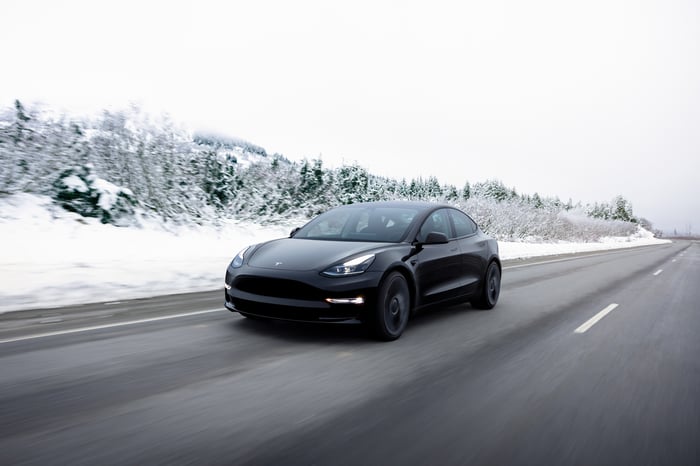
Not to purposely pick on Tesla, but as Musk's only public company at the moment, it serves as the ideal example. As other Musk-owned businesses, such as SpaceX and xAI, have rapidly grown, Tesla's sales growth has ground to a halt.
While some of this pertains to industry dynamics, such as consumers shying away from EVs due to a lack of broad-reaching infrastructure, the argument can be made that Tesla's stagnant sales and profit decline are directly proportional to Musk's attention being divided by his other companies. Placing a trillion-dollar price tag on SpaceX and taking it public will only magnify this dynamic.
4. It's too easy for something to go wrong with capital-intensive projects
The fourth reason I'm less than enthused about the forthcoming SpaceX IPO is the capital-intensive nature of the company's projects.
With the understanding that we don't yet have a prospectus to mull over, it takes a lot of capital and time to build reusable rockets and Starship vehicles, satellites for Starlink's network, and data centers for xAI. Raising a record amount of cash through an IPO may not be enough to cover the bill for these projects and could lead to additional share-based dilution.
What's more, space-based capital-intensive projects are often prone to setbacks. For instance, we've already witnessed delays in the launch of AST SpaceMobile's (NASDAQ: ASTS) Bluebird 6 satellite in December. Unsurprisingly, AST SpaceMobile's shares were punished with a double-digit percentage decline when the delay was announced.
There's essentially no room for error with a trillion-dollar valuation -- yet we're dealing with an industry that's known for delays and surprises.
5. Historical headwinds are insurmountable
The fifth reason I plan to completely avoid the SpaceX IPO is historical precedent.
The stock market entered 2026 at its second-priciest valuation in history, according to the Shiller P/E Ratio. The two previous times the Shiller P/E exceeded 40 since January 1871 were followed by declines of 49% (dot-com bubble) and 25% (2022 bear market) in the benchmark S&P 500. History strongly suggests a 20% or greater decline is coming for Wall Street's major stock indexes, and public companies with premium valuations are likely to take it on the chin.
High-profile IPOs also don't have the best immediate success rate. Saudi Aramco and Meta Platforms are two mega-IPOs that come to mind as having struggled for several quarters following their debuts.
Emotions tend to get the best of investors on debut days, which is all the more reason to steer clear of the SpaceX IPO.
Sean Williams has positions in Meta Platforms. The Motley Fool has positions in and recommends AST SpaceMobile, Meta Platforms, and Tesla. The Motley Fool has a disclosure policy.