
Rivian vs. Ford: The Underdog Story Investors Should Be Watching
Key Points
Rivian generates significantly less revenue than Ford, but both companies are posting losses, which makes the path to profitability more important than top-line size.
Investors should watch whether Rivian's recent partnerships accelerate its margin improvement, and whether Ford's gas-vehicle pivot actually boosts its bottom line.
The company that makes more money isn't always the better investment, and this comparison is a perfect example of why.
Ford’s (NYSE:F) revenue towers over Rivian's (NASDAQ:RIVN) in every quarter shown in the chart below, and it isn't close. But both companies are losing money. That shared reality reframes the entire comparison. What you actually want to know isn't who has the bigger top line today. It's who is building a more credible path to profitability.
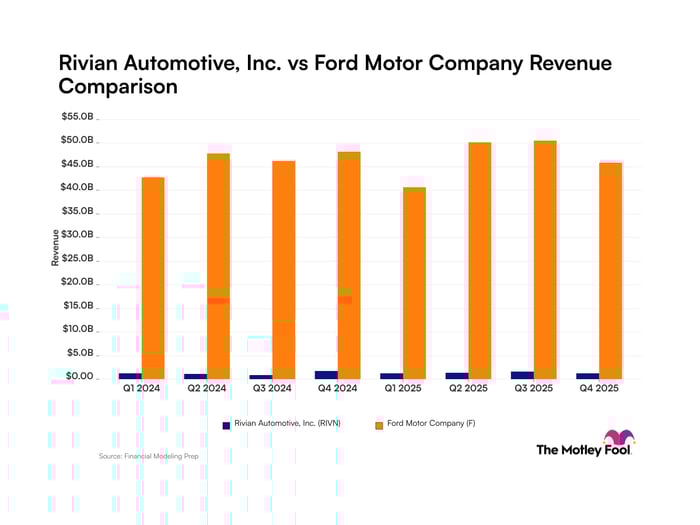
Image source: The Motley Fool.
Rivian: Navigating revenue volatility
Rivian made notable moves this past quarter. It secured an autonomous deployment agreement with Uber and advanced its software partnership with Volkswagen, two deals that could meaningfully diversify its revenue over time. Despite that progress, Rivian still reported a net income margin of approximately -63% for the quarter ended Dec. 31, 2025. That number looks alarming, but it reflects a company still in a capital-intensive build-out phase, not necessarily a broken business model.
Ford: Maintaining revenue scale
Ford spent the quarter adjusting assembly lines to prioritize gas-powered vehicles and launching a new dedicated battery division. Those are significant strategic bets, and they come with real costs. For the quarter ended Dec. 31, 2025, Ford recorded a net income margin of approximately -24%, a loss that's smaller than Rivian's in percentage terms, but striking for a company operating at $40 to $50 billion in quarterly revenue.
Why revenue matters for retail investors
Revenue is the foundational measure of a company's ability to generate sales before any costs are deducted. It's the starting line, not the finish line, which is why the gap between revenue and profitability is the number worth watching here.
Quarterly revenue for Rivian and Ford
| Quarter (Period End) | Rivian Revenue | Ford Revenue |
|---|---|---|
| Q1 2024 (March 2024) | $1.2 billion | $42.8 billion |
| Q2 2024 (June 2024) | $1.2 billion | $47.8 billion |
| Q3 2024 (Sept. 2024) | $874.0 million | $46.2 billion |
| Q4 2024 (Dec. 2024) | $1.7 billion | $48.2 billion |
| Q1 2025 (March 2025) | $1.2 billion | $40.7 billion |
| Q2 2025 (June 2025) | $1.3 billion | $50.2 billion |
| Q3 2025 (Sept. 2025) | $1.6 billion | $50.5 billion |
| Q4 2025 (Dec. 2025) | $1.3 billion | $45.9 billion |
Data source: Company filings. Data as of April 7, 2026.
Foolish take
The data tells a striking story: Ford's revenue towers over Rivian's in every quarter, ranging from roughly $40 billion to $50 billion throughout 2024 and 2025, while Rivian's bars barely register on the same scale. But revenue size alone doesn't determine which company is the better investment.
Ford's massive top line comes with a -24% net income margin as of Q4 2025. Rivian's -63% margin looks alarming, but it reflects a company still in its capital-intensive build-out phase. The more useful question for you isn't who makes more revenue today. It's who is closing the gap between revenue and profitability faster.
Watch whether Rivian's Volkswagen partnership and Uber autonomous deployment deal begin to meaningfully diversify its revenue. A positive signal would be revenue growing 20% or more year-over-year in 2026 while losses narrow. For Ford, track whether its shift toward gas-powered vehicles actually improves margins. Both companies are losing money. The winner over the next five years will be whichever one shows a credible, accelerating path to profitability.
Kevin Jackson has no position in any of the stocks mentioned. The Motley Fool has no position in any of the stocks mentioned. The Motley Fool has a disclosure policy.